
Babur and the First Battle of Panipat 1526: The Foundation of the Mughal Empire
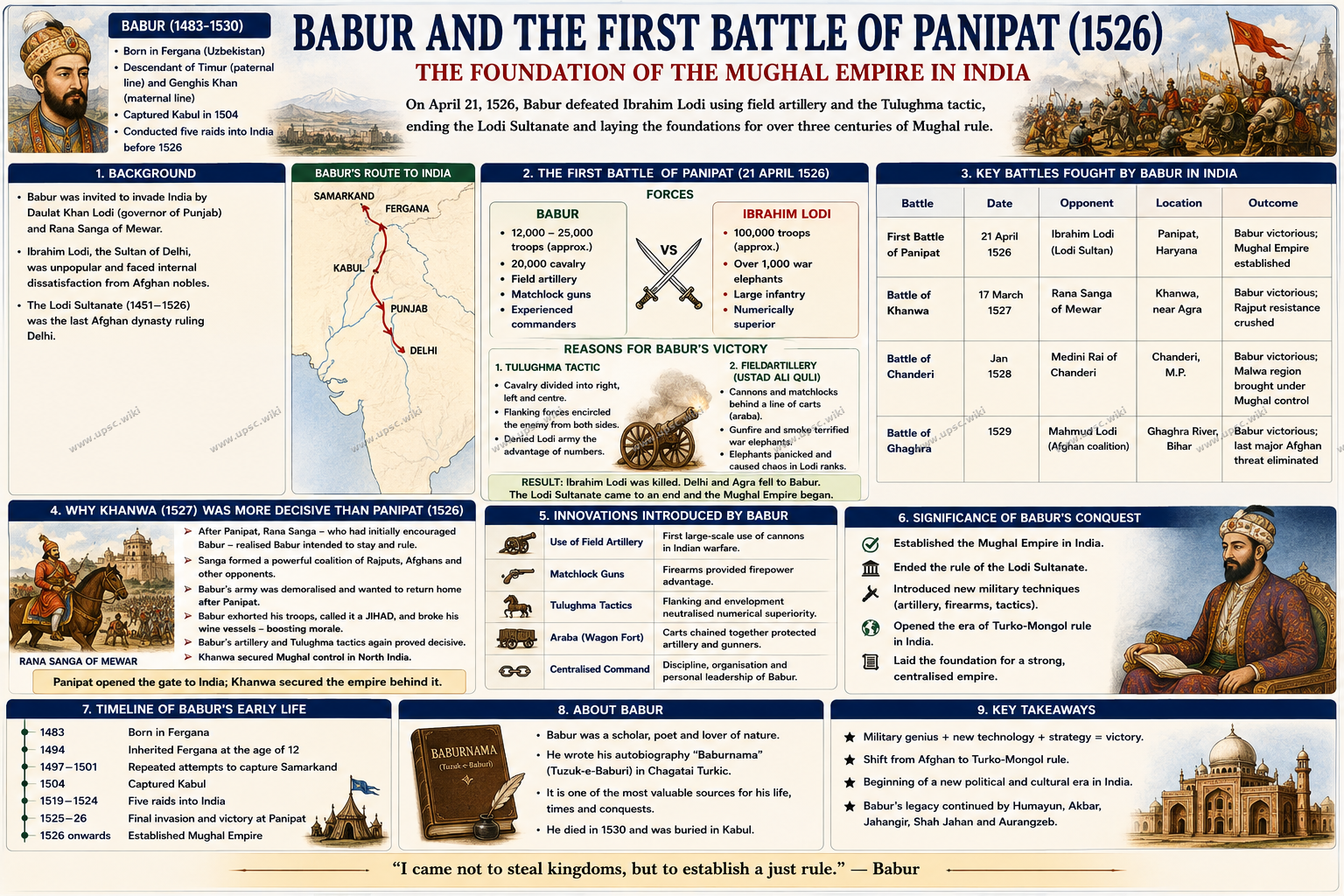
The Babur First Battle Panipat 1526 Mughal Empire foundation marks one of the most decisive turning points in Indian history. On April 21, 1526, Babur defeated Ibrahim Lodi using field artillery and t...
The Babur First Battle Panipat 1526 Mughal Empire foundation marks one of the most decisive turning points in Indian history. On April 21, 1526, Babur defeated Ibrahim Lodi using field artillery and the Tulughma flanking tactic, ending the Lodi Sultanate and laying the foundations for Mughal rule that would last over three centuries.
Who Was Babur and How Did He Rise to Power?
Zahir ud-Din Muhammad Babur (1483–1530 CE) was born in Fergana, in present-day Uzbekistan, into a lineage of extraordinary conquerors. On his father's side he descended from Timur (Tamerlane), and on his mother's side from Genghis Khan — a dual heritage that gave him both imperial ambition and innate military instinct. These twin ancestral lines made Babur acutely conscious of his destiny, and he spent his entire short life pursuing empire with relentless energy.
Babur's early life was defined by loss and resilience. He inherited the small kingdom of Fergana at the age of twelve, only to spend the following decade in a gruelling struggle to hold it. He made repeated but ultimately unsuccessful bids to recapture Samarkand — the storied crown jewel of Timurid civilization — from the powerful Uzbek chief Shaibani Khan. Driven out of Central Asia permanently, Babur captured Kabul in 1504 and made it his base of operations. From Kabul, he conducted five probing raids into the Indian subcontinent before his decisive campaign of 1526.
The invitation to invade came from an unlikely alliance of rivals. Daulat Khan Lodi, the disaffected governor of Punjab, and Rana Sanga of Mewar — two of the most powerful figures hostile to the reigning Sultan of Delhi — both encouraged Babur to march on India. Each expected to profit from Ibrahim Lodi's downfall. Neither anticipated that Babur intended not merely to raid, but to conquer and remain as the new master of Hindustan.
What Made the First Battle of Panipat 1526 a Military Revolution in India?
The First Battle of Panipat, fought on April 21, 1526, on the flat plains north of Delhi, was a masterclass in asymmetric warfare. By most estimates, Babur's force numbered between 12,000 and 25,000 soldiers — vastly outnumbered by Ibrahim Lodi's army of approximately 100,000 men supported by over 1,000 war elephants. Conventional logic favoured the Sultan decisively. Yet within a few hours, the Lodi army was broken, its Sultan lay dead on the battlefield, and the Mughal era had begun.
Babur overcame this daunting numerical disadvantage through two revolutionary innovations that together constituted a genuine military revolution:
- The Tulughma (flanking) maneuver: Babur divided his cavalry into distinct tactical wings. Light horsemen swept swiftly around both flanks of the Lodi formation in a pincer movement, encircling the enemy. This denied Ibrahim Lodi the ability to exploit his superior numbers — compressed and unable to maneuver, the Lodi mass became a liability rather than an advantage.
- Field Artillery under Ustad Ali Quli: This was the first large-scale deployment of field artillery in Indian warfare. Babur positioned his cannons and matchlock muskets behind a defensive line of linked carts (the wagon-fort or araba), shielding his gunners while they delivered sustained fire. The thunder, smoke, and fire of the guns terrified Ibrahim Lodi's war elephants, which panicked, turned, and stampeded back into the Lodi ranks, causing catastrophic chaos. Ibrahim Lodi was killed on the battlefield. His army collapsed.
Delhi and Agra fell to Babur within days. The Lodi Sultanate — which had ruled Delhi since 1451 — ceased to exist. The Mughal Empire was born from the smoke of Panipat's guns.
Key Battles Fought by Babur in India
| Battle | Date | Opponent | Location | Outcome |
|---|---|---|---|---|
| First Battle of Panipat | April 21, 1526 | Ibrahim Lodi (last Lodi Sultan of Delhi) | Panipat, Haryana | Babur victorious; Ibrahim Lodi killed; Mughal Empire established at Delhi and Agra |
| Battle of Khanwa | March 17, 1527 | Rana Sanga of Mewar (Rajput coalition) | Khanwa, near Agra | Babur victorious; Rajput resistance crushed; Mughal supremacy in northern India confirmed |
| Battle of Chanderi | January 1528 | Medini Rai of Chanderi | Chanderi, Madhya Pradesh | Babur victorious; Chanderi captured; Malwa region brought under Mughal control |
| Battle of Ghaghra | 1529 | Afghan coalition under Mahmud Lodi | Ghaghra River, Bihar | Babur victorious; last major Afghan threat in Bihar and Bengal eliminated |
Why Was the Battle of Khanwa More Decisive Than Panipat for the Mughal Empire?
Many historians argue that the Battle of Khanwa (March 17, 1527) was the true proving ground of Mughal power in India, and arguably more consequential than Panipat itself. After Panipat, Rana Sanga of Mewar — who had originally encouraged Babur to invade — realized with alarm that the Central Asian conqueror had no intention of withdrawing after defeating Lodi. Rana Sanga had envisioned himself as the kingmaker; instead he found a new and determined conqueror sitting in Delhi.
Rana Sanga assembled a formidable coalition of Rajput chieftains, Afghan nobles loyal to Lodi memory, and assorted opponents of Mughal rule. His combined force reportedly exceeded Babur's substantially. Faced with a demoralized army longing to return home to Kabul, Babur delivered a rousing speech declaring jihad against the enemy and calling his men "warriors of the faith." He renounced wine publicly — smashing his goblets and pouring his stores into the ground — a powerful symbolic gesture that electrified his troops.
The Tulughma tactics and field artillery again proved decisive at Khanwa. Rana Sanga was defeated, and the last great organized Rajput challenge to Mughal authority in northern India was broken. The difference between Panipat and Khanwa is elegantly stated by historians: Panipat opened the gate to India; Khanwa secured the empire behind it.
What Was Babur's Literary Legacy and How Did He View India?
Beyond his military genius, Babur was a man of exceptional intellectual curiosity and literary sensitivity. He authored the Baburnama (also known as the Tuzk-i-Baburi), his autobiography written in Chagatai Turkish — a Turkic language of Central Asia. The Baburnama is widely regarded as one of the greatest autobiographical works in world literature, valued not only as history but as literature of the highest order.
The Baburnama is extraordinarily candid. Babur describes his battles with clinical precision but also records his deepest emotions — grief at the deaths of beloved companions, his longing for the fruits and cool winds of Kabul, his wonder and occasional distaste at the landscapes of India. He observed Indian flora, fauna, river systems, climate, peoples, customs, and cities with the eye of a naturalist and the pen of a poet. His description of the Indian subcontinent constitutes one of the most valuable outsider accounts of early sixteenth-century India in existence.
Regarding India itself, Babur was frank in the Baburnama about his mixed feelings. He admired India's enormous wealth, magnificent cities, and temples. He found the intellectual and cultural discourse less stimulating than that of Central Asia and Persia. He missed profoundly the melons, grapes, and cold running water of Kabul and lamented India's intense heat. Yet he stayed, fought, and built — because empire was his calling.
Babur was also a genuine poet, composing verse in both Chagatai Turkish and Persian. He died in Agra in December 1530, just four years after Panipat, at the age of forty-seven. Per his dying wish, his body was initially buried in Agra but later moved to Kabul, where the Bagh-e-Babur (Garden of Babur) remains a cherished historic site to this day.
How Did Babur's Introduction of Gunpowder Warfare Permanently Transform India?
Babur's deployment of field artillery and matchlock muskets at Panipat in 1526 constituted a genuine military revolution on the Indian subcontinent. Before Panipat, Indian armies relied primarily on war elephants, cavalry, and massed infantry — formations that were psychologically and physically vulnerable to the fire, noise, and destructive power of cannon. After Panipat, every ruler and every kingdom in India understood that the age of the elephant was over and the age of gunpowder had begun.
This transformation explains much of the momentum behind Mughal expansion under Babur's successors. Humayun, Akbar, Jahangir, Shah Jahan, and Aurangzeb all inherited and refined the gunpowder military system Babur pioneered, extending Mughal dominion across virtually the entire subcontinent over the following two centuries. In this sense, Babur's victory at Panipat was not merely a dynastic founding moment — it was the pivot on which the military history of early modern India turned.
Frequently Asked Questions
Who was Babur and what was his lineage?
Babur (1483–1530 CE), born Zahir ud-Din Muhammad Babur in Fergana (modern Uzbekistan), was the founder of the Mughal Empire. He descended from Timur (Tamerlane) on his father's side and from Genghis Khan on his mother's side, making him the heir to two of history's greatest conquerors.
What were the key tactics used in the First Battle of Panipat 1526?
Babur used two decisive tactics: the Tulughma (flanking maneuver), in which light cavalry encircled the Lodi army from both sides, and field artillery under Ustad Ali Quli, which terrified Ibrahim Lodi's war elephants, causing them to stampede into Lodi's own troops. Together, these tactics neutralized the Lodi army's massive numerical advantage.
Why was the Battle of Khanwa more significant than Panipat?
The Battle of Khanwa (1527) ended the last major organized resistance to Mughal rule. While Panipat destroyed the Lodi Sultanate, Khanwa defeated the powerful Rajput coalition under Rana Sanga of Mewar — who had invited Babur but expected him to leave after defeating Lodi. Khanwa confirmed Mughal supremacy over all of northern India.
What is the Baburnama and why is it historically significant?
The Baburnama (Tuzk-i-Baburi) is Babur's autobiography, written in Chagatai Turkish. It is considered one of the greatest autobiographical works in world literature for its remarkable candor, literary quality, and historical detail. It provides an invaluable outsider's perspective on early 16th-century India, describing its geography, peoples, flora, fauna, and political landscape in vivid detail.
How did Babur's use of artillery change Indian warfare permanently?
Babur introduced field artillery and matchlock muskets to large-scale Indian warfare for the first time at Panipat in 1526. This gunpowder military revolution rendered traditional armies based on war elephants and massed infantry obsolete. Every subsequent ruler on the subcontinent was compelled to adopt firearms, fundamentally transforming the nature of Indian warfare for centuries.
Sources and Further Reading
According to IGNOU's BHIC-133 (History of India from c. 1206–1707), the First Battle of Panipat and Babur's subsequent campaigns are foundational events in the study of medieval Indian history. Satish Chandra's Medieval India: From Sultanat to the Mughals (2 vols.) provides detailed analysis of the military and political dimensions of Babur's conquests and their long-term significance. The Baburnama, translated into English by Annette Susannah Beveridge, remains the indispensable primary source for understanding Babur's own perspective on his campaigns, his times, and the subcontinent he conquered. A. L. Srivastava's The Mughal Empire (1526–1803) and Irfan Habib's edited volume Akbar and His India provide broader context for the Mughal imperial foundation. The Cambridge History of India (Volume IV: The Mughal Period) covers the transition from the Lodi Sultanate to Mughal rule in comprehensive scholarly detail and is recommended for optional history candidates seeking deeper engagement with primary and secondary source historiography.