
Bal Gangadhar Tilak: Swaraj, Extremist Nationalism and Mass Mobilization
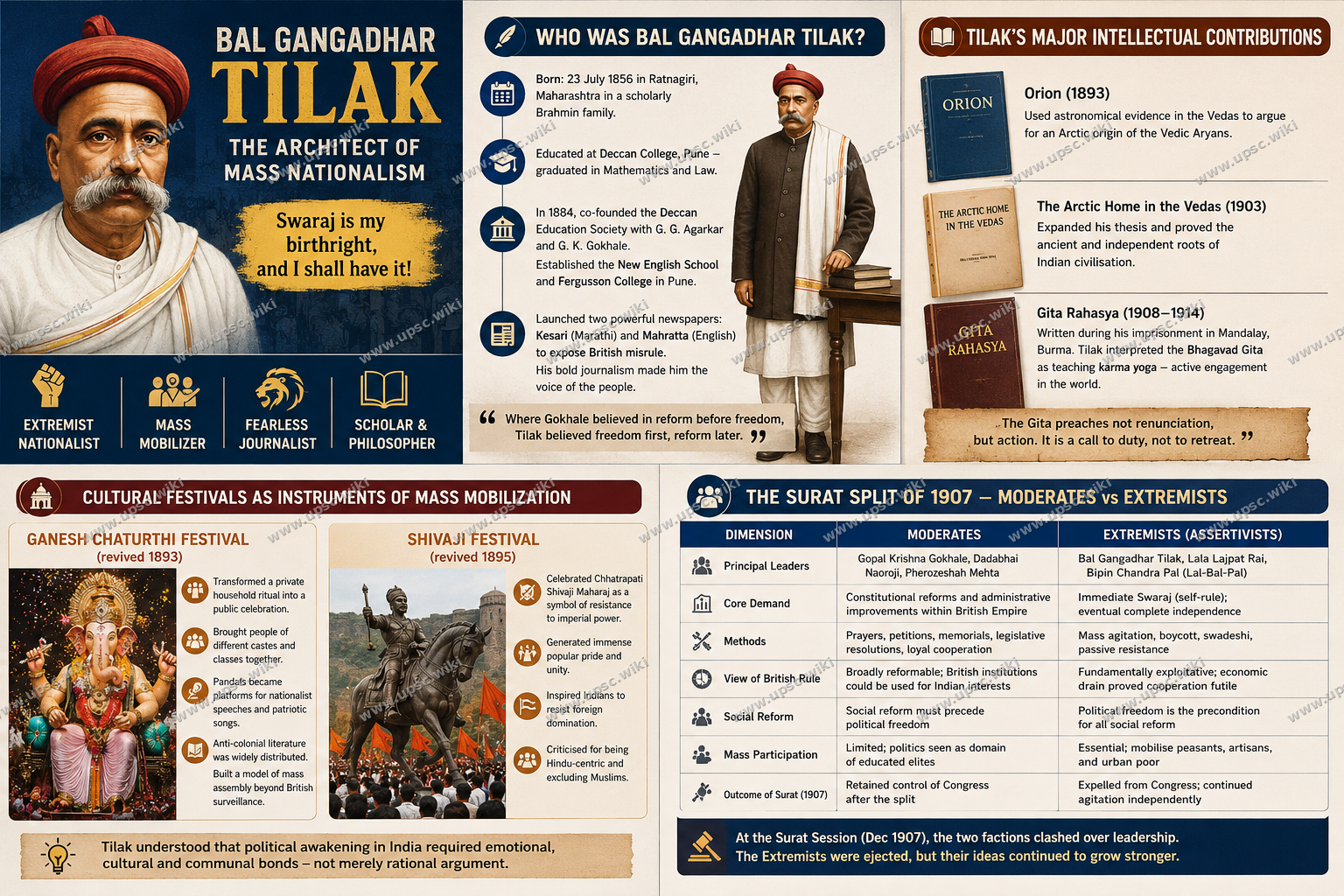
A comprehensive UPSC study note on Bal Gangadhar Tilak — his Swaraj declaration, extremist nationalism, mass mobilization through cultural festivals, the Surat Split of 1907, sedition trials, and his lasting influence on the Indian freedom movement.
Bal Gangadhar Tilak's Swaraj, extremist nationalism, and mass mobilization represent the most decisive shift in India's freedom movement — from polite petitions to aggressive popular resistance. Tilak (1856–1920), honoured as Lokmanya ("Beloved of the People"), transformed cultural festivals into political platforms and declared that self-rule was India's birthright, not a British gift.
Who Was Bal Gangadhar Tilak and What Shaped His Nationalist Vision?
Born on 23 July 1856 in Ratnagiri, Maharashtra, Bal Gangadhar Tilak grew up in a scholarly Brahmin household. He graduated from Deccan College, Pune, earning degrees in Mathematics and Law. In 1884, he co-founded the Deccan Education Society alongside Gopal Ganesh Agarkar and Gopal Krishna Gokhale — a body that established the New English School and Fergusson College in Pune to give Indians rigorous modern education without dependence on colonial patronage.
Tilak soon parted ways with Gokhale intellectually. Where Gokhale emphasised social reform before political independence, Tilak insisted that political freedom was the prerequisite for all reform. This conviction drove him to launch two influential newspapers: Kesari (Marathi, meaning "The Lion") and Mahratta (English). Unlike the measured prose of Moderate-run papers, Kesari and Mahratta were combative, confrontational, and unafraid to name British misrule as tyranny. Their circulations soared during famines and plague epidemics, when Tilak demanded accountability from the colonial administration.
What Were Tilak's Major Intellectual Contributions to Indian Nationalism?
Tilak was not only a political organiser but a prolific scholar. His book Orion (1893) used astronomical evidence embedded in the Vedas to argue for an Arctic origin of the Vedic Aryans. He expanded this thesis in The Arctic Home in the Vedas (1903), demonstrating that Indian civilisation had ancient, independent roots — a counter-argument to colonial claims of Indian cultural inferiority.
His most enduring philosophical work, Gita Rahasya, was composed during his six-year imprisonment in Mandalay, Burma (1908–1914). In it, Tilak argued that the Bhagavad Gita's core teaching is karma yoga — active, purposeful engagement with the world — rather than renunciation or passive withdrawal. This interpretation was a direct philosophical endorsement of political action and resistance, lending sacred authority to the nationalist struggle.
How Did Tilak Use Cultural Festivals as Instruments of Mass Mobilization?
Tilak's genius lay in recognising that colonial India could be politically awakened through its own cultural idioms. He revived two major public celebrations that became vehicles for nationalist organisation:
- Ganesh Chaturthi Festival (revived 1893): Tilak transformed what had been a private, household religious observance into a ten-day public celebration across Pune and Maharashtra. The festival brought together people from different castes and classes in open pandals, where nationalist speeches were delivered, patriotic songs were sung, and anti-colonial literature was distributed. It built a model of mass assembly that bypassed British surveillance of formal political meetings.
- Shivaji Festival (revived 1895): Tilak celebrated Chhatrapati Shivaji Maharaj as a Hindu warrior-king who had resisted Mughal imperial power — drawing an implicit parallel with resistance to British imperialism. The festival generated intense popular pride, though its Hindu-centric framing also attracted criticism for potentially alienating Muslim communities.
Both festivals demonstrated Tilak's understanding that sustained political mobilisation required emotional, cultural, and communal bonds — not merely rational argument.
What Was the Surat Split of 1907 and Why Did It Matter?
By the early twentieth century, the Indian National Congress was deeply divided between two factions whose philosophies of resistance were irreconcilable. The following table summarises the key differences:
| Dimension | Moderates | Extremists (Assertivists) |
|---|---|---|
| Principal Leaders | Gopal Krishna Gokhale, Dadabhai Naoroji, Pherozeshah Mehta | Bal Gangadhar Tilak, Lala Lajpat Rai, Bipin Chandra Pal ("Lal-Bal-Pal") |
| Core Demand | Constitutional reforms and administrative improvements within the British Empire | Immediate Swaraj (self-rule); eventual complete independence |
| Methods | Prayers, petitions, memorials, legislative resolutions, loyal cooperation with British institutions | Mass agitation, boycott of British goods and institutions, swadeshi, passive resistance |
| View of British Rule | Broadly reformable; British institutions could be used to secure Indian interests | Fundamentally exploitative; economic drain proved cooperation was futile |
| Social Reform | Social reform must precede political freedom | Political freedom is the precondition for all meaningful social reform |
| Mass Participation | Limited; politics seen as domain of educated elites | Essential; movement must mobilise peasants, artisans, and the urban poor |
| Outcome of Surat (1907) | Retained control of Congress after the split | Expelled from Congress; continued agitation independently |
At the Surat Session of December 1907, the two factions clashed physically on the floor of the Congress pandal over the choice of Congress president and the adoption of the Extremists' programme. The Extremists were expelled. Congress remained under Moderate control until the Lucknow Pact of 1916 reunited the two tendencies under the pressure of World War I and a new political context.
What Was Tilak's Famous "Swaraj" Declaration and Its Significance?
Around 1905–1907, Tilak proclaimed the defining slogan of the Extremist movement: "Swaraj is my birthright and I shall have it" (in Marathi: Swaraj maza janmasiddha hak aahe ani to mi milvanarch). This declaration was revolutionary in its framing — it refused to treat self-rule as a privilege to be earned through loyalty or gradual reform. Instead, it asserted Swaraj as an inherent, inalienable right of every Indian, regardless of British approval.
The slogan energised a generation of nationalists and defined the emotional register of the Extremist programme: non-negotiable, urgent, and rooted in dignity rather than supplication.
How Did the British Colonial State Respond to Tilak's Nationalism?
The colonial government viewed Tilak as its most dangerous domestic opponent. He faced sedition trials on three occasions:
- First Trial (1897): Following articles in Kesari that were deemed inflammatory in the context of Pune's anti-plague agitation — during which Plague Commissioner W.C. Rand was assassinated by the Chapekar brothers — Tilak was convicted and sentenced to 18 months' rigorous imprisonment.
- Second Trial (1908): After Tilak published articles in Kesari defending the revolutionary act of Khudiram Bose (who had thrown a bomb targeting a British magistrate), he was charged with sedition. The trial attracted global attention; the Irish lawyer Sir Valentine Chirol called him "the Father of Indian unrest." Tilak was sentenced to six years' transportation to Mandalay, Burma — the harshest sentence imposed on a political prisoner in India up to that point. During this imprisonment he wrote Gita Rahasya. His deportation transformed him from a regional Maharashtrian leader into a pan-Indian symbol of nationalist suffering.
- Third Trial (1916): He was acquitted.
What Role Did Tilak Play in the Home Rule Movement and the Lucknow Pact?
After returning from Mandalay in 1914, Tilak worked energetically to reunite the Congress factions and escalate the independence demand. In April 1916, he founded the Home Rule League in Belgaum (modern Karnataka), demanding self-government for India within the British Empire — a more moderate framing than full independence, designed to build the broadest possible coalition. Annie Besant founded a separate Home Rule League in September 1916 at Adyar, Madras. The two leagues coordinated their campaigns and together created the first sustained, nation-wide demand for political autonomy since the Partition of Bengal agitations.
The Lucknow Pact (1916) was a landmark agreement between the Indian National Congress and the All-India Muslim League, negotiated with Tilak's active participation. Both organisations agreed on a common constitutional framework for Indian self-government, including separate electorates for Muslims — a controversial provision that Tilak accepted as a necessary compromise for Hindu-Muslim political unity against British rule. The Pact was a high point of Congress-League cooperation and demonstrated Tilak's pragmatic statecraft.
What Was Tilak's Relationship with Gandhi and His Historical Legacy?
Mahatma Gandhi returned to India from South Africa in January 1915. At the Lucknow Congress session of 1916, Tilak and Gandhi worked side by side, and Tilak publicly recognised Gandhi's extraordinary capacity for popular leadership. Tilak died on 1 August 1920 — the very moment Gandhi was launching the Non-Cooperation Movement, the first mass civil disobedience campaign of the Gandhian era.
Gandhi delivered a moving public tribute, calling Tilak "the Maker of Modern India." The connection was not merely rhetorical: Gandhi consciously adopted Tilak's methods — cultural symbolism, festival-based organisation, swadeshi, and the courting of imprisonment as a badge of honour — while transforming their moral basis by insisting on strict non-violence. The Gandhian mass movement of the 1920s and beyond was built, in large part, on the organisational architecture Tilak had pioneered.
Tilak's intellectual legacy — the Arctic Home thesis, the Gita Rahasya's philosophy of engaged action, and the Kesari's tradition of fearless journalism — continued to shape Indian nationalism, Hindu reform movements, and regional Maharashtrian identity long after his death.
Frequently Asked Questions
What does "Lokmanya" mean and why was the title given to Tilak?
Lokmanya is a Marathi honorific meaning "Beloved of the People" or "Accepted by the People as their Leader." The title was spontaneously conferred on Tilak by the public — not by any official body — in recognition of his mass popularity, his willingness to go to prison for the nationalist cause, and his role in transforming politics from an elite activity into a genuine people's movement across Maharashtra and beyond.
What was the significance of Tilak's declaration "Swaraj is my birthright"?
Tilak's declaration — Swaraj maza janmasiddha hak aahe ani to mi milvanarch — rejected the Moderate Congress position that Indians must earn self-rule through demonstrated loyalty and gradual reform. By framing Swaraj as a birthright, Tilak asserted that no colonial power had the moral authority to withhold it. The slogan became the emotional cornerstone of the Extremist programme and directly influenced the language of Gandhi's later mass movements, which also treated freedom as an inherent human right rather than a colonial concession.
What was the Surat Split of 1907 and what were its consequences?
The Surat Split occurred at the December 1907 session of the Indian National Congress, when the Moderate and Extremist factions clashed irreconcilably over the choice of Congress president and the adoption of the Extremist programme of boycott, swadeshi, and passive resistance. The Extremists, led by Tilak, Lala Lajpat Rai, and Bipin Chandra Pal, were expelled. Moderates dominated Congress until 1916. The split weakened the nationalist movement in the short term but clarified its ideological lines and ultimately forced Congress to adopt the more assertive programme the Extremists had championed.
Why was Tilak's 1908 sedition trial considered a landmark event in Indian legal and political history?
Tilak's 1908 trial for sedition — following Kesari articles he wrote in defence of the revolutionary Khudiram Bose — was the most prominent political trial in colonial India up to that date. The prosecution's argument that journalism defending violent resistance constituted sedition raised fundamental questions about press freedom and the right of Indians to comment on colonial policy. Tilak's impassioned courtroom defence, his six-year sentence to Mandalay, and the global press coverage transformed him into an international symbol of colonial injustice and anti-colonial resistance.
How did Tilak's Gita Rahasya contribute to the philosophical foundations of Indian nationalism?
Written during his Mandalay imprisonment (1908–1914), Gita Rahasya offered a systematic reinterpretation of the Bhagavad Gita arguing that its central teaching is karma yoga — selfless, purposeful action in the world — rather than renunciation or passive acceptance of circumstance. This reading provided the independence movement with a Hindu scriptural foundation for political activism and resistance. It also countered colonial and Orientalist arguments that Hindu religion promoted world-denial and political passivity, demonstrating instead that India's own classical tradition demanded engaged citizenship.
Sources and Further Reading
According to IGNOU's BHIC-134 (History of India: c. 1707–1950) course material, Tilak's extremist nationalism and mass mobilisation strategies represent a pivotal transition in the Indian freedom movement, marking the shift from elite constitutionalism to popular agitation. For deeper study, consult: Bal Gangadhar Tilak, Gita Rahasya (1915; English translation by B.S. Sukthankar); A.K. Bhagwat and G.P. Pradhan, Lokmanya Tilak: A Biography (1965); Bipin Chandra et al., India's Struggle for Independence (Penguin, 1989), especially chapters on the Extremist movement and Surat Split; Stanley Wolpert, Tilak and Gokhale: Revolution and Reform in the Making of Modern India (University of California Press, 1962); and the relevant chapters in Sumit Sarkar's Modern India 1885–1947 (Macmillan, 1983).