
Gandhi's Political Philosophy: Satyagraha, Non-Violence and Civil Disobedience
A comprehensive UPSC study note on Gandhi's political philosophy — Satyagraha, Ahimsa, Swaraj, Swadeshi, and Sarvodaya — covering intellectual influences, key concepts, the Constructive Programme, the caste question, and Ram Rajya.
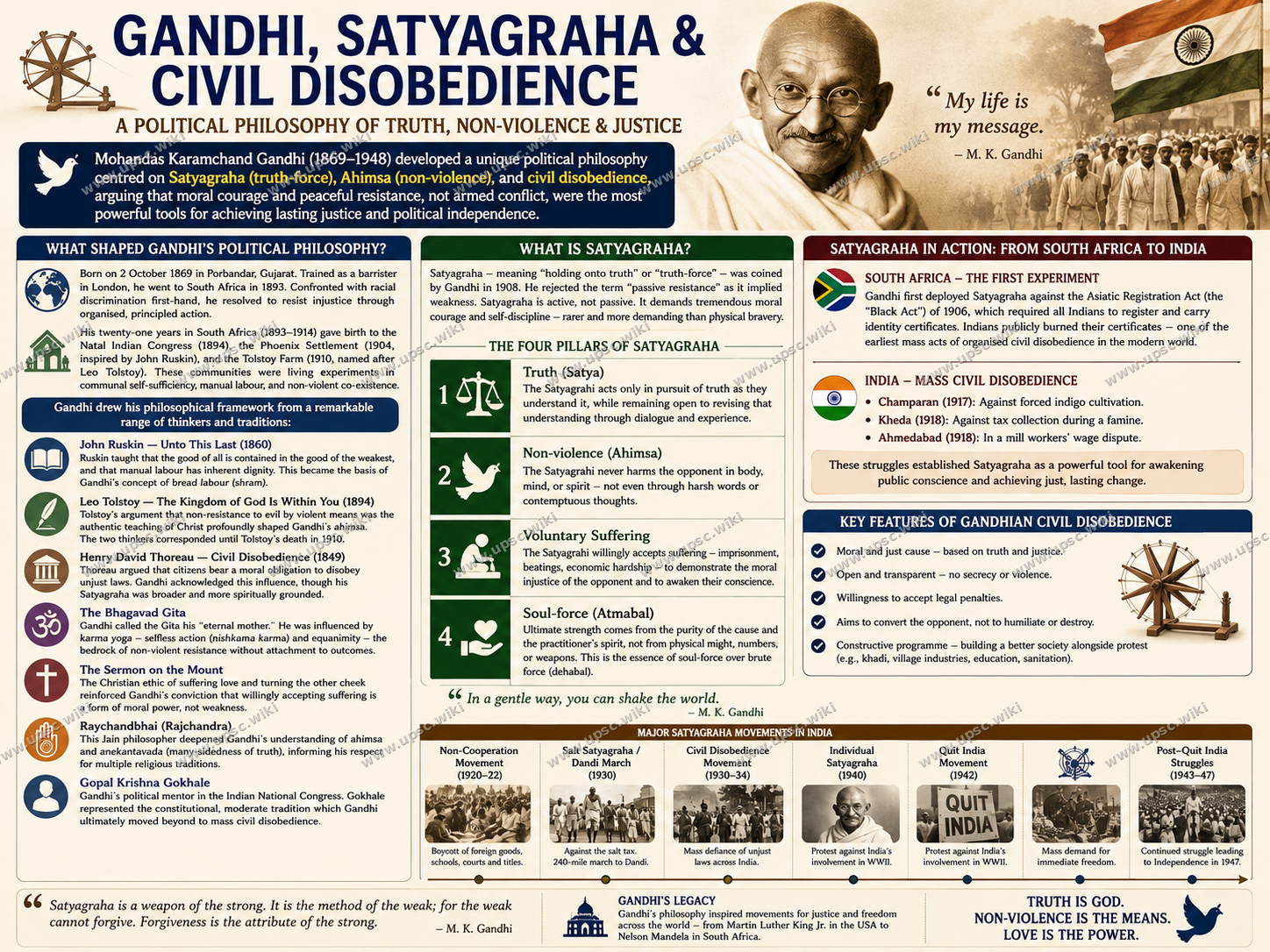
Gandhi Satyagraha non-violence civil disobedience political philosophy — Mohandas Karamchand Gandhi (1869–1948) developed a unique political philosophy centred on Satyagraha (truth-force), Ahimsa (non-violence), and civil disobedience, arguing that moral courage and peaceful resistance, not armed conflict, were the most powerful tools for achieving lasting justice and political independence.
What Were the Intellectual Sources That Shaped Gandhi's Political Philosophy?
Gandhi was born on 2 October 1869 in Porbandar, Gujarat. Trained as a barrister in London, he went to South Africa in 1893 — an experience that proved decisive. Confronted with racial discrimination first-hand (most famously being thrown off a train at Pietermaritzburg despite holding a first-class ticket), he resolved to resist injustice through organised, principled action. His twenty-one years in South Africa (1893–1914) gave birth to the Natal Indian Congress (1894), the Phoenix Settlement (1904, inspired by John Ruskin), and the Tolstoy Farm (1910, named after Leo Tolstoy). These communities were living experiments in communal self-sufficiency, manual labour, and non-violent co-existence.
Gandhi drew his philosophical framework from a remarkable range of thinkers and traditions:
- John Ruskin — Unto This Last (1860): Gandhi read this text on a train journey in 1904 and was so moved that he founded the Phoenix Settlement the same week. Ruskin's teaching — that the good of all is contained in the good of the weakest, and that manual labour has inherent dignity — became the basis of Gandhi's concept of bread labour (shram): the conviction that everyone, regardless of social position, must perform some physical work each day.
- Leo Tolstoy — The Kingdom of God Is Within You (1894): Tolstoy's argument that non-resistance to evil by violent means was the authentic teaching of Christ profoundly shaped Gandhi's ahimsa. The two thinkers corresponded until Tolstoy's death in 1910.
- Henry David Thoreau — Civil Disobedience (1849): Thoreau argued that citizens bear a moral obligation to disobey unjust laws. Gandhi acknowledged this influence, though he noted that his own Satyagraha was broader and more spiritually grounded than Thoreau's essentially individualist act of conscience.
- The Bhagavad Gita: Gandhi called the Gita his "eternal mother." He was particularly influenced by karma yoga — the doctrine of selfless action (nishkama karma) and equanimity in the face of outcomes — which he read as the philosophical bedrock of non-violent resistance without attachment to personal gain or fear of consequences.
- The Sermon on the Mount: The Christian ethic of suffering love and turning the other cheek reinforced Gandhi's conviction that willingly accepting suffering was a form of moral power, not weakness or defeat.
- Raychandbhai (Rajchandra): This Jain philosopher and poet was Gandhi's spiritual guide in matters of personal ethics. Rajchandra deepened Gandhi's understanding of ahimsa and the Jain principle of anekantavada (many-sidedness of truth), which later informed Gandhi's respect for multiple religious traditions.
- Gopal Krishna Gokhale: Gandhi's political mentor within the Indian National Congress, Gokhale represented the constitutional, moderate tradition. Gandhi revered him, but ultimately moved far beyond constitutional methods to mass civil disobedience.
What Is Satyagraha and How Did Gandhi Apply It as a Tool of Civil Disobedience?
The word Satyagraha — meaning "holding onto truth" or "truth-force" — was coined by Gandhi in 1908 through a naming competition in his South African journal, Indian Opinion. He was dissatisfied with the English phrase "passive resistance" because it implied weakness, a last resort for those unable to fight. Satyagraha, by contrast, is active, not passive. It requires tremendous moral courage and self-discipline — qualities Gandhi considered rarer and more demanding than physical bravery on a battlefield.
At its core, Satyagraha rests on four mutually reinforcing principles:
- Truth (Satya): The Satyagrahi acts only in pursuit of truth as they understand it, while remaining genuinely open to revising that understanding through dialogue and experience.
- Non-violence (Ahimsa): The Satyagrahi never harms the opponent in body, mind, or spirit — not even through harsh words or contemptuous thoughts.
- Voluntary suffering: The Satyagrahi willingly accepts suffering — imprisonment, beatings, economic hardship — to demonstrate the moral injustice of the opponent's position and to awaken the opponent's own conscience.
- Soul-force (Atmabal): Ultimate strength derives from the purity of the cause and the practitioner's spirit, not from physical might, numbers, or weapons. This is the fundamental distinction between soul-force (atmabal) and brute force (dehabal).
Gandhi first deployed Satyagraha in South Africa against the Asiatic Registration Act (the "Black Act") of 1906, which required all Indians to register and carry identity certificates. Indians publicly burned their certificates — one of the earliest mass acts of organised civil disobedience in the modern world. Back in India, Satyagraha was applied in Champaran (1917, against forced indigo cultivation), Kheda (1918, against tax collection during a famine), and Ahmedabad (1918, in a mill workers' wage dispute). It then scaled to the national level through the Non-Cooperation Movement (1920–22), the Salt March and Civil Disobedience Movement (1930–34), and the Quit India Movement (1942).
Gandhi was unambiguous that ahimsa demanded active courage: "I do believe that where there is only a choice between cowardice and violence, I would advise violence." A coward who refused to resist injustice out of fear was, in Gandhi's moral calculus, worse than a person who used violence to protect the innocent. Ahimsa was for the brave, not the timid.
Gandhi's Five Core Philosophical Concepts: A Comparative Overview
| Concept | Literal Meaning | Definition | Practical Application |
|---|---|---|---|
| Satyagraha | Holding onto Truth / Truth-Force | Active non-violent resistance grounded in truth and moral courage; the practitioner accepts suffering willingly to appeal to the opponent's conscience rather than to coerce or destroy the opponent. | Dandi Salt March (1930); Non-Cooperation Movement (1920–22); Champaran Satyagraha (1917); anti-registration campaigns in South Africa (1906–1914). |
| Ahimsa | Non-violence / Non-harm | Not merely the absence of physical violence but active, unconditional love for all beings; non-violence in thought, word, and deed; an attribute of the strong, not the weak. | Refusal to retaliate during lathi charges and mass arrests; fasts to resolve communal riots; fostering Hindu-Muslim unity as a daily political practice. |
| Swaraj | Self-Rule | Self-governance at three mutually dependent levels: individual self-mastery (freedom from inner vices such as greed and anger), village self-government (Gram Swaraj), and national political independence from colonial rule. | Hind Swaraj (1909) critiqued modern industrial civilisation; demand for decentralised village republics rather than a centralised nation-state modelled on Western parliamentary democracy. |
| Swadeshi | Of One's Own Country | Use and promotion of Indian-made goods; economic self-reliance as the prerequisite of political independence; critique of industrial capitalism that destroys local livelihoods and creates colonial economic dependence. | Boycott of British-made cloth; daily spinning on the charkha (spinning wheel) as a meditative and political act; the charkha placed on the Congress tricolour flag. |
| Sarvodaya | Welfare of All / Rise of All | Gandhi's adaptation of Ruskin's Unto This Last: not the utilitarian "greatest good for the greatest number" — which could sacrifice the weakest — but the welfare of every individual, especially the most marginalised. | Critique of majority-rule parliamentary democracy as capable of trampling minorities; foundation of Vinoba Bhave's post-independence Bhoodan (land-gift) movement. |
What Did Gandhi Mean by Swaraj, Swadeshi, Sarvodaya and Ram Rajya?
Swaraj is perhaps Gandhi's most philosophically complex concept. In Hind Swaraj (1909), written during a ship voyage from London, Gandhi argued that an India which simply adopted British parliamentary institutions would merely be replacing "English rule without the Englishman" — it would retain the tiger's nature while replacing the tiger. True Swaraj required moral self-purification: individuals had to free themselves from inner vices (greed, lust, anger, fear) before they deserved political freedom. At the collective level, Gandhi envisaged Gram Swaraj — self-governing village republics linked in a loose federation — as the ideal political unit. He was deeply suspicious of the centralised modern state and industrial capitalism, both of which he saw as instruments of structural violence against the rural poor.
Swadeshi extended far beyond an economic boycott. The charkha was not merely a production tool; Gandhi spun for at least thirty minutes each day as a meditative, disciplinary, and political act — a visible symbol of self-reliance, the dignity of manual labour, and solidarity with the millions of rural weavers whose livelihoods had been destroyed by Lancashire cotton mills. When Congress leaders adopted the charkha on the party flag, it announced to the world that Indian nationalism was inseparable from the cause of the rural poor.
Sarvodaya was Gandhi's challenge to both liberal utilitarianism and Marxist class struggle. He rejected any social calculus that permitted sacrificing the weakest for aggregate progress. A just society must leave no one behind. This vision demanded voluntary redistribution, trusteeship of wealth (the rich holding their surplus as trustees for the community, not as personal property), and the abolition of extreme economic inequality through moral persuasion rather than revolutionary seizure.
Ram Rajya was Gandhi's image of the ideal polity. Drawn from Hindu cosmological tradition, he was always careful to insist it was emphatically not a theocratic Hindu state but a moral society founded on truth, justice, non-violence, and care for the weakest — a standard equally available to Muslims, Christians, Sikhs, Jains, Buddhists, and atheists. Ram Rajya represented the kingdom of God on earth: a permanent moral benchmark against which the quality of any government, colonial or independent, could be measured.
What Was Gandhi's Constructive Programme and How Did He Address Caste?
Gandhi believed that political independence without prior social transformation was at best hollow and at worst dangerous — it would merely transfer power from British hands to the hands of an Indian elite that replicated colonial structures of inequality. His Constructive Programme (first published 1941, revised 1945) outlined eighteen items for building a just and self-reliant social order from the grassroots up, regardless of who ruled India from Delhi. These included: Hindu-Muslim unity; removal of untouchability; khadi and village industries; village sanitation; basic adult education; economic equality; uplift of women; education in Indian languages (rather than English as the sole medium); improvement in the conditions of agricultural labourers and industrial workers; attention to tribal communities, lepers, and students; and basic healthcare and hygiene.
Gandhi insisted that these constructive activities were not secondary to political agitation but were its necessary complement — and, in the long run, its deeper foundation. A society that had not achieved internal justice and self-reliance could not sustain genuine independence.
On the question of caste, Gandhi's position was complex, evolving, and remains genuinely controversial. In his early writings he accepted the principle of varna — the four-fold division of society into Brahmins, Kshatriyas, Vaishyas, and Shudras — as a natural and functional order based on hereditary occupation, arguing it minimised social conflict by assigning each person a defined role. He strongly and consistently opposed untouchability, however, viewing it as a corruption of Hinduism with no scriptural sanction. He coined the term Harijan ("children of God") for those formerly called "untouchables" or "depressed classes," and worked for their entry into Hindu temples and access to public resources.
B. R. Ambedkar — constitutional lawyer, Dalit leader, and architect of the Indian Constitution — launched a fundamental critique of Gandhi's position. Ambedkar argued that calling Dalits "Harijans" was condescending rather than liberating; that varna was the structural root from which untouchability grew and could not be preserved while untouchability was abolished; and that Gandhi's approach ultimately preserved upper-caste Hindu social power under a reformed guise. Ambedkar advocated the Annihilation of Caste (the title of his landmark 1936 address) — a complete dismantling of the caste system, not its reform. He famously converted to Buddhism in October 1956, weeks before his death, leading approximately 600,000 followers in what he described as a rejection of caste-based Hinduism.
The Poona Pact of September 1932 crystallised this antagonism. The British government's Communal Award had proposed separate electorates for Dalits — a measure Ambedkar supported as a means of genuine political representation. Gandhi undertook a fast unto death to oppose separate electorates, arguing they would permanently divide Hindu society and isolate Dalits further. Facing enormous moral and political pressure — including the possibility that Gandhi's death would trigger anti-Dalit violence — Ambedkar signed the Pact. Separate electorates were replaced by reserved seats within a joint Hindu electorate, but with a larger total number of reserved seats than the Communal Award had proposed. Ambedkar later wrote that the Pact had been extracted from him under duress and represented a historic injustice to Dalits.
Frequently Asked Questions
What does Satyagraha mean and where did Gandhi first use it?
Satyagraha means "holding onto truth" or "truth-force." Gandhi coined the term in 1908 through a naming competition in his South African journal, Indian Opinion, to replace the inadequate phrase "passive resistance." He first applied it in South Africa against the Asiatic Registration Act (the "Black Act") of 1906, which required all Indians to register and carry identity certificates. Indians burned their certificates in mass demonstrations — one of the earliest forms of organised Gandhian civil disobedience.
How is Gandhi's concept of non-violence different from passive resistance?
Gandhi explicitly rejected the label "passive resistance" because it suggested a weapon of the weak or a strategy adopted by those unable to fight. Ahimsa (non-violence), as Gandhi understood it, is active, not passive — it requires immense moral courage, self-discipline, and a willingness to accept suffering voluntarily. The Satyagrahi does not merely refuse to harm; they actively seek to transform the opponent by appealing to the opponent's conscience through example and suffering. Gandhi also insisted that a coward was worse than a violent person: he would choose violence over cowardice if forced to choose between only those two options.
What is the difference between Swaraj and Swadeshi in Gandhi's philosophy?
Swaraj means self-rule and operates at three levels: individual self-mastery (freedom from moral vices), village self-governance (Gram Swaraj), and national political independence from British colonial rule. Swadeshi means "of one's own country" and refers to the preference for locally produced goods, especially hand-spun khadi cloth, as a strategy of economic self-reliance and resistance to industrial capitalism. While Swaraj is the political and moral goal, Swadeshi is one of the primary economic methods for achieving the self-sufficiency that Swaraj requires. Both rest on the same critique: that dependence — whether political or economic — undermines freedom and dignity.
What was Gandhi's Constructive Programme?
Gandhi's Constructive Programme, first published in 1941, was a list of eighteen social reform activities that Gandhi believed were necessary to build the foundations of a truly free and just India, independent of who held political power. The items included: achieving Hindu-Muslim unity; removing untouchability; promoting khadi and village industries; improving village sanitation; providing basic adult education; advancing women's equality; promoting education in Indian languages; achieving economic equality; and improving conditions for agricultural and industrial workers. Gandhi argued that freedom fighters should work on these issues simultaneously with political agitation, so that political independence would be accompanied by genuine social liberation.
How did Gandhi's views on caste differ from Dr. B. R. Ambedkar's?
Gandhi accepted the concept of varna (the four-fold hereditary division of labour) as a legitimate social institution, though he strongly opposed untouchability as a perversion of Hinduism. He referred to untouchables as "Harijans" (children of God) and worked for their inclusion within Hindu society. Ambedkar, himself from a Dalit community, argued that varna was the very root of untouchability and could not be separated from it; he believed Gandhi's approach ultimately served to preserve the caste system. Ambedkar advocated the complete annihilation of caste, not reform within it, and famously converted to Buddhism in 1956 as a rejection of caste-based Hinduism. The Poona Pact of 1932 crystallised their fundamental disagreement: Ambedkar signed it under the pressure of Gandhi's fast, but later described it as a betrayal of Dalit political interests.
Sources and Further Reading
According to IGNOU's BHIC-134 (History of India: 1707–1950), Gandhi's political philosophy is a core component of the modern Indian history syllabus, examined in the contexts of the nationalist movement, social reform, and anti-colonial resistance. Students preparing for UPSC are advised to read Gandhi's own works directly: Hind Swaraj (1909) for his critique of modern civilisation and his vision of self-rule; An Autobiography: The Story of My Experiments with Truth (1927) for the personal and spiritual formation of his ideas; and Constructive Programme: Its Meaning and Place (1941, revised 1945) for his social vision. B. R. Ambedkar's Annihilation of Caste (1936) is essential for understanding the sharpest contemporary critique of Gandhi on the caste question. For secondary scholarship, Judith M. Brown's Gandhi: Prisoner of Hope (1989) offers a balanced biographical treatment, and Raghavan Iyer's The Moral and Political Thought of Mahatma Gandhi (1973) remains the most comprehensive academic analysis of his philosophical system. For the South African formative period specifically, see Maureen Swan's Gandhi: The South African Experience (1985).