
Khajuraho Temples
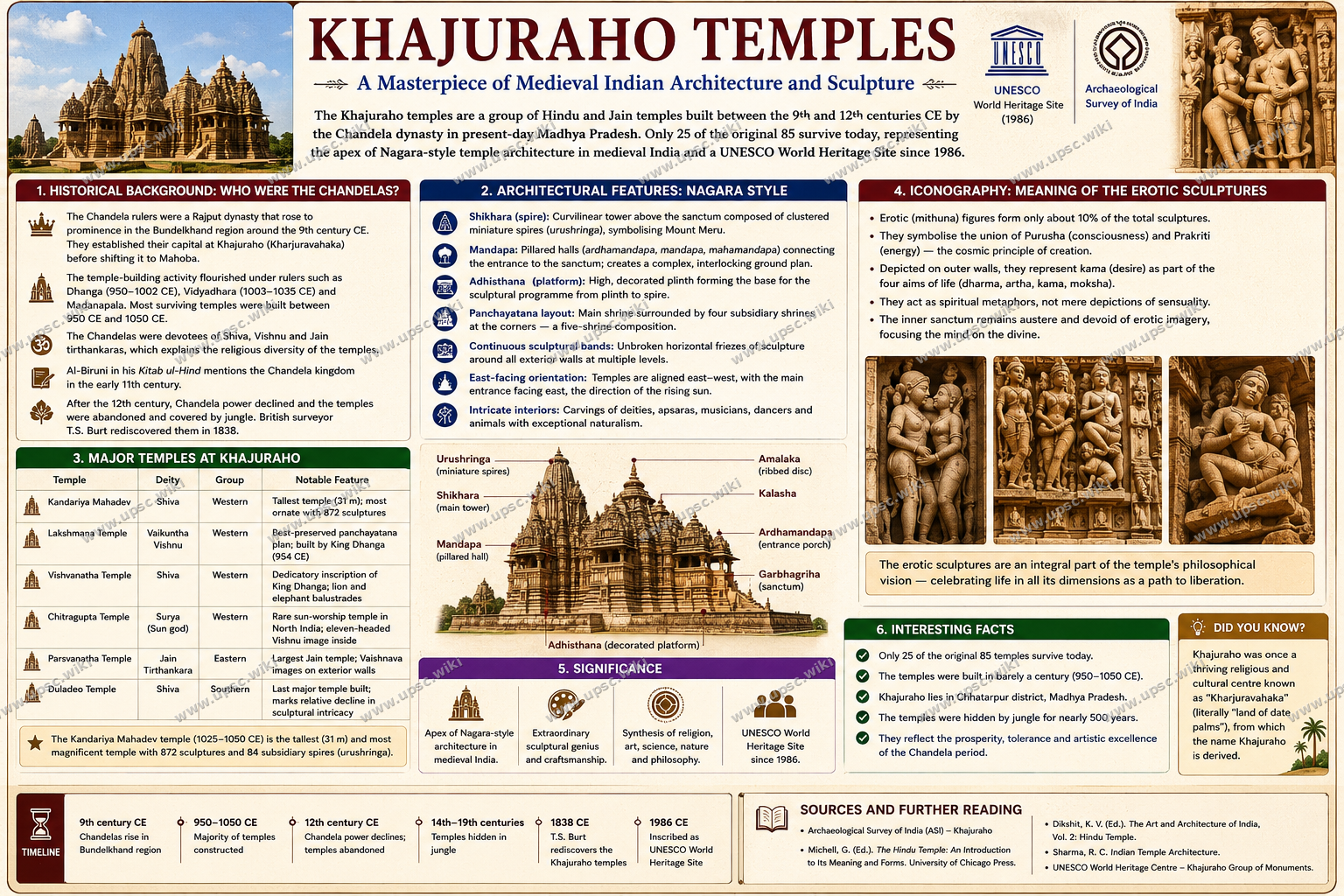
The Khajuraho temples are medieval masterpieces built by the Chandela dynasty between the 9th and 12th centuries CE, celebrated for Nagara-style architecture, mithuna sculpture, and UNESCO World Heritage status since 1986.
Khajuraho temples are a group of Hindu and Jain temples built between the 9th and 12th centuries CE by the Chandela dynasty in present-day Madhya Pradesh. Only 25 of the original 85 survive today, representing the apex of Nagara-style temple architecture in medieval India and a UNESCO World Heritage Site since 1986.
Historical Background: Who Were the Chandelas?
The Chandela rulers were a Rajput dynasty that rose to prominence in the Bundelkhand region of central India around the 9th century CE. They established their capital at Khajuraho — then known as Kharjuravahaka — before subsequently shifting it to Mahoba. At their peak, the Chandelas controlled a vast territory stretching from the Yamuna River in the north to the Vindhya ranges in the south.
The temple-building activity at Khajuraho reached its zenith under rulers such as Dhanga (r. 950–1002 CE), Vidyadhara (r. 1003–1035 CE), and Madanapala. Most of the surviving temples were constructed between 950 CE and 1050 CE — a period of barely a century that represents one of the most concentrated bursts of artistic creativity in Indian history. The Chandelas were devotees of Shiva, Vishnu, and Jain tirthankaras, which explains the religious diversity visible across the complex.
The Persian scholar Al-Biruni, who visited India in the early 11th century, mentions the Chandela kingdom in his Kitab ul-Hind. The temples gradually fell into disuse after the 12th century when Chandela power waned, and by the 14th century they were largely concealed within dense jungle. The British surveyor T.S. Burt rediscovered the temples in 1838 and brought them to wider scholarly attention, beginning the modern era of archaeological study at the site.
Architectural Features: What Style Do the Khajuraho Temples Follow?
The Khajuraho temples exemplify the Nagara style of North Indian temple architecture, specifically the Chandela sub-style — sometimes called the Central Indian or Madhya Pradesh variant. The defining characteristics of this style include:
- Shikhara (spire): A curvilinear tower rising above the sanctum sanctorum (garbhagriha). The shikhara at Khajuraho is composed of clustered miniature spires (urushringa) that create the impression of a mountain range, symbolising Mount Meru — the cosmic axis of Hindu cosmology.
- Mandapa: A pillared hall connecting the entrance porch (ardhamandapa) to the sanctum. The Khajuraho temples often feature multiple interconnected mandapas, giving them a complex, interlocking ground plan unique in Indian architecture.
- Adhisthana (platform): A high, decorated plinth that elevates the entire temple complex and serves as the base for the sculptural programme extending from ground level upward.
- Panchayatana layout: The principal shrine is surrounded by four subsidiary shrines at the corners of the platform, creating a five-shrine composition of great visual and spatial complexity.
- Continuous sculptural bands: Unlike South Indian temples where sculpture is concentrated in defined niches, the Khajuraho temples carry unbroken horizontal friezes of sculpture running around all exterior walls at multiple levels, from plinth to spire.
The temples are oriented along an east-west axis, with the main entrance facing east — the direction of the rising sun and considered auspicious in Hindu tradition. The interior walls are equally decorated with intricate carvings of deities, celestial beings (apsaras and surasundaris), musicians, dancers, and animals rendered with exceptional naturalism.
Major Temples at Khajuraho
The surviving temples are grouped into three geographic clusters — Western, Eastern, and Southern. The Western Group, enclosed within a protected archaeological park managed by the Archaeological Survey of India, contains the most impressive structures and is the primary focus for aspirants studying medieval art and architecture.
| Temple | Deity | Group | Notable Feature |
|---|---|---|---|
| Kandariya Mahadev | Shiva | Western | Tallest temple (31 m); most ornate sculptural programme with 872 carvings |
| Lakshmana Temple | Vaikuntha Vishnu | Western | Best-preserved panchayatana plan; built by King Dhanga (954 CE) |
| Vishvanatha Temple | Shiva | Western | Dedicatory inscription of King Dhanga; lion and elephant balustrades |
| Chitragupta Temple | Surya (Sun god) | Western | Rare sun-worship temple in North India; eleven-headed Vishnu image inside |
| Parsvanatha Temple | Jain Tirthankara | Eastern | Largest Jain temple at Khajuraho; Vaishnava images on exterior walls |
| Duladeo Temple | Shiva | Southern | Last major temple built at the site; marks relative decline in sculptural intricacy |
The Kandariya Mahadev temple deserves special attention. Standing approximately 31 metres tall, it was built around 1025–1050 CE and features 872 sculptures on its exterior walls, arranged in three horizontal bands. Its shikhara is composed of 84 subsidiary spires, making it one of the most technically sophisticated examples of the mature Nagara style. It is the standard scholarly reference point for any discussion of Chandela architectural achievement.
Iconography: What Do the Erotic Sculptures Represent?
The erotic sculptures (mithuna figures) at Khajuraho are perhaps the most widely discussed — and most frequently misunderstood — aspect of the temples. Several critical points are essential for an informed and academically grounded understanding:
- Proportion: Erotic imagery constitutes only approximately 10% of the total sculptural programme. The vast majority depicts deities, celestial beings, devotional scenes, court life, battle and hunting scenes, and everyday village activities. The mithuna figures are one strand among many.
- Placement: Erotic figures are invariably located on the outer walls (bahya bhitti) and on balcony mouldings, never inside the sanctum. This placement is theologically deliberate — one must symbolically leave worldly desires outside before entering the sacred interior to meet the deity.
- Theological interpretations: Scholars have advanced several complementary readings: (a) the Tantric tradition that views sexual union as a metaphor for the divine union of Shiva and Shakti and the merging of individual consciousness with the universal; (b) the concept that desire (kama) is one of the four purusharthas (aims of human life) and must be acknowledged, not suppressed, before transcendence is possible; (c) apotropaic belief — erotic images were thought to ward off lightning, evil spirits, and malevolent forces from the sacred structure; (d) the temple as an educational space where novices studying dharma, artha, and kama encountered all dimensions of human experience prior to renunciation.
- Artistic and cultural context: The mithuna imagery reflects a broader tradition rooted in texts such as the Kamasutra of Vatsyayana and the Natyashastra of Bharata, and must be understood within the aesthetic framework of rasa (emotional essence) rather than through a contemporary Western lens. The carvings are works of high technical art, executed with extraordinary delicacy and anatomical knowledge.
UNESCO World Heritage Status and Contemporary Significance
The Khajuraho Group of Monuments was inscribed on the UNESCO World Heritage List in 1986 under criteria (i) and (iii) — recognising it as both a masterpiece of human creative genius and as exceptional testimony to a significant medieval cultural tradition. The site is maintained by the Archaeological Survey of India (ASI) and annually attracts hundreds of thousands of visitors from across the world.
For aspirants, Khajuraho appears across multiple papers and dimensions of the syllabus:
- Prelims: Direct questions on the Chandela dynasty, Nagara architectural terminology (shikhara, urushringa, panchayatana), UNESCO heritage sites in India, and specific temples — especially Kandariya Mahadev and Lakshmana Temple.
- GS Paper I (Mains): Under Art and Culture — evolution of temple architecture from early to medieval periods, Rajput patronage of art, and the synthesis of the sacred and aesthetic in Indian civilisation.
- Optional History: The Chandela period is covered under medieval political history; candidates must understand the dynasty's rise, its remarkable cultural output, and its eventual decline after incursions from the northwest weakened the Bundelkhand region.
- Essay Paper: The temples exemplify India's civilisational tradition of integrating the sacred and the sensual — a nuanced and philosophically rich theme for essays on Indian art, culture, and the idea of moksha.
Frequently Asked Questions
Who built the Khajuraho temples and in which period?
The Khajuraho temples were built by the Chandela dynasty, a Rajput clan that ruled the Bundelkhand region of central India. The major construction activity took place between approximately 950 CE and 1050 CE, with the most celebrated temples built during the reigns of King Dhanga and King Vidyadhara. Originally about 85 temples were constructed; only 25 survive today.
What architectural style do the Khajuraho temples represent?
The Khajuraho temples represent the Nagara style of North Indian temple architecture, specifically the Chandela or Central Indian sub-style. Key features include the curvilinear shikhara (tower), clustered subsidiary spires (urushringa), a panchayatana layout with four corner shrines, a high decorated platform (adhisthana), and continuous horizontal bands of sculpture on all exterior walls.
What percentage of Khajuraho sculptures are erotic?
Erotic (mithuna) sculptures constitute only approximately 10% of the total iconographic programme at Khajuraho. The remaining 90% depicts deities, celestial women (surasundaris and apsaras), devotional and mythological scenes, court activities, battle scenes, and animals. The erotic figures are always placed on the outer walls, never within the sanctum sanctorum.
When did Khajuraho receive UNESCO World Heritage status?
The Khajuraho Group of Monuments was inscribed as a UNESCO World Heritage Site in 1986. It was recognised under criteria (i) and (iii), acknowledging it as a masterpiece of human creative genius and as exceptional testimony to a significant cultural tradition. The site is managed by the Archaeological Survey of India (ASI).
Which is the tallest and most important temple at Khajuraho?
The Kandariya Mahadev temple, dedicated to Shiva, is the tallest at approximately 31 metres and is widely considered the finest example of the mature Chandela style. Built around 1025–1050 CE, it has 872 exterior sculptures arranged in three bands and features 84 subsidiary spires on its shikhara. It stands in the Western Group of temples, the most visited cluster.
Sources and Further Reading
The primary academic source for this article is IGNOU BHIC-131: History of India from Earliest Times to 1206 CE (Ancient and Medieval India), which provides a comprehensive account of the Chandela dynasty, the development of Nagara temple architecture, and the art-historical significance of the Khajuraho monuments within the broader framework of medieval Indian civilisation.
- Archaeological Survey of India (ASI). Khajuraho: A Guide. New Delhi: ASI Publications.
- Dehejia, Vidya. Indian Art. London: Phaidon Press, 1997.
- Huntington, Susan L. The Art of Ancient India: Buddhist, Hindu, Jain. New York: Weatherhill, 1985.
- Michell, George. The Hindu Temple: An Introduction to Its Meaning and Forms. Chicago: University of Chicago Press, 1988.
- NCERT Class XI — An Introduction to Indian Art, Chapter on Temple Architecture.
- UNESCO World Heritage List: Khajuraho Group of Monuments (1986), Reference No. 240.