
Manipuri
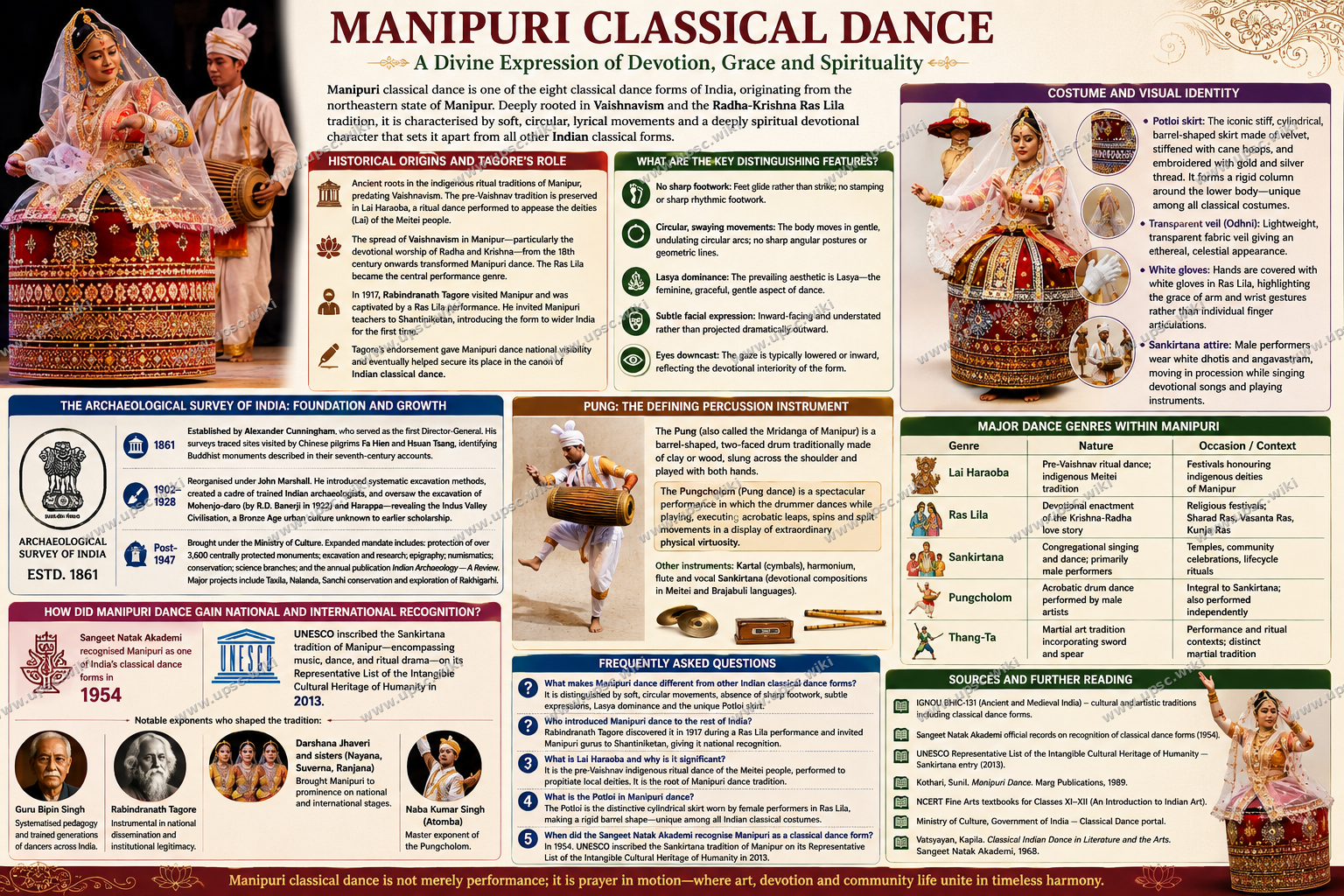
Manipuri classical dance is one of the eight classical dance forms of India, originating from the northeastern state of Manipur. Deeply rooted in Vaishnavism and the Radha-Krishna Ras Lila tradition,...
Manipuri classical dance is one of the eight classical dance forms of India, originating from the northeastern state of Manipur. Deeply rooted in Vaishnavism and the Radha-Krishna Ras Lila tradition, it is characterised by soft, circular, lyrical movements and a deeply spiritual devotional character that sets it apart from all other Indian classical forms.
Historical Origins and Tagore's Role
Manipuri dance has ancient roots in the indigenous ritual traditions of Manipur, predating the arrival of Vaishnavism in the region. The pre-Vaishnav tradition is preserved in the form of Lai Haraoba, a ritual dance performed to appease the deities (Lai) of the Meitei people. Lai Haraoba is considered the fountainhead of Manipuri dance and remains one of its most defining traditions alongside the Vaishnava repertoire.
The spread of Vaishnavism in Manipur—particularly the devotional worship of Radha and Krishna—from the 18th century onwards transformed Manipuri dance into a vehicle of spiritual expression. The Ras Lila, enacting the divine love of Radha and Krishna, became the central performance genre of the tradition.
In 1917, Rabindranath Tagore visited Manipur and was captivated by a Ras Lila performance. Recognising its profound artistic and spiritual value, he invited Manipuri teachers to Shantiniketan in Bengal, introducing the form to wider India for the first time. Tagore's endorsement gave Manipuri dance national visibility and eventually helped secure its place in the canon of Indian classical dance.
What Are the Key Distinguishing Features of Manipuri Dance?
Manipuri dance stands apart from other classical Indian dance forms in several fundamental ways:
- No sharp footwork: Unlike Bharatanatyam, Kathak, or Odissi, Manipuri does not emphasize stamping of feet or sharp rhythmic footwork on the ground. Movements flow softly, and the feet glide rather than strike.
- Circular, swaying movements: The body moves in gentle, undulating circular arcs. There are no sharp angular postures or strong geometric lines common to other classical forms.
- Lasya dominance: The prevailing aesthetic is Lasya—the feminine, graceful, gentle aspect of dance—as opposed to the more vigorous Tandava style associated with Lord Shiva.
- Subtle facial expression: Unlike Bharatanatyam or Kathakali, the facial expressions in Manipuri are inward-facing and understated rather than projected dramatically outward. The spiritual mood is internalised.
- Eyes downcast: The gaze is typically lowered or inward, reflecting the devotional interiority of the form.
Costume and Visual Identity
The visual signature of Manipuri dance is unmistakable among all classical forms:
- Potloi skirt: Female performers in Ras Lila wear the iconic Potloi—a stiff, cylindrical, barrel-shaped skirt made of velvet, stiffened with cane hoops, and embroidered richly with gold and silver thread. It does not flare or move freely but forms a rigid column around the lower body, creating a silhouette unlike any other classical costume in India.
- Transparent veil (Odhni): The upper body is draped with a lightweight, transparent fabric veil, giving the dancer an ethereal, almost celestial appearance.
- White gloves: Hands are often covered with white gloves during Ras Lila performances, drawing attention to the grace of arm and wrist gestures rather than individual finger articulations.
- Sankirtana attire: In the male Sankirtana genre, performers wear white dhotis and angavastram, moving in procession while singing devotional songs and playing instruments.
Pung: The Defining Percussion Instrument
The Pung (also called the Mridanga of Manipur) is the defining percussion instrument of Manipuri dance and music. It is a barrel-shaped, two-faced drum traditionally made of clay or wood, slung across the shoulder and played with both hands. The Pung player is not a mere accompanist—the Pungcholom (Pung dance) is itself a spectacular performance tradition in which the drummer dances while playing, executing acrobatic leaps, spins, and split movements in a display of extraordinary physical virtuosity.
Other important instruments include the Kartal (cymbals), the harmonium, and the flute. The vocal component—Manipuri Sankirtana—features devotional compositions in Meitei and Brajabuli languages, rooted in the Vaishnavite literary tradition shared with Bengal and Assam.
Major Dance Genres Within Manipuri
| Genre | Nature | Occasion / Context |
|---|---|---|
| Lai Haraoba | Pre-Vaishnav ritual dance; indigenous Meitei tradition | Festivals honouring indigenous deities of Manipur |
| Ras Lila | Devotional enactment of the Krishna-Radha love story | Religious festivals; Sharad Ras, Vasanta Ras, Kunja Ras |
| Sankirtana | Congregational singing and dance; primarily male performers | Temples, community celebrations, lifecycle rituals |
| Pungcholom | Acrobatic drum dance performed by male artists | Integral to Sankirtana; also performed independently |
| Thang-Ta | Martial art tradition incorporating sword and spear | Performance and ritual contexts; distinct martial tradition |
How Did Manipuri Dance Gain National and International Recognition?
The Sangeet Natak Akademi, India's apex body for performing arts, formally recognised Manipuri as one of India's classical dance forms in 1954. This placed it alongside Bharatanatyam, Kathak, Odissi, Kuchipudi, Mohiniyattam, Kathakali, and Sattriya in the official canon of Indian classical dance.
UNESCO inscribed the Sankirtana tradition of Manipur—encompassing music, dance, and ritual drama performed in temples and during festivals—on its Representative List of the Intangible Cultural Heritage of Humanity in 2013. This recognition acknowledged Sankirtana not merely as an artistic tradition but as a living spiritual and social institution integral to Meitei community life.
Notable exponents who shaped the modern transmission of Manipuri dance include:
- Guru Bipin Singh — the most influential 20th-century guru who systematised pedagogy, reconstructed classical repertoire, and trained generations of dancers across India
- Rabindranath Tagore — instrumental in national dissemination and institutional legitimacy
- Darshana Jhaveri and her sisters (Nayana, Suverna, Ranjana) — trained under Guru Bipin Singh and brought Manipuri to prominence on national and international stages
- Naba Kumar Singh (Atomba) — master exponent of Pungcholom
Frequently Asked Questions
What makes Manipuri dance different from other Indian classical dance forms?
Manipuri classical dance is distinguished by its soft, circular movements and complete absence of sharp footwork or stamping—unlike Bharatanatyam or Kathak. The facial expressions are subtle and inward, the aesthetic is predominantly Lasya (graceful), and the cylindrical Potloi skirt worn by female performers is unique among all Indian classical costumes.
Who introduced Manipuri dance to the rest of India?
Rabindranath Tagore discovered Manipuri dance during a visit to Manipur in 1917 where he witnessed a Ras Lila performance. Deeply moved, he invited Manipuri gurus to Shantiniketan, thereby introducing the form to wider India and giving it national recognition for the first time.
What is Lai Haraoba and why is it significant?
Lai Haraoba is the pre-Vaishnav indigenous ritual dance of the Meitei people of Manipur, performed to propitiate the local deities (Lai). It predates the Vaishnava influence and is considered the root from which Manipuri dance tradition grew. It remains a living ritual practice and a defining feature of Manipuri cultural identity.
What is the Potloi in Manipuri dance?
The Potloi is the distinctive cylindrical skirt worn by female performers in Ras Lila. Made of stiff velvet reinforced with cane, it forms a rigid barrel shape around the lower body, creating a visual silhouette unlike any other classical dance costume in India. It is one of the most recognisable visual markers of Manipuri dance.
When did the Sangeet Natak Akademi recognise Manipuri as a classical dance form?
The Sangeet Natak Akademi recognised Manipuri as one of India's classical dance forms in 1954. Additionally, UNESCO inscribed the Sankirtana tradition of Manipur on its Representative List of the Intangible Cultural Heritage of Humanity in 2013.
Sources and Further Reading
The content of this article draws primarily from IGNOU BHIC-131 (Ancient and Medieval India), which covers the cultural and artistic traditions of the Indian subcontinent including classical dance forms and their historical development within the broader context of Indian civilisation.
- Sangeet Natak Akademi official records on the recognition of classical dance forms (1954)
- UNESCO Representative List of the Intangible Cultural Heritage of Humanity — Sankirtana entry (2013)
- Kothari, Sunil. Manipuri Dance. Marg Publications, 1989
- NCERT Fine Arts textbooks for Classes XI–XII (An Introduction to Indian Art)
- Ministry of Culture, Government of India — Classical Dance portal
- Vatsyayan, Kapila. Classical Indian Dance in Literature and the Arts. Sangeet Natak Akademi, 1968