
Persian Literature in India
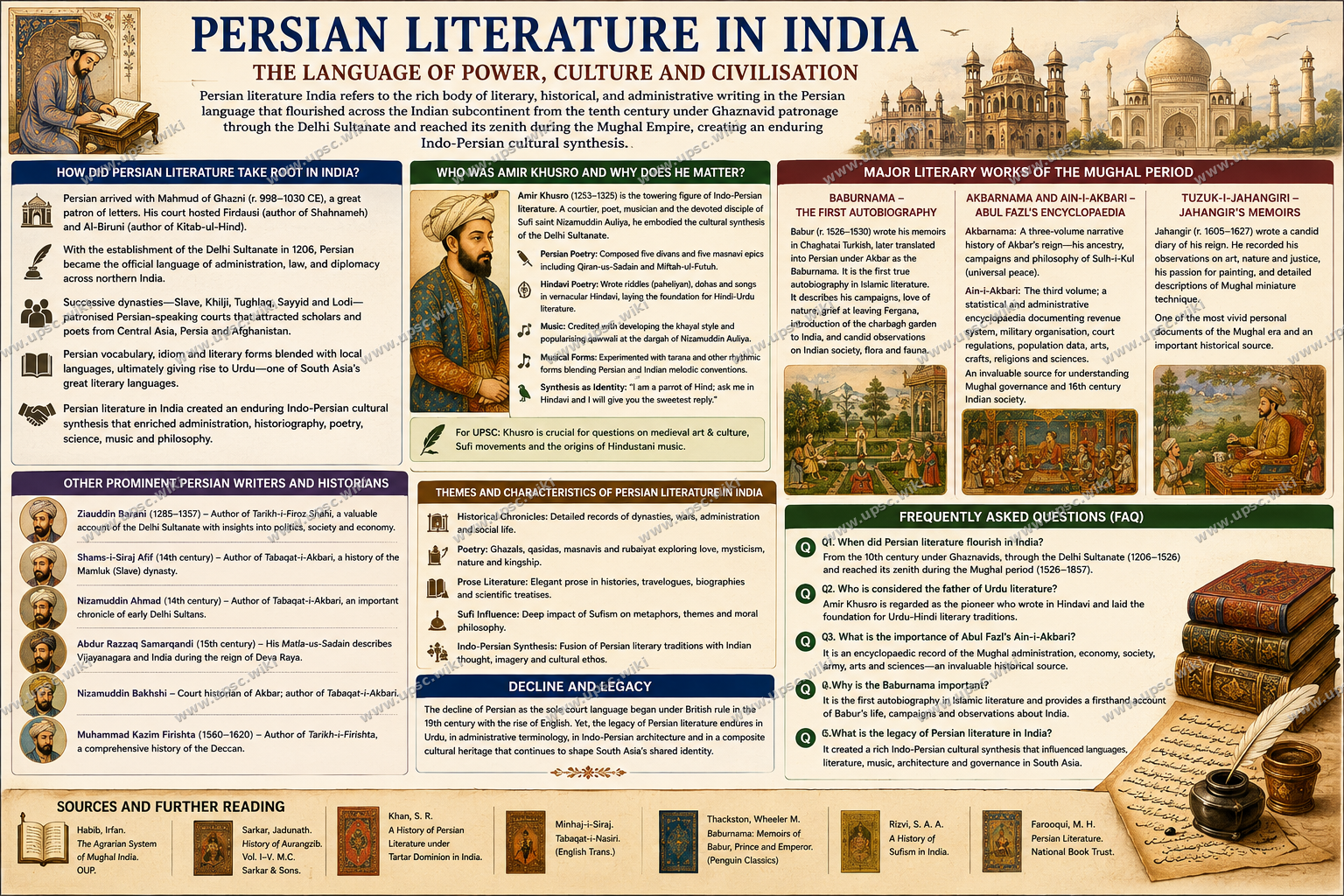
Persian literature in India shaped court culture, administration, and artistic life from the Ghaznavids through the Mughal Empire. This article covers Amir Khusro, the Baburnama, Akbarnama, Ain-i-Akbari, and the Indo-Persian cultural synthesis — essential for UPSC History.
Persian literature India refers to the rich body of literary, historical, and administrative writing in the Persian language that flourished across the Indian subcontinent from the tenth century under Ghaznavid patronage through the Delhi Sultanate and reached its zenith during the Mughal Empire, creating an enduring Indo-Persian cultural synthesis.
How Did Persian Literature Take Root in India?
The Persian language arrived in India as the language of power and refinement long before the Mughals. Mahmud of Ghazni (r. 998–1030 CE), who launched seventeen raids into the subcontinent, was also a lavish patron of Persian letters. His court at Ghazni hosted the poet Firdausi, composer of the epic Shahnameh, and Al-Biruni, whose Kitab-ul-Hind remains one of the finest ethnographic accounts of medieval India written in Persian.
When the Delhi Sultanate was established in 1206, Persian became the official language of administration, law, and diplomacy across northern India. Successive dynasties — the Slave dynasty, the Khiljis, the Tughlaqs, the Sayyids, and the Lodis — maintained Persian-speaking courts that attracted scholars and poets from Central Asia, Persia, and Afghanistan. Persian vocabulary, idiom, and literary forms fused steadily with local languages, ultimately producing Urdu, one of South Asia's great literary languages.
Who Was Amir Khusro and Why Does He Matter?
Amir Khusro (1253–1325) is the towering figure of Indo-Persian literature. Born to a Turkic father and an Indian mother, Khusro embodied the cultural synthesis that defined the Delhi Sultanate era. He served at the courts of several sultans and was a devoted disciple of the Sufi saint Nizamuddin Auliya.
Khusro's contributions span literature, music, and language:
- Persian poetry: He composed five divans (collections) and five masnavi epics modelled on Nizami Ganjavi's Khamsa, including Qiran-us-Sadain and Miftah-ul-Futuh.
- Hindavi poetry: Khusro wrote riddles (paheliyan), dohas (couplets), and songs in the vernacular proto-Hindi of Delhi, helping lay the foundation for what would become Hindi-Urdu literature.
- Music: He is credited with developing the khayal style of Hindustani classical vocal music and with popularising qawwali, the devotional music rooted in Sufi practice at the dargah of Nizamuddin Auliya.
- Musical forms: Khusro experimented with the tarana and other rhythmic forms that blended Persian and Indian melodic conventions.
- Synthesis as identity: His famous self-description — "I am a parrot of Hind; ask me in Hindavi and I will give you the sweetest reply" — captures his pride in Indian identity alongside Persian erudition.
For UPSC purposes, Khusro is important both as a literary figure and as evidence of the syncretic culture of the Delhi Sultanate. He appears in questions on medieval art and culture, Sufi movements, and the origins of Hindustani music.
What Were the Major Literary Works of the Mughal Period?
The Mughal dynasty (1526–1857) elevated Persian to unprecedented heights. The emperors themselves were often gifted writers, and their courts produced works that serve as indispensable historical chronicles as well as literary masterpieces.
Baburnama — The First Autobiography in the Islamic World
Babur (r. 1526–1530), the founder of the Mughal Empire, wrote his memoirs in Chaghatai Turkish. The work was translated into Persian under Akbar's order and is universally known as the Baburnama. It is celebrated as the first true autobiography in the Islamic literary tradition. Babur describes his campaigns, his love of nature (he is credited with introducing the formal charbagh garden to India), his grief at leaving Fergana, and his candid observations on Indian society, flora, and fauna. The Baburnama is an exceptional primary source for early sixteenth-century South and Central Asian history.
Akbarnama and Ain-i-Akbari — Abul Fazl's Encyclopaedic Project
Emperor Akbar (r. 1556–1605) commissioned his court historian Abul Fazl to write a comprehensive history of his reign. The result was a two-part monument of Indo-Persian prose:
- Akbarnama: A three-volume narrative history of Akbar's reign covering his birth, ancestry, and campaigns in rich detail, also articulating his philosophy of Sulh-i-Kul (universal peace and tolerance).
- Ain-i-Akbari: The third volume of the Akbarnama, functioning as a statistical and administrative encyclopaedia. It documents the Mughal revenue system, military organisation, court regulations, population data, and descriptions of arts, crafts, religions, and sciences. Historians regard it as an invaluable data source for understanding Mughal governance and Indian society in the sixteenth century.
Abul Fazl's prose style — ornate, allusive, and deeply indebted to Persian rhetorical conventions — exemplifies the mature Indo-Persian literary register.
Tuzuk-i-Jahangiri — Jahangir's Memoirs
Emperor Jahangir (r. 1605–1627) continued the tradition of royal memoir-writing. His Tuzuk-i-Jahangiri (also called Jahangirnama) is a candid personal diary of his reign. Jahangir records his observations on art, nature, and justice with rare frankness — including his passion for painting and his detailed descriptions of Mughal miniature technique. The Tuzuk is one of the most vivid personal documents of the Mughal era and an important source for the history of Mughal art.
What Was the Nature of Indo-Persian Cultural Synthesis?
Persian literature in India was never simply imported; it was continuously transformed by Indian themes, Sanskrit learning, and local languages. Key dimensions of this synthesis include:
- Translations: Sanskrit classics such as the Mahabharata (rendered as Razmnama under Akbar), the Ramayana, the Atharva Veda, and the Upanishads were translated into Persian, making Hindu learning accessible across cultural boundaries.
- Sufi poetry: Persian Sufi verse absorbed Indian philosophical themes. The mystical imagery of union (wisal) resonated with Vedantic ideas of non-duality, creating a shared spiritual vocabulary.
- Historiography: Works like Ziauddin Barani's Tarikh-i-Firuz Shahi and Yahya bin Ahmad Sirhindi's Tarikh-i-Mubarak Shahi combined Persian historical conventions with close observation of Indian political conditions.
- Language evolution: The sustained contact between Persian, Arabic, and Indian vernaculars gave birth to Urdu — initially called Rekhta — which became the shared literary medium of composite Indian culture.
How Did Persian Literature Decline in India?
The decline of Persian as a literary and administrative language in India was gradual but accelerating after the mid-eighteenth century. The weakening of Mughal authority after Aurangzeb's death in 1707 removed the primary institutional patron of Persian letters. Regional successor states — Awadh, Hyderabad, and others — briefly sustained the tradition, but the decisive blow came with British colonial rule. In 1835, Lord Macaulay's Minute on Education and the subsequent introduction of English as the medium of administration and higher education formally displaced Persian from public life. English replaced Persian in courts and offices, and the English-educated Indian became the new elite. Persian continued as a learned language in some scholarly and literary circles well into the twentieth century, but its role as a living court language in India had effectively ended.
Frequently Asked Questions
Who is considered the greatest Indo-Persian poet?
Amir Khusro (1253–1325) is widely regarded as the greatest Indo-Persian poet. He was prolific in both Persian and Hindavi (proto-Hindi), contributed to the development of khayal music and qawwali, and embodied the cultural synthesis of medieval India.
What makes the Baburnama historically significant?
The Baburnama is the first autobiography written in the Islamic literary world. Composed by Babur, the founder of the Mughal Empire, it provides first-hand accounts of his campaigns, his observations on Indian geography and society, and intimate personal reflections, making it an invaluable primary historical source.
What is the Ain-i-Akbari and why is it important for UPSC?
The Ain-i-Akbari, written by Abul Fazl, is the third volume of the Akbarnama. It is an administrative and statistical encyclopaedia of Akbar's empire covering revenue, military, and cultural data. For UPSC, it is key evidence of Mughal administrative organisation and Akbar's policy of religious tolerance, Sulh-i-Kul.
How did Persian literature influence Indian languages?
Persian's prolonged presence as the court language introduced thousands of Persian and Arabic loanwords into Hindi, Bengali, Punjabi, and other Indian languages. More significantly, the contact between Persian and local vernaculars gave birth to Urdu, which became one of South Asia's richest literary languages.
Why did Persian literature decline in India?
Persian literature in India declined due to the collapse of Mughal patronage after 1707 and the decisive policy shift under British colonial rule. Macaulay's 1835 Education Minute replaced Persian with English in administration and higher education, removing the institutional support that had sustained Persian literary culture for centuries.
Sources and Further Reading
The primary source basis for this article is the IGNOU BHIC-132 course material, Early Medieval India, which covers the Ghaznavid incursions, the establishment of the Delhi Sultanate, and the literary and cultural developments of the era including the career of Amir Khusro. Supplementary material is drawn from IGNOU BHIC-133, Medieval India, which covers the Mughal period in detail — including the royal memoirs, the Akbarnama, Ain-i-Akbari, and the broader Indo-Persian cultural synthesis.
Additional recommended reading:
- Irfan Habib, Medieval India: The Study of a Civilisation (National Book Trust, India)
- Harbans Mukhia, The Mughals of India (Blackwell Publishing)
- Muzaffar Alam, The Languages of Political Islam in India, c. 1200–1800 (University of Chicago Press)
- Sunil Sharma, Amir Khusraw: The Poet of Sultans and Sufis (Oneworld Publications)
- Abul Fazl, Ain-i-Akbari, trans. H. Blochmann and H. S. Jarrett (Asiatic Society of Bengal)