
Judaism in India — Jewish Communities
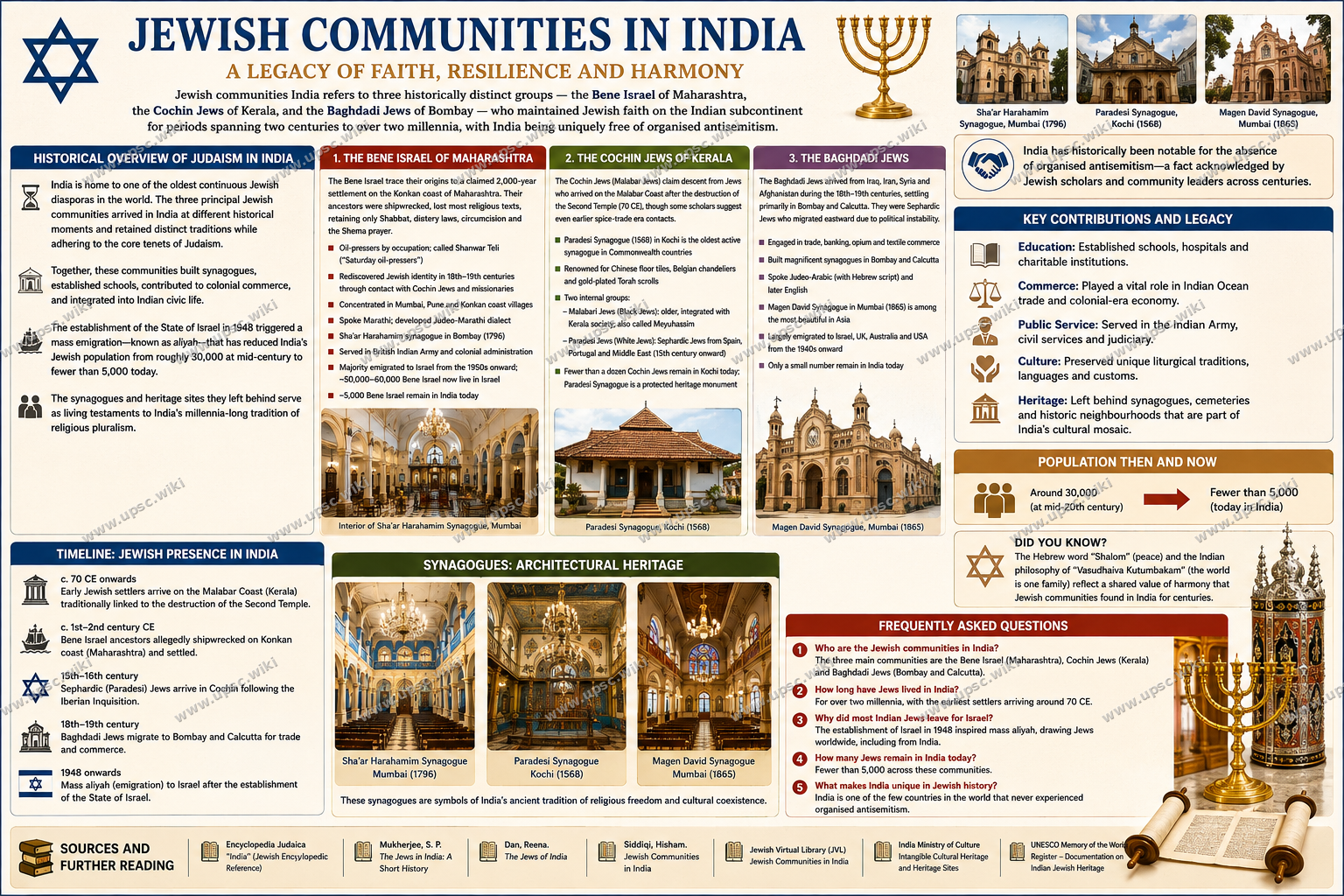
India's three Jewish communities — Bene Israel of Maharashtra, Cochin Jews of Kerala, and Baghdadi Jews of Bombay — shaped the subcontinent's religious history through ancient migrations, unique synagogues, and a mass post-1948 aliyah that brought their communities near disappearance.
Jewish communities India refers to three historically distinct groups — the Bene Israel of Maharashtra, the Cochin Jews of Kerala, and the Baghdadi Jews of Bombay — who maintained Jewish faith on the Indian subcontinent for periods spanning two centuries to over two millennia, with India being uniquely free of organised antisemitism.
Historical Overview of Judaism in India
India is home to one of the oldest continuous Jewish diasporas in the world. Unlike most other countries, India has historically been notable for the absence of organised antisemitism — a fact acknowledged by Jewish scholars and community leaders across centuries. The three principal Jewish communities arrived in India at different historical moments and retained distinct traditions, liturgical practices, and social identities while adhering to the core tenets of Judaism.
Together, these communities built synagogues, established schools, contributed to colonial commerce, and integrated into Indian civic life. However, the establishment of the State of Israel in 1948 triggered a mass emigration — known as aliyah — that has reduced India's Jewish population from roughly 30,000 at mid-century to fewer than 5,000 today. The synagogues and heritage sites they left behind serve as living testaments to India's millennia-long tradition of religious pluralism.
Who Were the Bene Israel of Maharashtra?
The Bene Israel are the largest and oldest of India's Jewish communities. They trace their origins to a claimed 2,000-year settlement on the Konkan coast of Maharashtra, particularly in villages around Alibag and Raigad district. According to community tradition, their ancestors were shipwrecked on the Konkan coast and lost most of their religious texts, retaining only the Shabbat observance, dietary laws, circumcision, and recitation of the Shema prayer.
For centuries, the Bene Israel worked primarily as oil-pressers, earning the Marathi name Shanwar Teli — meaning "Saturday oil-pressers" — because they refrained from work on Saturdays in observance of the Jewish Sabbath. They were largely isolated from mainstream Jewish practice until the 18th and 19th centuries, when contact with Cochin Jews and later with colonial-era Christian missionaries helped them rediscover and formalise their Jewish identity. Missionaries, while seeking converts, inadvertently introduced the Bene Israel to the full Hebrew Bible and broader Jewish law.
- Concentrated in Maharashtra, especially Mumbai, Pune, and the Konkan coast villages
- Largest Jewish community in India; approximately 5,000 remain in India today
- Spoke Marathi as their mother tongue and developed Judeo-Marathi as a community dialect
- Established the Sha'ar Harahamim synagogue in Bombay in 1796, among the earliest in the city
- Served in significant numbers in the British Indian Army and colonial civil administration
- Majority emigrated to Israel from the 1950s onward; an estimated 50,000 to 60,000 Bene Israel now live in Israel
Who Were the Cochin Jews of Kerala?
The Cochin Jews — also called Malabar Jews — are among the most historically documented Jewish communities in Asia. They traditionally claim descent from Jews who arrived on the Malabar Coast of Kerala following the destruction of the Second Temple in Jerusalem by the Romans in 70 CE, though some scholars suggest even earlier settlement linked to ancient spice-trade contacts between Kerala and the Levant.
The most celebrated landmark of the Cochin Jewish community is the Paradesi Synagogue, built in 1568 in the Mattancherry neighbourhood of Kochi. It is considered the oldest active synagogue in Commonwealth countries and is renowned for its hand-painted Chinese floor tiles (gifted in the 18th century), Belgian glass chandeliers, and gold-plated Torah scrolls. The word Paradesi means "foreigner" in Malayalam and refers to the later-arriving Sephardic Jews who built it.
The Cochin Jewish community was internally divided between two groups:
- Malabari Jews (Black Jews): The older, more numerous group who had integrated with local Kerala society over centuries. They were darker-complexioned and are also known as Meyuhassim (people of lineage). They had their own synagogues distinct from the Paradesi Synagogue.
- Paradesi Jews (White Jews): Sephardic Jews who arrived from Spain, Portugal, and the Middle East from the 15th century onward, particularly following the Iberian Inquisition. They were lighter-complexioned and maintained stricter social separation from the Malabari Jews.
This internal division — which affected synagogue seating and social interaction — reflected caste-like hierarchies absorbed from the surrounding Indian society. By the 20th century the two groups had largely reconciled, but the community had dwindled dramatically. Today fewer than a dozen Cochin Jews remain in Kochi; the Paradesi Synagogue is maintained as a heritage monument and receives thousands of visitors annually.
Who Were the Baghdadi Jews?
The Baghdadi Jews arrived in India from Iraq, Iran, Syria, and Afghanistan during the 18th and 19th centuries, settling primarily in Bombay (Mumbai) and Calcutta (Kolkata). They were Sephardic Jews — descended from the Jewish communities of medieval Iberia — who had migrated eastward following political instability in the Ottoman Empire and Mesopotamia.
The most prominent Baghdadi Jewish family in India was the Sassoon family, founded by David Sassoon (1792 to 1864), who arrived in Bombay from Baghdad around 1832. The Sassoons built a commercial empire spanning the cotton trade, opium (under the colonial East India trade network), banking, and real estate. They were also major philanthropists, funding hospitals, schools, and libraries across Bombay — including the David Sassoon Library (1847) and Sassoon Docks. Their architecture blended Victorian, Indo-Saracenic, and Jewish motifs.
Baghdadi Jews were culturally distinct from both the Bene Israel and the Cochin Jews. They spoke Judeo-Arabic (Baghdadi Judeo-Arabic), maintained Sephardic liturgical traditions, and — particularly among the wealthy elite — identified more closely with British colonial culture than with Indian society. Landmarks such as the Magen David Synagogue (Mumbai, 1861) and the Keneseth Eliyahoo Synagogue (Mumbai, 1884) stand as architectural reminders of this community's prosperity and civic contribution.
How Did Emigration After 1948 Transform These Communities?
The creation of the State of Israel in May 1948 opened the path of aliyah — return to the Jewish homeland — for diaspora communities worldwide. For India's Jewish communities, who had lived with relative security but often in social and religious isolation, aliyah represented both a spiritual calling and a practical opportunity.
Tens of thousands of Indian Jews emigrated to Israel during the 1950s, 1960s, and 1970s. The term Operation Magic Carpet (also known as Operation On Wings of Eagles, 1949 to 1950) technically refers to the airlift of Yemeni Jews to Israel, but the broader pattern of organised aliyah affected Indian communities in comparable ways. Today, an estimated 70,000 to 80,000 people of Indian-Jewish origin live in Israel, where they form a recognised community and have established cultural organisations preserving Marathi, Malayalam, and Judeo-Arabic heritage.
The consequence for India has been near-disappearance of living communities. Synagogues that once served hundreds of families now hold services only on High Holidays, if at all. Many synagogues have been converted to heritage museums or are maintained by non-Jewish caretakers employed by local trusts. The remaining Jews in India are concentrated mainly in Mumbai, with small numbers in Pune, Thane, and Ahmedabad.
Frequently Asked Questions
What are the three main Jewish communities in India?
The three main Jewish communities in India are the Bene Israel of Maharashtra, the Cochin Jews (Malabar Jews) of Kerala, and the Baghdadi Jews of Bombay and Calcutta. Each arrived at different historical periods and maintained distinct cultural, linguistic, and liturgical traditions, while all adhering to core Jewish practice.
What is the significance of the Paradesi Synagogue in Kochi?
The Paradesi Synagogue, built in 1568 in Mattancherry, Kochi, is the oldest active synagogue in Commonwealth countries. Built by Sephardic (Paradesi) Jews, it is famous for its hand-painted Chinese floor tiles, Belgian glass chandeliers, and gold-plated Torah scrolls. Today it is a major heritage site visited by thousands of tourists each year and is protected under Indian heritage conservation laws.
Who were the Bene Israel and why are they called Shanwar Teli?
The Bene Israel are the largest Jewish community in India, with a claimed 2,000-year history on the Konkan coast of Maharashtra. They earned the Marathi name Shanwar Teli — meaning "Saturday oil-pressers" — because they worked as oil-pressers but refused to work on Saturdays in observance of the Jewish Sabbath. Approximately 5,000 Bene Israel still reside in India, with the majority having emigrated to Israel after 1948.
What role did the Sassoon family play in Indian Jewish history?
The Sassoon family, led by David Sassoon who arrived in Bombay from Baghdad around 1832, became the most prominent Baghdadi Jewish family in India. They built a commercial empire in cotton trading and banking and were major philanthropists who funded hospitals, libraries, and schools in Bombay. The David Sassoon Library and the Sassoon Docks are enduring landmarks of their legacy in Mumbai.
Why did Jewish communities leave India in large numbers after 1948?
The establishment of the State of Israel in 1948 opened the path of aliyah — immigration to the Jewish homeland — for diaspora communities. Indian Jews emigrated in large numbers during the 1950s to 1970s, drawn by the prospect of living in a Jewish state and the opportunity to rejoin a larger Jewish world. This mass emigration reduced India's Jewish population from approximately 30,000 to fewer than 5,000 today, with an estimated 70,000 to 80,000 people of Indian-Jewish origin now living in Israel.
Sources and Further Reading
This article draws on IGNOU BHIC-131 (History of India: Earliest Times to the 8th Century CE) for the broader context of ancient communities and foreign contacts with the Indian subcontinent. It should be noted that IGNOU BHIC-131 coverage of Jewish communities specifically is limited; the topic of Judaism in India falls more directly within IGNOU's BHIC-134 (History of India: c. 1707 to 1950) for the colonial-era Baghdadi Jews, and within the Art and Culture component of UPSC Civil Services preparation broadly. The following academic sources provide comprehensive coverage:
- Isenberg, Shirley Berry. India's Bene Israel: A Comprehensive Inquiry and Sourcebook. Judah L. Magnes Museum, Berkeley, 1988.
- Katz, Nathan, and Ellen S. Goldberg. The Last Jews of Cochin: Jewish Identity in Hindu India. University of South Carolina Press, 1993.
- Roland, Joan G. Jews in British India: Identity in a Colonial Era. Brandeis University Press / University Press of New England, 1989.
- Weil, Shalva. "Bene Israel" and "Cochin Jews" entries in Encyclopaedia Judaica, 2nd edition. Macmillan Reference USA, 2007.
- Musleah, Rahel. On the Banks of the Ganga: The Sojourn of Jews in Calcutta. Christopher Publishing House, 1975.
- Archaeological Survey of India. Heritage documentation of the Paradesi Synagogue, Mattancherry, Kochi.
- Ministry of Culture, Government of India. Jewish heritage sites — official documentation and conservation reports.