
Archaeology as Historical Source
Understand how archaeology serves as a primary historical source for reconstructing ancient India — covering ASI, excavation types, major sites, and limitations for UPSC History preparation.
Archaeology as a historical source refers to the systematic study of human past through material remains — tools, pottery, structures, and organic matter — that survive in the ground. It is indispensable for reconstructing pre-literate societies and validating or challenging textual narratives of ancient India.
Why Does Archaeology Matter for Indian History?
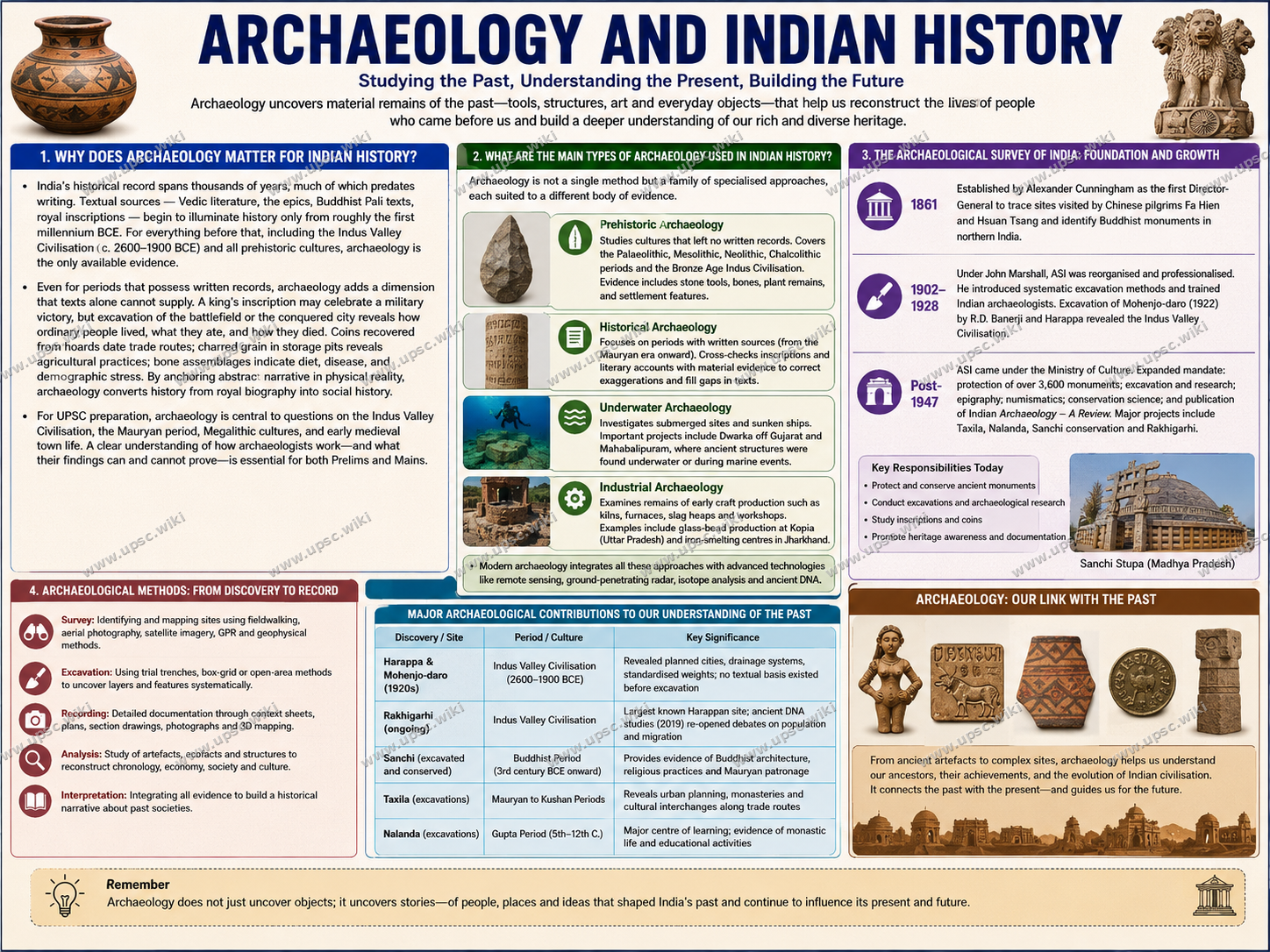
India's historical record spans thousands of years, much of which predates writing. Textual sources — Vedic literature, the epics, Buddhist Pali texts, royal inscriptions — begin to illuminate history only from roughly the first millennium BCE. For everything before that, including the Indus Valley Civilisation (c. 2600–1900 BCE) and all prehistoric cultures, archaeology is the only available evidence.
Even for periods that possess written records, archaeology adds a dimension that texts alone cannot supply. A king's inscription may celebrate a military victory, but excavation of the battlefield or the conquered city reveals how ordinary people lived, what they ate, and how they died. Coins recovered from hoards date trade routes; charred grain in storage pits reveals agricultural practices; bone assemblages indicate diet, disease, and demographic stress. By anchoring abstract narrative in physical reality, archaeology converts history from royal biography into social history.
For UPSC preparation, archaeology is central to questions on the Indus Valley Civilisation, the Mauryan period, Megalithic cultures, and early medieval town life. A clear understanding of how archaeologists work — and what their findings can and cannot prove — is therefore essential for both Prelims and Mains.
What Are the Main Types of Archaeology Used in Indian History?
Archaeology is not a single method but a family of specialised approaches, each suited to a different body of evidence:
- Prehistoric archaeology — Studies cultures that left no written records. In India this covers the Palaeolithic (Old Stone Age), Mesolithic, Neolithic, and Chalcolithic periods, as well as the Bronze Age Indus Civilisation. Evidence consists entirely of stone tools, animal bones, plant remains, and settlement features.
- Historical archaeology — Focuses on periods for which written sources also exist (roughly from the Mauryan era onward). It cross-checks inscriptions and literary accounts against the material record, correcting exaggeration and filling silences in texts.
- Underwater archaeology — Investigates submerged coastal sites and sunken ships. India's most celebrated underwater project has been at Dwarka off the Gujarat coast, where structures tentatively linked to the legendary Dwaraka have been surveyed, and at Mahabalipuram, where a tsunami in 2004 briefly exposed ancient carved blocks offshore.
- Industrial archaeology — Examines the physical remains of early craft production: kilns, furnaces, slag heaps, and workshop floors. Sites like Kopia in Uttar Pradesh (glass-bead manufacture) and iron-smelting centres in Jharkhand illustrate how specialised production organised ancient economies.
In practice, modern Indian archaeology draws on all four approaches, increasingly supplemented by remote sensing, ground-penetrating radar, isotope analysis, and ancient DNA studies.
The Archaeological Survey of India: Foundation and Growth
The institutional backbone of Indian archaeology is the Archaeological Survey of India (ASI), established in 1861 by Alexander Cunningham, who served as its first Director-General. Cunningham's primary concern was to trace the sites visited by the Chinese pilgrims Fa Hien and Hsuan Tsang, thereby identifying Buddhist monuments described in their seventh-century accounts. His surveys produced the foundational corpus of Buddhist and early Hindu sites across northern India.
The ASI was reorganised and professionalised under John Marshall, who served as Director-General from 1902 to 1928. Marshall introduced systematic excavation methods, created a cadre of trained Indian archaeologists, and oversaw the most consequential discovery in South Asian history: the excavation of Mohenjo-daro (by R.D. Banerji in 1922) and Harappa, which revealed the existence of the Indus Valley Civilisation — a Bronze Age urban culture entirely unknown to earlier scholarship.
After independence, the ASI was brought under the Ministry of Culture. Its post-1947 mandate expanded to include: protection of over 3,600 centrally protected monuments; excavation and research; epigraphy (the study of inscriptions); numismatics (coins); science branches for conservation; and the compilation of the Indian Archaeology — A Review annual publication. Major post-independence excavations include Taxila, Nalanda, Sanchi conservation, and the ongoing exploration of Rakhigarhi (the largest known Harappan site).
Major Archaeological Contributions to Our Understanding of the Past
The following table summarises landmark discoveries and their historical significance:
| Discovery / Site | Period / Culture | Key Significance |
|---|---|---|
| Harappa & Mohenjo-daro (1920s) | Indus Valley Civilisation (2600–1900 BCE) | Revealed planned cities, drainage systems, and standardised weights — no textual basis existed before excavation |
| Rakhigarhi (ongoing) | Indus Valley Civilisation | Largest known Harappan site; ancient DNA studies (2019) re-opened debates on Aryan migration and population continuity |
| Sanchi Stupa | Mauryan–Shunga period (3rd–1st c. BCE) | Architectural evidence for the spread of Buddhism and royal patronage; inscriptions name merchant donors |
| Iron Age megalithic sites (Tamil Nadu, Kerala) | c. 1200–300 BCE | Black-and-red ware, iron tools, and burial patterns predate textual Sangam literature |
| Taxila | Achaemenid, Mauryan, Indo-Greek, Kushan | Successive city layers document the political succession of northwest India from the 6th c. BCE onward |
| Nalanda excavations | Gupta and post-Gupta (5th–12th c. CE) | Structural evidence for the greatest monastic university of ancient Asia, supplementing Hsuan Tsang's account |
How Does Archaeology Complement Other Historical Sources?
Archaeology does not replace literary or epigraphic sources; it enters into dialogue with them. A three-way conversation between texts, inscriptions, and material remains produces a richer and more reliable history than any single source alone.
Consider the Mauryan period. The Arthashastra describes the layout of a fortified capital; excavation at Pataliputra (modern Patna) has uncovered massive wooden palisades, column halls, and moats that corroborate — and occasionally correct — the text. Similarly, Ashoka's rock edicts proclaim the spread of dhamma; the distribution of excavated Buddhist sites, including stupas and monasteries far beyond the edicts' locations, shows the actual geographic reach of Mauryan religious culture. Coins bearing royal portraits and dynastic symbols fill gaps in regnal chronology that texts leave ambiguous.
In the prehistoric period the relationship is even more fundamental: there is no text to complement. The reconstruction of Harappan urban planning, trade networks (evidenced by lapis lazuli from Afghanistan and carnelian beads distributed across Mesopotamia), and the still-undeciphered Indus script rests entirely on material evidence.
What Are the Limitations of Archaeology as a Historical Source?
Despite its power, archaeology has significant constraints that historians must acknowledge:
- Fragmentary survival — Only a tiny fraction of past objects and structures survive. Organic materials (wood, cloth, leather, papyrus) almost never endure in the Indian subcontinent's humid climate. What remains is biased toward durable materials: stone, fired clay, and metal.
- Sampling bias — Excavation is expensive and time-consuming. Archaeologists tend to dig large, visible mounds (tells) in accessible locations. Small villages, pastoral camps, and forest-dwelling communities are chronically under-represented in the record.
- Interpretation subjectivity — Material objects do not speak for themselves. A burnt layer can result from conquest, accidental fire, or ritual. The same pottery style may indicate a migrating people or a trade good adopted by locals. Interpretation always involves inference, and different scholars frequently reach different conclusions from the same evidence.
- Destruction of sites — Urban expansion, agriculture, dam construction, and looting destroy irreplaceable sites every year. The submergence of hundreds of sites under the Sardar Sarovar reservoir, and ongoing illegal antiquities trafficking, are acute problems for Indian archaeology.
- Dating uncertainties — Radiocarbon dating, thermoluminescence, and dendrochronology all carry margins of error. For events separated by decades rather than centuries, archaeological dating is rarely precise enough to settle historical disputes.
- Funding and institutional gaps — The ASI's excavation capacity is limited relative to India's vast archaeological potential. Many known sites await systematic excavation; others are only partially published, making independent scholarly evaluation difficult.
Frequently Asked Questions
What is the role of archaeology in reconstructing Indian history?
Archaeology provides material evidence — tools, pottery, buildings, coins — that supplements or corrects written sources. It is the primary source for pre-literate periods like the Indus Valley Civilization and prehistoric cultures where no textual records exist.
Who founded the Archaeological Survey of India?
Alexander Cunningham founded the Archaeological Survey of India in 1861. John Marshall later transformed it into a professional body that led major excavations, including those at Mohenjo-daro and Harappa in the 1920s.
What are the main types of archaeology relevant to Indian history?
The main types are prehistoric archaeology (studying pre-literate cultures), historical archaeology (correlating material and textual records), underwater archaeology (submerged sites like Dwarka), and industrial archaeology (early craft and manufacturing evidence).
What are the limitations of archaeology as a historical source?
Key limitations include the fragmentary nature of the surviving record, challenges in interpreting context without texts, destruction of sites by urban development, and potential for subjective interpretation of material remains.
How is archaeology relevant for UPSC examination?
UPSC History questions frequently draw on archaeological evidence for the Indus Valley Civilization, Mauryan period, and early medieval sites. Understanding the role of ASI, major sites, and dating methods is essential for both Prelims and Mains.
Sources and Further Reading
This article draws on IGNOU's BHIC-131 (History of India from Earliest Times to 300 BCE) and BHIC-132 (History of India, 300 BCE–1206 CE) course materials, which provide systematic coverage of archaeological methods and discoveries in Indian history. Additional references: A.L. Basham, The Wonder That Was India; D.K. Chakrabarti, The Oxford Companion to Indian Archaeology; Archaeological Survey of India official publications.