
Literary Sources — Ancient India
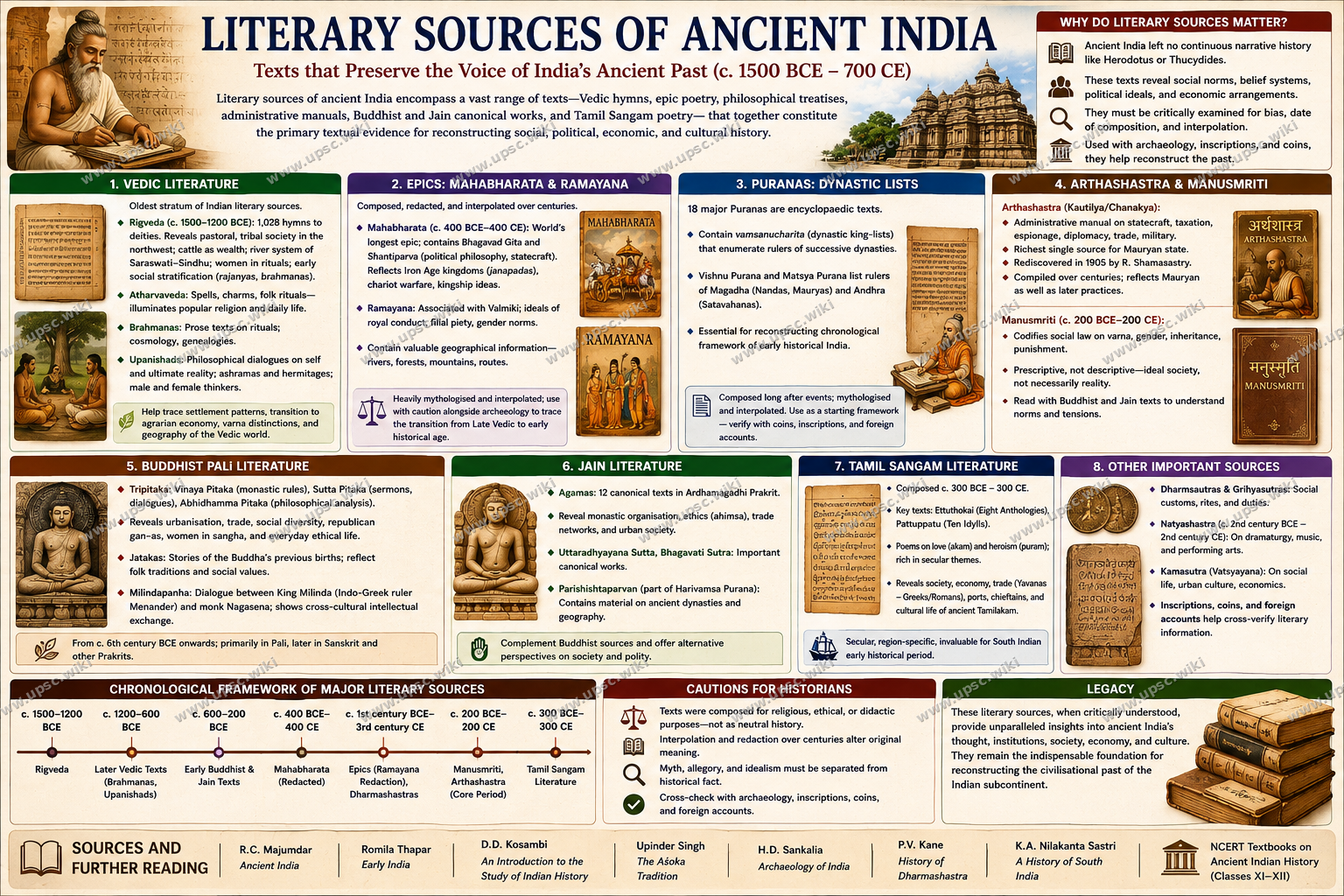
Literary sources of ancient India encompass a vast range of texts — Vedic hymns, epic poetry, philosophical treatises, administrative manuals, Buddhist and Jain canonical works, and Tamil Sangam poetr...
Literary sources of ancient India encompass a vast range of texts — Vedic hymns, epic poetry, philosophical treatises, administrative manuals, Buddhist and Jain canonical works, and Tamil Sangam poetry — that together constitute the primary textual evidence for reconstructing social, political, economic, and cultural history from roughly 1500 BCE to 700 CE.
Why Do Literary Sources Matter for Reconstructing Ancient Indian History?
Ancient India left no continuous narrative history in the manner of Herodotus or Thucydides. Instead, historians must work across a vast, heterogeneous body of literature — religious, legal, philosophical, and poetic — extracting historical information embedded within texts composed for entirely different purposes. Literary sources must always be read alongside archaeological evidence, epigraphy, and numismatics: they reveal social norms, belief systems, political ideals, and economic arrangements, but they require critical interrogation for bias, date of composition, and interpolation.
Vedic Literature
The Vedic corpus is the oldest stratum of Indian literary sources. The Rigveda (c. 1500–1200 BCE), composed in archaic Sanskrit, is a collection of 1,028 hymns addressed to deities. Though primarily religious, it reveals a pastoral, tribal society in the northwest of the subcontinent: cattle were the primary measure of wealth, the river system of the Saraswati-Sindhu basin provided the geographic frame, and women participated in religious rituals and intellectual debate. Tribal chiefs (rajanyas) and a priestly class (brahmanas) are already distinguishable, marking early social stratification.
The Atharvaveda reflects a different social register — spells, charms, and folk rituals — that illuminate popular religion, social anxieties, and everyday life beyond the elite. The Brahmanas are prose texts elaborating on ritual procedure; they also contain cosmological narratives and genealogies. The Upanishads, the culmination of Vedic thought, record philosophical dialogues on the nature of the self and ultimate reality, featuring both male and female thinkers and revealing the social world of ashrams and forest hermitages. Together, the Vedic texts allow historians to trace settlement patterns, the transition from a purely pastoral to an agrarian economy, the early elaboration of varna distinctions, and the geography of the Vedic world.
Epics: Mahabharata and Ramayana
The two great epics represent a different category of literary source — composed, redacted, and interpolated over centuries. The Mahabharata, in its current form dated roughly 400 BCE to 400 CE, is the world's longest epic. It contains the Bhagavad Gita and, in the Shantiparva, extended discourses on political philosophy and statecraft. The narrative reflects an Iron Age society of kingdoms (janapadas) in the Ganga plain, chariot warfare, and emergent ideas of kingship. The Ramayana, associated with Valmiki, presents ideals of royal conduct, filial piety, and gender norms. Both epics contain geographical information — rivers, forests, mountains, and routes — that is invaluable for historical geography.
Historians use the epics cautiously: they are heavily mythologised, the core story is overlaid with later didactic and theological material, and the date of any given passage is uncertain. Used alongside archaeology, however, they help reconstruct the transition from the Late Vedic period to the early historical age.
Puranas: Dynastic Lists and Their Limitations
The 18 major Puranas are encyclopaedic texts covering cosmology, genealogy, mythology, and dharma. Their most important historical feature is the vamsanucharita — dynastic king-lists that enumerate rulers of successive dynasties. The Vishnu Purana and Matsya Purana list rulers of Magadha (including the Nandas and Mauryas) and the Andhra (Satavahana) dynasty. Without Puranic king-lists, the chronological framework of early historical India would be far harder to reconstruct.
However, Puranas were composed long after the events described; they are mythologised and subject to interpolation. Historians treat Puranic dynastic information as a starting framework that must be verified against coins, inscriptions, and foreign accounts.
Arthashastra and Manusmriti: Administrative and Legal Texts
The Arthashastra, attributed to Kautilya (Chanakya), minister to Chandragupta Maurya, is an administrative manual covering statecraft, taxation, espionage, diplomacy, trade regulation, and military organisation. It is the richest single text source for the Mauryan state. The text was rediscovered in 1905 by R. Shamasastry at the Mysore Oriental Library, transforming historians' understanding of Mauryan governance. The existing text was compiled over several centuries, so it reflects not only Mauryan but also later practices; critical editions identify chronological layers.
The Manusmriti (c. 200 BCE–200 CE) is the most authoritative of the Dharmashastra texts, codifying social law governing varna, gender relations, inheritance, and punishment. It is a prescriptive, not a descriptive, text: it tells us what the brahmanical tradition wished society to look like, not necessarily what everyday social reality was. Used alongside Buddhist and Jain texts, it helps reconstruct norms and the tensions surrounding them.
How Do Buddhist Pali Texts Illuminate Mauryan India?
The Buddhist Pali canon — the Tripitaka — is divided into Vinaya (monastic discipline), Sutta (discourses of the Buddha), and Abhidhamma (philosophical analysis). Beyond doctrine, these texts are rich in narrative detail about contemporary society. The Jataka tales — 547 stories of the Buddha's past lives — are set in the world of early historical India and describe merchants, artisans, kings, courtesans, and ordinary people in remarkable social and economic detail: trade routes, guild systems, city life, and rural villages of the Mauryan period.
The Sri Lankan chronicles Dipavamsa and Mahavamsa are essential sources for the reign of Ashoka — the spread of Buddhism, the Third Buddhist Council, and the mission to Sri Lanka. Without them, Ashoka's biography would rest almost entirely on his own edicts.
Sangam Tamil Literature
The Sangam corpus — eight anthologies (Ettuttokai) and ten idylls (Pattuppattu), composed roughly between the 3rd century BCE and the 3rd century CE — is the primary literary source for the history of peninsular India in the early centuries of the Common Era. It describes the three ruling lineages — Chera, Chola, and Pandya — their courts, warfare, tribute, and patronage networks. Ports such as Puhar (Kaveripattinam) and Korkai appear in the texts alongside references to Roman wine, lamps, and gold, providing literary corroboration for Indo-Roman trade attested in archaeology and foreign accounts.
Comparative Overview: Key Literary Sources
| Text | Type | Period | Historical Value | Limitations |
|---|---|---|---|---|
| Rigveda | Religious hymns | c. 1500–1200 BCE | Tribal society, geography, economy, early varna | Religious, not historical; oral transmission |
| Mahabharata | Epic | 400 BCE–400 CE | Political thought, Iron Age society, geography | Heavily mythologised; multi-century redaction |
| Vishnu / Matsya Purana | Encyclopaedic | Compiled 4th–10th c. CE | Dynastic king-lists for Magadha and Andhra | Composed long after events; interpolated |
| Arthashastra | Administrative manual | c. 4th c. BCE (compiled later) | Mauryan state: taxation, espionage, trade, law | Multi-layer text; not purely Mauryan |
| Manusmriti | Law code (Dharmashastra) | c. 200 BCE–200 CE | Brahmanical social norms, varna, gender, law | Prescriptive, not descriptive; elite bias |
| Jataka Tales | Buddhist narrative | Pali canon, c. 3rd c. BCE onward | Social, economic life in Mauryan period | Didactic frame; narrative embellishment |
| Mahavamsa / Dipavamsa | Buddhist chronicle | Compiled 4th–6th c. CE | Ashoka's reign, Third Council, Buddhist spread | Sri Lankan perspective; sectarian interests |
| Sangam literature | Tamil poetry | c. 3rd c. BCE–3rd c. CE | South Indian polity, society, Indo-Roman trade | Poetic conventions; dating uncertain |
Frequently Asked Questions
How are Vedic texts used as historical sources?
Vedic texts are used as historical sources by extracting information embedded in religious content: the Rigveda reveals a pastoral, tribal society in northwest India (c.1500–1200 BCE) with cattle as wealth and the Saraswati-Sindhu river system as geographic context. The Atharvaveda reveals popular beliefs and social anxieties. However, Vedic texts require careful contextualisation as they are primarily religious, not historical, documents.
What is the historical value of the Arthashastra?
The Arthashastra, attributed to Kautilya (Chanakya), is an administrative manual covering statecraft, taxation, diplomacy, espionage, trade, and law. It is the richest single text source for Mauryan governance. Rediscovered in 1905 by R. Shamasastry, it transformed understanding of the Mauryan state. However, since the existing text was compiled over centuries, it reflects not just Mauryan but also later practices.
Why are Puranas important yet limited as historical sources?
Puranas contain dynastic king-lists (vamsanucharita) that are essential for reconstructing succession of dynasties like the Nandas, Mauryas, Shungas, and Andhras. Without Puranic lists, Indian historical chronology would be far more obscure. However, they are limited because they were composed long after the events described, are heavily mythologised, and are subject to later interpolation — requiring corroboration from coins and inscriptions.
What do Jataka tales reveal about ancient Indian society?
The 547 Jataka tales — stories of the Buddha's previous lives — are set in the world of early historical India (5th–3rd century BCE) and provide vivid descriptions of social classes, occupations, trade, city life, and rural economy. They describe merchants, artisans, thieves, kings, and ordinary people, giving social and economic history a human texture that religious or administrative texts rarely provide.
How does Sangam literature serve as a historical source?
Sangam Tamil literature (eight anthologies and ten idylls, roughly 3rd century BCE–3rd century CE) describes the three chiefs — Chera, Chola, and Pandya — their courts, warfare, and society. It mentions ports like Puhar (Kaveripattinam) and trade with Rome (Roman wine and lamps). For the history of peninsular India and Indo-Roman trade, Sangam literature is an irreplaceable primary source.
Sources and Further Reading
This article draws on IGNOU's BHIC-131 (History of India from Earliest Times to 300 BCE) and BHIC-132 (History of India, 300 BCE–1206 CE) course materials, which cover literary sources systematically. Additional references: Romila Thapar, Early India: From the Origins to AD 1300; A.L. Basham, The Wonder That Was India; R. Shamasastry (trans.), Arthashastra of Kautilya.