
Colonialism — Theory and Practice in Indian History
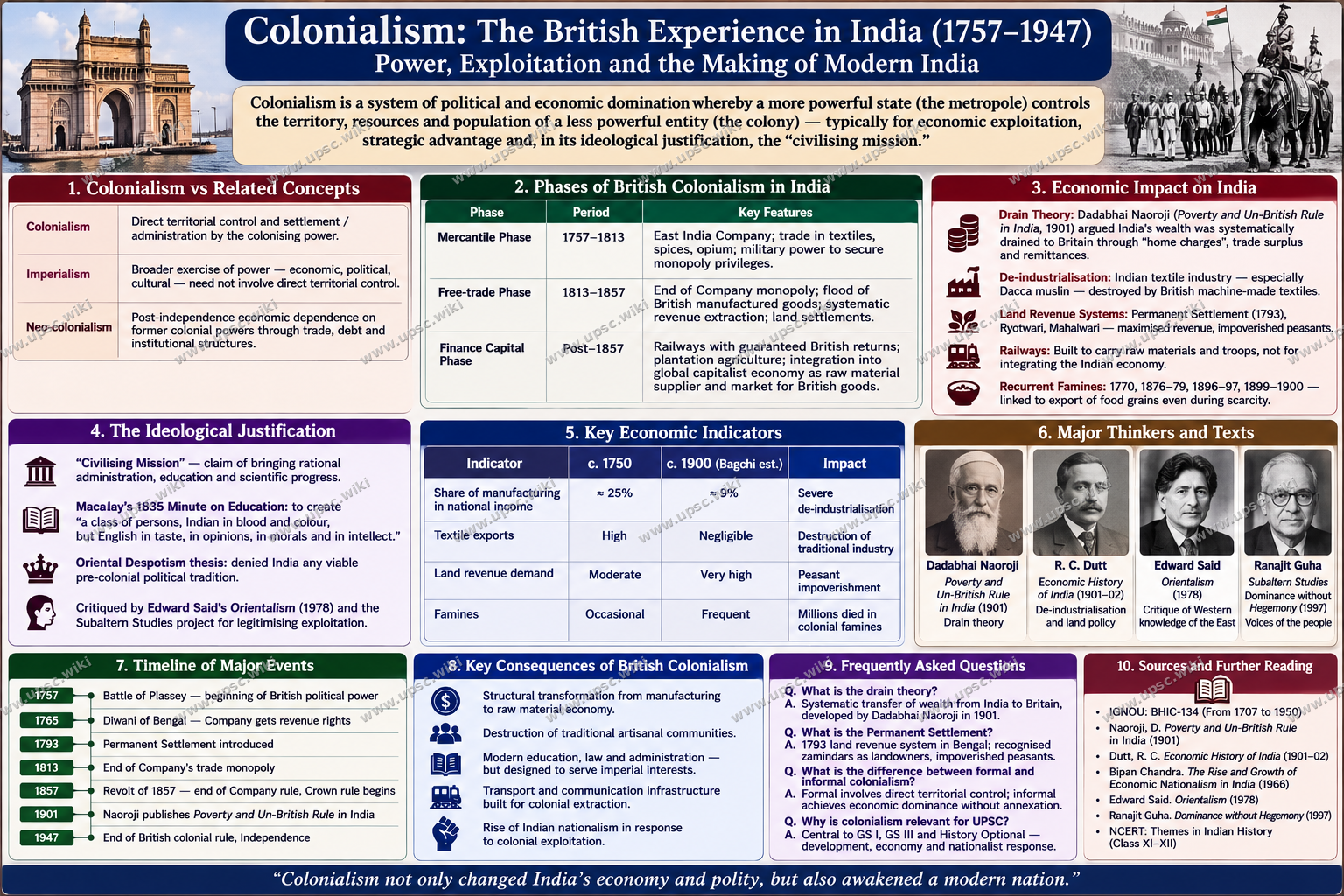
Colonialism is a system of political and economic domination whereby a more powerful state (the metropole) controls the territory, resources, and population of a less powerful entity (the colony), typ...
Colonialism is a system of political and economic domination whereby a more powerful state (the metropole) controls the territory, resources, and population of a less powerful entity (the colony), typically for economic exploitation, strategic advantage, and — in its ideological self-justification — the "civilising mission." British colonialism in India (1757–1947) is the most historically significant instance of modern colonialism for UPSC study.
What Is Colonialism and How Does It Differ from Related Concepts?
Political theorists distinguish colonialism from related concepts. Colonialism involves direct territorial control and settlement or administration by the colonising power. Imperialism is the broader exercise of power — economic, political, cultural — that need not involve direct territorial control. Neo-colonialism describes post-independence economic dependence on former colonial powers maintained through trade patterns, debt, and institutional structures.
In the Indian case, British colonialism evolved through distinct phases. The mercantile phase (1757–1813) was dominated by the East India Company, which traded in textiles, spices, and opium, using military power to secure monopoly privileges. The free-trade phase (1813–1857) saw the removal of Company monopolies, the flooding of Indian markets with British manufactured goods (especially cotton textiles), and the beginning of systematic revenue extraction through land settlements. The finance capital phase (post-1857) involved railway construction (financed by guaranteed returns to British investors paid from Indian revenue), plantation agriculture, and the integration of India into the global capitalist economy as a supplier of raw materials and a market for British manufactures.
How Did British Colonialism Affect India's Economy?
The economic impact of colonialism on India is the most debated question in Indian economic history. Dadabhai Naoroji's drain theory (articulated in Poverty and Un-British Rule in India, 1901) argued that India was systematically drained of its wealth through "home charges" (payments to Britain for administrative costs, interest on railway debt, and military expenses), trade surpluses appropriated without equivalent return, and the remittance of profits by British companies and officials.
De-industrialisation was another key consequence. India's traditional textile industry — particularly Dacca muslin — was destroyed by competition from machine-made British textiles, whose import duties were deliberately kept low. Indian artisans were reduced to agricultural labourers. R. C. Dutt's Economic History of India (1901–02) documented the structural transformation of India from a manufacturing to a raw material economy.
- Land revenue systems: Permanent Settlement (Bengal, 1793), Ryotwari (Bombay/Madras), and Mahalwari (North India) — each extracted maximum revenue while creating new property relations
- Railway as instrument of colonialism: Built to carry raw materials to ports and troops to trouble spots, not to integrate the Indian domestic economy
- Deindustrialisation: Share of manufacturing in national income fell from c. 25% in 1750 to approximately 9% by 1900 (Bagchi estimate)
- Recurrent famines: 1770 (Great Bengal Famine), 1876–79, 1896–97, 1899–1900 — linked to export of food grains even during scarcity
What Was the Ideological Justification for British Colonialism?
British colonialism justified itself through the "civilising mission" — the claim that Britain was bringing rational administration, rule of law, education, railways, and scientific progress to societies incapable of self-governance. Macaulay's 1835 Minute on Education expressed this most explicitly: the goal was to create "a class of persons, Indian in blood and colour, but English in taste, in opinions, in morals, and in intellect." The Oriental Despotism thesis denied India any viable pre-colonial political tradition.
Nationalist historians — and later postcolonial theorists like Edward Said (Orientalism, 1978) and Ranajit Guha (Subaltern Studies) — exposed this discourse as ideologically constructed to legitimise exploitation. Said's concept of "Orientalism" — the West's constructed, essentialised representation of the "East" as exotic, irrational, and inferior — became a foundational framework for postcolonial historiography. The Subaltern Studies project recovered the voices of peasants, workers, women, and tribals suppressed in elite nationalist and colonial historiography.
Frequently Asked Questions
What is the drain theory and who developed it?
The drain theory holds that British colonialism systematically transferred wealth from India to Britain through home charges (administrative and military costs paid from Indian revenue), guaranteed returns on railway investment, and the structural trade surplus that India maintained with Britain without receiving equivalent goods in return. Dadabhai Naoroji developed the theory in his 1901 work Poverty and Un-British Rule in India. It provided the first systematic economic critique of colonialism and became central to nationalist economic thought.
How did the Permanent Settlement of 1793 shape colonial India's agrarian structure?
The Permanent Settlement (1793), introduced by Lord Cornwallis in Bengal and Bihar, fixed land revenue payments from zamindars permanently and recognised them as owners of the land. This created a class of absentee landlords with little incentive to invest in agriculture, while cultivators lost customary rights and became tenant farmers. The Settlement extracted maximum immediate revenue but impoverished peasants and stagnated agricultural productivity — creating structural problems that shaped colonial agrarian debates for over a century.
What is the difference between formal and informal colonialism?
Formal colonialism involves direct territorial annexation and administration by the colonial power — British India, French Indo-China, Dutch East Indies. Informal colonialism achieves economic dominance without formal political control — Britain's relationship with Latin America in the nineteenth century (trading privileges, debt obligations, gunboat diplomacy) is the classic example. John Gallagher and Ronald Robinson's 1953 article "The Imperialism of Free Trade" argued that Britain preferred informal control where possible, formal colonialism where necessary.
What is postcolonial theory and how does it apply to Indian history?
Postcolonial theory examines the cultural, political, and psychological legacies of colonialism. Key contributions relevant to India include Edward Said's Orientalism (the construction of India as exotic "Other"), Frantz Fanon's analysis of colonial psychology, and the Subaltern Studies project (Ranajit Guha, Dipesh Chakrabarty, Partha Chatterjee) that recovered voices suppressed in elite nationalist historiography. Partha Chatterjee's The Nation and Its Fragments (1993) argued that nationalism replicated colonial categories even as it resisted colonial rule.
How is colonialism relevant for UPSC?
Colonialism is central to GS Paper I (modern Indian history, post-independence development), GS Paper III (Indian economy), and History Optional Paper II (economic and social impact of British rule). UPSC questions have addressed the drain theory, Naoroji's contribution, de-industrialisation, the Permanent Settlement, and the ideological dimensions of colonial rule. The theme also connects to Essay Paper questions on development, underdevelopment, and the colonial legacy.
Sources and Further Reading
This article draws on IGNOU's BA History curriculum, particularly BHIC-134 (From 1707 to 1950), which covers colonialism's economic and political impact on India in comprehensive detail. The foundational texts include Dadabhai Naoroji's Poverty and Un-British Rule in India (1901), R. C. Dutt's Economic History of India (1901–02), and Bipan Chandra's The Rise and Growth of Economic Nationalism in India (People's Publishing House, 1966). For theory, see Edward Said's Orientalism (Pantheon, 1978) and Ranajit Guha's Dominance without Hegemony (Harvard, 1997). Mike Davis's Late Victorian Holocausts (Verso, 2001) provides a powerful account of the colonial-famine nexus.