
Industrial Revolution: Origins in Britain, Spread to Europe and the Global Economic Impact
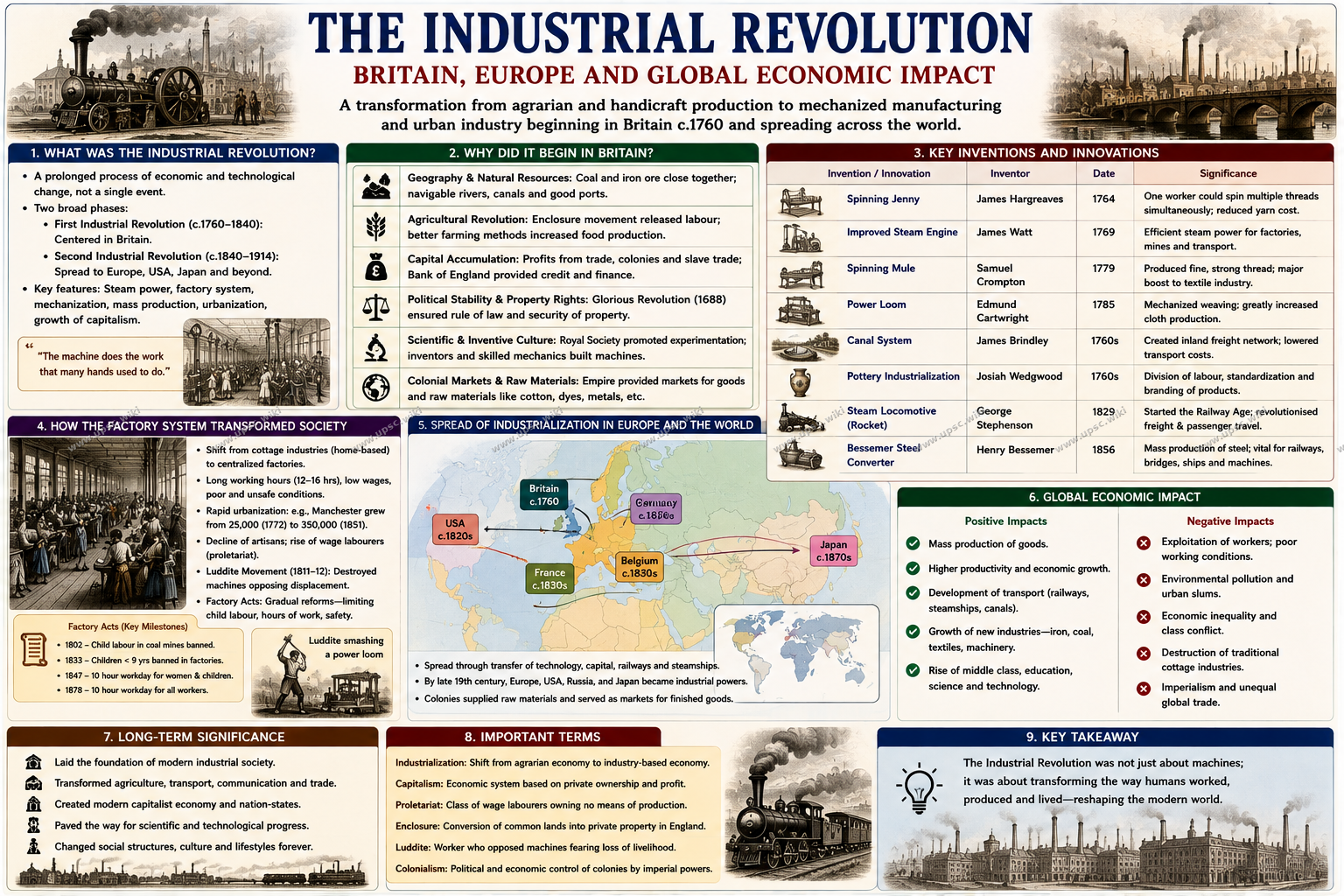
A comprehensive study note on the Industrial Revolution — its origins in Britain, causes, key inventions, spread across Europe and North America, and its devastating economic impact on colonial India.
The Industrial Revolution Britain Europe global economic impact refers to the sweeping transformation of economies from agrarian and handicraft production to mechanized manufacturing and urban industry, beginning in Britain around 1760 and spreading across Europe and the world through the nineteenth century, fundamentally reshaping societies, labor systems, and international trade.
What Was the Industrial Revolution and When Did It Begin?
The Industrial Revolution was not a single event but a prolonged process of economic and technological change. Historians typically identify two broad phases: the First Industrial Revolution (c. 1760–1840), centered almost entirely in Britain, and the Second Industrial Revolution (c. 1840–1914), during which industrial capitalism expanded across France, Belgium, Germany, the United States, and eventually Japan. The transition involved replacing human and animal power with steam power, centralizing production in factories, and the mass movement of populations from rural areas into rapidly growing industrial cities.
Why Did the Industrial Revolution Begin in Britain?
Britain's emergence as the world's first industrial nation was the product of several intersecting advantages:
- Geography and Natural Resources: Britain's island geography meant that no point was far from navigable water. Coal and iron ore deposits lay close together in regions like South Wales, Yorkshire, and the Midlands, dramatically reducing transport costs. Navigable rivers and, later, a network of canals connected mines to ports and markets without costly overland hauling.
- The Agricultural Revolution: The enclosure movement dispossessed thousands of small farmers, driving surplus labor into towns and factories. Scientific farming methods — crop rotation, selective livestock breeding — increased food output, supporting a larger non-agricultural workforce.
- Capital Accumulation: Profits from colonial trade, the Atlantic slave trade, and financial institutions such as the Bank of England (founded 1694) provided the investment capital needed to build factories and infrastructure. The City of London became the world's foremost money market.
- Political Stability and Property Rights: The Glorious Revolution of 1688 established parliamentary supremacy and secured property rights, encouraging entrepreneurs to invest without fear of arbitrary royal expropriation. A stable legal framework underpinned enforceable commercial contracts.
- Scientific and Inventive Culture: The Royal Society (founded 1660) fostered practical experimentation. Inventors like James Watt worked in close partnership with manufacturers, and Britain's deep craft traditions produced a large pool of skilled mechanics capable of building and maintaining complex machinery.
- Colonial Markets: The British Empire provided captive markets for manufactured goods and reliable sources of raw materials — cotton from India and America, for instance — giving British manufacturers a built-in competitive advantage unavailable to continental rivals.
Key Inventions and Innovations of the Industrial Revolution
| Invention / Innovation | Inventor | Date | Significance |
|---|---|---|---|
| Spinning Jenny | James Hargreaves | 1764 | Allowed one worker to spin multiple threads simultaneously; transformed textile production and slashed yarn costs |
| Improved Steam Engine | James Watt | 1769 | Efficient steam power applicable to factories, mines, and transport; the defining technology of the era |
| Spinning Mule | Samuel Crompton | 1779 | Combined features of the spinning jenny and water frame; produced fine, strong thread suitable for high-quality cloth |
| Power Loom | Edmund Cartwright | 1785 | Mechanized weaving; dramatically increased cloth output per worker and displaced handloom weavers |
| Canal System | James Brindley | 1760s | Created Britain's first national inland freight network, reducing bulk transport costs and integrating regional markets |
| Pottery Industrialization | Josiah Wedgwood | 1760s | Applied factory methods, division of labor, and modern branding to ceramics; pioneered mass-market consumer goods |
| Steam Locomotive (Rocket) | George Stephenson | 1829 | Demonstrated the viability of steam-powered railways; opened the Railway Age and transformed freight and passenger travel |
| Bessemer Steel Converter | Henry Bessemer | 1856 | Enabled cheap mass production of steel; essential for railways, bridges, shipbuilding, and the Second Industrial Revolution |
How Did the Factory System Transform Society?
The shift from cottage industries — home-based, small-scale production organized by merchants who supplied raw materials and collected finished goods — to centralized factories was among the most disruptive social changes in modern history. The textile industry led the way: Lancashire's cotton mills employed thousands, including children as young as six, for 12–16 hours per day under hazardous conditions. Urbanization was explosive: Manchester's population grew from roughly 25,000 in 1772 to 350,000 by 1851.
The artisan class — skilled weavers, spinners, and craftsmen who had owned their tools and controlled their labor — faced systematic ruin. The Luddite movement (1811–12) expressed this anguish: workers smashed machinery in the Midlands and Yorkshire, not from ignorance of technology but from justified fear of deliberate economic displacement. The state responded with military force and introduced the death penalty for machine-breaking under the Frame Breaking Act (1812).
A new proletariat emerged — wage laborers owning no means of production, entirely dependent on factory owners for survival. This class formation underpinned the thinking of Karl Marx and Friedrich Engels, whose Communist Manifesto (1848) analyzed industrial capitalism's contradictions and predicted class struggle. Reformers like Robert Owen demonstrated at New Lanark that humane factory conditions could coexist with profitability. The trade union movement, the Chartist political campaign for democratic rights, and the Reform Act of 1832 — which extended the parliamentary franchise — were all direct responses to the social pressures industrialization created.
How Did Industrialization Spread Across Europe and the World?
Belgium industrialized first among continental nations (1820s–30s), benefiting from Sambre-Meuse valley coal and proximity to British technology and capital. France followed more slowly (1840s–50s), constrained by smaller and more dispersed coal deposits and relatively less concentrated capital; its industrialization remained more regionally fragmented than Britain's centralized model.
Germany's industrialization (1850s–1880s) was distinctive in being explicitly state-directed, coordinated under Prussian leadership and later under Bismarck's unified German Empire. It focused on heavy industry — iron, steel, coal, chemicals, and electrical engineering. The Ruhr Valley became Europe's most productive industrial region. Large banks (the Grossbanken) provided long-term industrial financing rather than leaving manufacturers dependent on retained profits. By the 1890s, German industrial output had surpassed Britain's, particularly in the newer science-based chemical and electrical industries.
In the United States, New England's textile mills in the 1810s were followed by the great railway-building era (1830s–70s). The Transcontinental Railroad (1869) unified national markets across a continent, creating the conditions for mass production and mass consumption. By 1900, the USA was the world's largest industrial economy, producing more steel than Britain and Germany combined. Japan's Meiji Restoration (1868) launched a state-directed industrialization modeled partly on Germany, demonstrating that non-Western societies could industrialize rapidly given sufficient political will and technology transfer.
What Was the Impact on India and the Colonial World?
For colonized societies, the Industrial Revolution was an economic catastrophe. Britain's machine-made cotton textiles — produced cheaply in Lancashire — flooded Indian markets, systematically destroying the famous handloom weaving industries that had once supplied cloth to the world. The Dhaka muslin industry, which had produced cloth so fine it was described as "woven air" and prized in Mughal courts and European markets alike, collapsed entirely under competition from machine-made cloth sold at a fraction of its price.
Dadabhai Naoroji's Drain Theory, articulated in Poverty and Un-British Rule in India (1901), explained the economic mechanism of colonial exploitation: British industrial capitalism extracted raw materials from India at depressed prices, processed them into manufactured goods in British factories, and sold the finished products back to Indian consumers — systematically draining India's wealth and suppressing any indigenous industrialization. Naoroji calculated the annual drain in the tens of millions of pounds, an argument later extended by R.C. Dutt and adopted by the Indian National Congress.
Railways, introduced in India from 1853, were presented as a modernizing gift but, as Marx observed in his 1853 New-York Tribune articles, they primarily served British commercial interests — connecting cotton-producing interiors to port cities for export, and opening Indian markets to British manufactured goods. They did, however, integrate Indian internal markets, facilitate the emergence of an Indian business class in cities like Bombay and Ahmedabad, and eventually enable nationalist political organization across the subcontinent.
What Were the Environmental and Long-Term Economic Consequences?
The environmental costs of industrialization were severe and laid the foundations for modern ecological crises. Coal-burning in industrial cities produced chronic smog; factory waste poisoned rivers; deforestation for fuel stripped entire landscapes. London's "Great Stink" of 1858 — caused by untreated sewage and industrial effluent in the Thames during a summer heat wave — was so overpowering that Parliament itself suspended sittings. The crisis forced the construction of Joseph Bazalgette's modern London sewer system, one of the great public health engineering achievements of the century.
Economically, the Industrial Revolution established the framework of sustained GDP growth, capital accumulation, and technological innovation that defines the modern global economy. It created wage labor and capital as the organizing categories of economic life. Adam Smith's Wealth of Nations (1776), written at the dawn of industrialization, provided the intellectual justification for free markets and the division of labor. David Ricardo's theory of comparative advantage explained why nations should specialize in what they produce most efficiently — a rationale that shaped global trade policy for two centuries and underpinned the structure of colonial economic relationships that disadvantaged India, Africa, and much of Asia.
Frequently Asked Questions
Why did the Industrial Revolution start in Britain and not in France or Germany?
Britain combined several unique advantages: accessible coal and iron deposits, navigable waterways, capital from colonial trade, secure property rights following the Glorious Revolution of 1688, a culture of practical invention, and captive colonial markets. No continental nation possessed all these factors simultaneously in the mid-eighteenth century, giving Britain a decisive head start.
What was the role of the steam engine in the Industrial Revolution?
James Watt's improved steam engine (1769) was the central technology of the Industrial Revolution. It converted heat energy from coal into mechanical motion, powering textile mills, mines, iron foundries, and eventually steam locomotives and steamships. The steam engine broke the dependence on water power (which required specific geography) and allowed factories to be built anywhere coal could be delivered, enabling massive urban industrialization.
How did the Industrial Revolution affect India's economy?
British industrial production devastated India's handicraft industries, particularly cotton and silk textiles. Machine-made cloth from Lancashire mills undercut Indian handloom weavers on price, destroying livelihoods across Bengal and other weaving regions. The colonial structure ensured India served as a supplier of raw materials and a consumer of British manufactured goods rather than developing its own industrial base. Dadabhai Naoroji's Drain Theory quantified this systematic economic exploitation.
What was the Luddite movement and why is it significant?
The Luddites were English textile workers who destroyed weaving and knitting machinery between 1811 and 1812, primarily in the Midlands and Yorkshire. They were not simply anti-technology; they were skilled artisans protesting the deliberate use of machinery to undercut wages and displace their craft. The movement was suppressed by military force, but it represents the first major organized working-class resistance to industrial capitalism and raised questions about technological displacement that remain relevant today.
How did Germany's industrialization differ from Britain's?
Germany's industrialization (1850s–1880s) was state-directed rather than market-driven, coordinated under Prussian leadership and later under Bismarck's unified German state. It focused on heavy industries — steel, chemicals, and electrical engineering — rather than textiles, and was supported by large banks that provided long-term industrial financing (the "German model" of bank-industry coordination). By the 1890s, German industrial output surpassed Britain's, especially in the newer science-based industries.
Sources and Further Reading
According to IGNOU's modern world history curriculum, the Industrial Revolution is a central theme in understanding the emergence of the modern world order, European imperialism, and the economic subordination of Asia and Africa. E.J. Hobsbawm's Industry and Empire (1968) remains the definitive account of British industrialization and its global consequences. David Landes's The Wealth and Poverty of Nations (1998) examines why some nations industrialized and others did not. For India's experience, Dadabhai Naoroji's Poverty and Un-British Rule in India (1901) is the foundational primary source. Eric Hobsbawm's companion volumes The Age of Revolution 1789–1848 and The Age of Capital 1848–1875 provide indispensable context for the global spread of industrialization. Robert Allen's The British Industrial Revolution in Global Perspective (Cambridge University Press, 2009) offers the most rigorous recent account of why Britain industrialized first, grounding the explanation in comparative wage and energy costs.