
Khalji Dynasty: Jalal ud-Din Khalji, Alauddin Khalji and the Zenith of the Delhi Sultanate
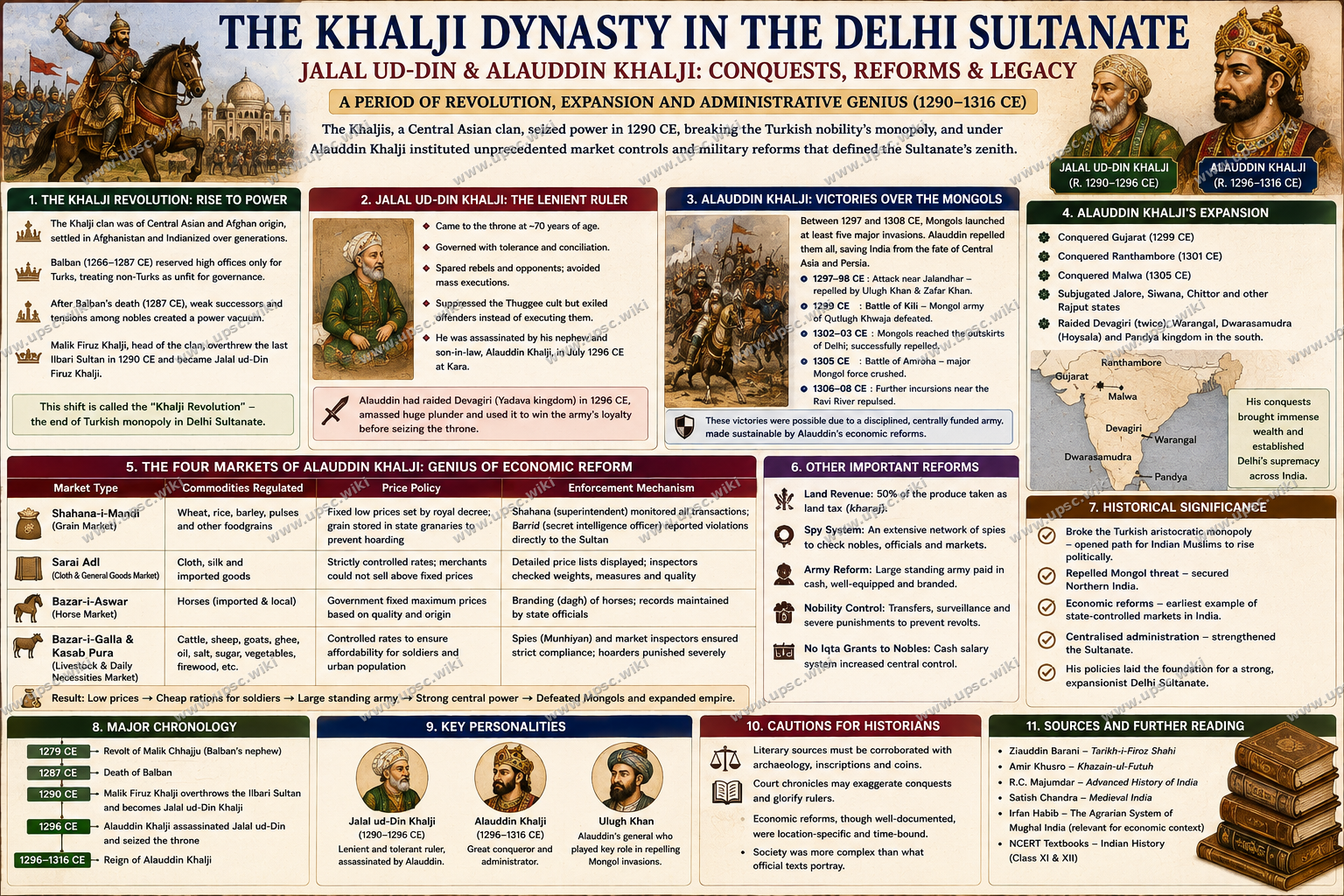
The Khalji Dynasty (1290–1320 CE) brought a revolution in Delhi Sultanate politics — ending Turkish nobility's monopoly on power — and under Alauddin Khalji, introduced unprecedented market reforms, defeated the Mongols, and expanded the Sultanate to its greatest territorial extent.
The Khalji Dynasty Delhi Sultanate Jalal ud-Din Alauddin economic reforms represent one of medieval India's most transformative periods: the Khaljis, a Central Asian clan, seized power in 1290 CE, breaking the Turkish nobility's monopoly, and under Alauddin Khalji instituted unprecedented market controls and military reforms that defined the sultanate's zenith.
The Khalji Revolution: How Did a Non-Turkish Clan Rise to Power in Delhi?
The Khalji clan was of Central Asian and Afghan origin — possibly Turkish by distant ancestry — but had settled in Afghanistan for generations and become significantly Indianized. Their rise in 1290 CE marked a decisive rupture in the politics of the Delhi Sultanate. Until then, the Ilbari (Mamluk) Sultans had jealously guarded power within a narrow circle of Turkish nobles, a system institutionalized by Sultan Ghiyasuddin Balban (r. 1266–1287 CE).
Balban's rigid policy reserved high offices exclusively for Turkish amirs, treating non-Turks as unfit for governance. His death in 1287 CE was followed by weak successors, and the resultant power vacuum allowed the Khaljis — who had long served the Sultanate in military capacities — to assert themselves. The revolt of Malik Chhajju (Balban's nephew) in 1279 CE had already demonstrated that tensions within the ruling class were simmering. By 1290, Malik Firuz, head of the Khalji clan and an elderly military commander, overthrew the last Ilbari Sultan and ascended the throne as Jalal ud-Din Firuz Khalji. Historians refer to this shift as the "Khalji Revolution" — a turning point when the Turkish monopoly on political power was permanently broken.
Who Was Jalal ud-Din Khalji and Why Was He Considered a Lenient Ruler?
Jalal ud-Din Khalji (r. 1290–1296 CE) came to the throne at approximately 70 years of age — an unusually advanced age for a sultan who had to contend with hostile nobles and a skeptical court. Despite this, he proved to be a notably liberal ruler by the standards of medieval sultanates.
Where his predecessors had routinely executed rebels and opponents, Jalal ud-Din preferred conciliation. When followers of Malik Chhajju's revolt were brought before him, he dealt with them leniently rather than ordering mass executions — a policy that earned him both admiration and criticism, as many nobles saw firmness as essential to royal authority. He also successfully suppressed the Thuggee cult (organized gangs of ritual robbers and murderers), sentencing offenders to exile rather than death.
His reign ended tragically. His own nephew and son-in-law, Ali Gurshap — better known as Alauddin Khalji — raided the wealthy Yadava kingdom of Devagiri in 1296 CE without the Sultan's permission, accumulating vast plunder and using it to win the loyalty of soldiers. On his return, Alauddin lured Jalal ud-Din to a meeting at Kara and had him assassinated in July 1296 CE. He then declared himself Sultan, marching to Delhi and overwhelming any resistance.
What Were the Military Achievements of Alauddin Khalji Against the Mongols?
Alauddin Khalji (r. 1296–1316 CE) is rightly considered one of the most powerful and capable sultans of the Delhi Sultanate. His two greatest contributions to Indian history were his successful repulsion of the Mongol invasions and his unprecedented administrative and economic reforms.
Between 1297 and 1308 CE, the Mongols — still a formidable force in Central Asia — launched at least five major invasions of the Indian subcontinent:
- 1297–98 CE: Mongol attack near Jalandhar — repelled by Alauddin's generals Ulugh Khan and Zafar Khan.
- 1299 CE (Battle of Kili): A massive Mongol force under Qutlugh Khwaja was decisively defeated near Delhi.
- 1302–03 CE: Mongols reached the outskirts of Delhi itself; Alauddin reorganized his defences and repelled them.
- 1305 CE (Battle of Amroha): A major Mongol force was crushed, with thousands of prisoners captured.
- 1306–08 CE: Further incursions near the Ravi River were repulsed decisively.
These victories saved the Indian subcontinent from the devastation that the Mongols had inflicted on Central Asia, Persia, and China. Alauddin's success rested on a disciplined, centrally funded army — which in turn made his market reforms not merely idealistic but strategically necessary.
What Were the Four Markets of Alauddin Khalji and How Did They Work?
Alauddin Khalji's market regulation system — often called the system of the "four markets" — was one of the most ambitious economic experiments of medieval India. The core purpose was fiscal: by artificially lowering the prices of essential commodities, Alauddin could pay his enormous standing army relatively low salaries while ensuring soldiers could still afford necessities. This allowed him to maintain a large, well-equipped force without exhausting the treasury.
| Market Type | Commodities Regulated | Price Policy | Enforcement Mechanism |
|---|---|---|---|
| Shahana-i-Mandi (Grain Market) | Wheat, rice, barley, pulses, and other foodgrains | Fixed low prices set by royal decree; grain stored in state granaries to prevent hoarding | Shahana (superintendent) monitored all transactions; Barrid (secret intelligence officer) reported violations directly to the Sultan |
| Sarai Adl (Cloth and General Goods Market) | Cloth, silk, and imported goods | Strictly controlled rates; merchants required to register with the Diwan-i-Riyasat (Controller of Markets) | Merchants who overcharged faced physical punishment — ears cut off or fingers amputated for violations |
| Horse Market | Horses for the cavalry | Fixed prices to prevent the army from being exploited by horse traders; quality control enforced by state-licensed brokers | Dedicated licensed brokers only; Munhiyans (informers) placed among traders to detect fraud and price manipulation |
| Cattle and General Commodities Market | Cattle, buffaloes, goats, and miscellaneous goods | Standardized rates; no private sale above fixed prices permitted at any time | Shahana and intelligence officers present at all times; severe punishments including flogging for any violations |
The enforcement system was extraordinarily rigorous. Alauddin posted a Shahana (market superintendent) at each market and stationed secret agents called Barrids and Munhiyans (informers) who reported independently to the Sultan. Merchants were registered; no transaction could take place off the official market. Even minor overcharging resulted in harsh corporal punishment. Contemporary chronicler Ziauddin Barani provides extensive accounts of this system in his Tarikh-i-Firuz Shahi.
What Other Administrative Reforms Did Alauddin Khalji Introduce?
Beyond market control, Alauddin undertook sweeping changes to governance:
- Revenue Reform: Land revenue in the Doab (the fertile region between the Ganga and Yamuna rivers) was raised to 50% of produce — among the highest rates in medieval India. Alauddin eliminated intermediary local chiefs (the khuts and muqaddams) who had traditionally retained a share of revenue, enforcing direct collection by state officials instead.
- Spy System (Barid and Munhiyans): An extensive intelligence network reported on officials, merchants, nobles, and even members of the royal court. Alauddin distrusted his nobles deeply and used information gathered by spies to preempt conspiracies before they could materialise.
- Prohibition and Social Control: Alauddin banned alcohol and gambling in Delhi — a policy he enforced strictly. He also prohibited social gatherings among nobles and required royal permission for inter-noble marriages, aiming to prevent the formation of political factions that could threaten his throne.
- Southern Campaigns: His general Malik Kafur led campaigns deep into the Deccan and South India — reaching Devagiri (1307–08), Warangal (1309–10), Dwarasamudra (the Hoysala capital, 1310), and Mabar in present-day Tamil Nadu (1311). These were primarily tribute-extraction campaigns; permanent annexation was limited, but they brought immense wealth to the Delhi treasury.
What Was Alauddin Khalji's Cultural Legacy?
Alauddin was also a notable patron of the arts. He provided royal patronage to Amir Khusrau, the celebrated poet and musician known as the "Parrot of India" (Tuti-i-Hind), who composed works in both Persian and proto-Hindi (Hindavi). Amir Khusrau's literary output — including the Khazain ul-Futuh, which chronicles Alauddin's reign — and his musical innovations profoundly influenced the Indo-Islamic cultural tradition.
In architecture, Alauddin built the magnificent Alai Darwaza (1311 CE) at the Qutb Minar complex in Delhi — a masterpiece of early Indo-Islamic architecture in red sandstone and white marble, notable for its true arches and restrained ornamentation. He also began the Alai Minar, intended to be twice the height of the Qutb Minar, but only one story was completed before his death in 1316 CE.
How Did the Khalji Dynasty End?
Alauddin Khalji fell gravely ill in his final years (c. 1315–16 CE). During this period, effective power shifted to his general and trusted commander, Malik Kafur, who managed the court and suppressed rivals among the Sultan's own sons. After Alauddin's death in January 1316, Kafur briefly controlled the throne — executing one claimant — before being murdered by palace guards within months.
Alauddin's son Mubarak Shah Khalji (r. 1316–1320 CE) then ruled for a few years, but his reign was marked by instability and a reversal of his father's strict policies. Mubarak Shah was ultimately killed by his own favourite, Khusrau Khan (a converted Hindu also known as Nasir ud-Din), who briefly seized power — an event that scandalized the Muslim nobility. Khusrau Khan was himself swiftly overthrown by Ghiyasuddin Tughluq, a seasoned frontier governor, who established the Tughluq Dynasty in 1320 CE, formally ending the Khalji era.
Despite its brevity — spanning just thirty years (1290–1320 CE) — the Khalji Dynasty left an indelible mark on Indian history. The "Khalji Revolution" permanently ended the Turkish ethnic monopoly on power. Alauddin's market reforms and military reorganization demonstrated that the Delhi Sultanate could project centralized state authority on an unprecedented scale. His repulsion of the Mongols preserved the subcontinent from devastation comparable to that visited upon Persia and Central Asia. The Khaljis thus represent the zenith of the early Delhi Sultanate and a pivotal chapter in the narrative of medieval India.
Frequently Asked Questions
Who founded the Khalji Dynasty and when?
The Khalji Dynasty was founded by Jalal ud-Din Firuz Khalji in 1290 CE. He was an elderly Khalji chief who overthrew the last Ilbari (Mamluk) Sultan and ascended the throne of Delhi, marking the end of the Turkish nobility's exclusive hold on power — an event historians call the "Khalji Revolution."
What were Alauddin Khalji's four markets and why did he establish them?
Alauddin Khalji established four regulated markets in Delhi: the Shahana-i-Mandi (grain market), the Sarai Adl (cloth and cattle market), the horse market, and the general commodities market. He fixed prices artificially low so that he could maintain a large standing army at low salaries while soldiers could still afford essential goods. Each market was supervised by a Shahana and monitored by secret intelligence agents (Barrids and Munhiyans) who reported directly to the Sultan, with harsh punishments for violators.
How did Alauddin Khalji defend against the Mongol invasions?
Alauddin Khalji repelled at least five major Mongol invasions between 1297 and 1308 CE through a combination of military preparedness, a large centrally funded standing army, and tactical skill. Key victories included the Battle of Kili (1299), the Battle of Amroha (1305), and engagements near the Ravi River (1306–08). His success protected the Indian subcontinent from the catastrophic destruction that the Mongols had inflicted on Central Asia, Persia, and China.
What is the architectural legacy of Alauddin Khalji?
Alauddin Khalji's most significant architectural contribution is the Alai Darwaza (1311 CE), the southern gateway to the Qutb Minar complex in Delhi. It is considered a landmark in Indo-Islamic architecture for its true arches, marble inlay, and elegant red sandstone construction. He also began the Alai Minar — planned to be twice the height of the Qutb Minar — but it was left unfinished at one story at the time of his death in 1316 CE.
How did the Khalji Dynasty end?
The Khalji Dynasty ended in 1320 CE. After Alauddin Khalji's death in 1316, his general Malik Kafur briefly held power before being killed. His son Mubarak Shah Khalji ruled until 1320, when he was assassinated by Khusrau Khan (a Hindu convert). Khusrau Khan's brief usurpation was ended by Ghiyasuddin Tughluq, who established the Tughluq Dynasty — bringing the Khalji era to a close after approximately thirty years of rule.
Sources and Further Reading
According to IGNOU's BHIC-133 course materials on Medieval India, the Khalji period represents a critical phase of political and economic experimentation in the Delhi Sultanate. Scholars such as Irfan Habib and K.A. Nizami have analysed Alauddin's market reforms extensively in their academic works on medieval Indian history. Ziauddin Barani's Tarikh-i-Firuz Shahi remains the primary contemporary source for this period. Additional reading is available in Satish Chandra's Medieval India: From Sultanate to the Mughals (Har-Anand Publications), A.B.M. Habibullah's The Foundation of Muslim Rule in India, and Peter Jackson's The Delhi Sultanate: A Political and Military History (Cambridge University Press).