
Lord Curzon as Viceroy: Archaeological Survey of India, University Commission and the Bengal Partition
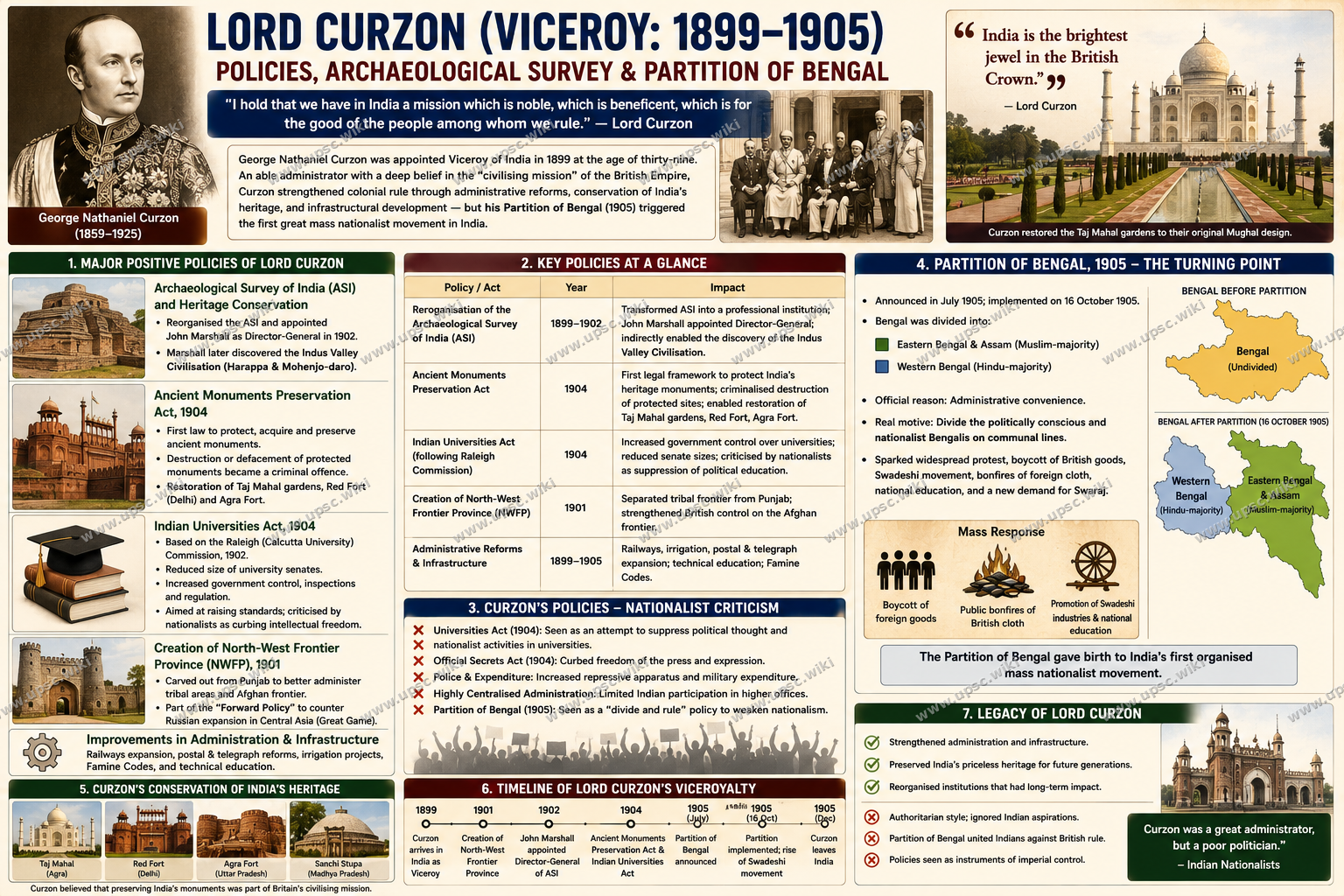
A comprehensive UPSC study note on Lord Curzon's viceroyalty (1899–1905): the reorganisation of the Archaeological Survey of India, the Ancient Monuments Preservation Act 1904, the Calcutta University Commission, the North-West Frontier Province, and the Bengal Partition that triggered the Swadeshi Movement.
Lord Curzon Viceroy policies Archaeological Survey Bengal Partition mark the most consequential — and controversial — chapter in British India's late-colonial administrative history. George Nathaniel Curzon served as Viceroy from 1899 to 1905, transforming heritage conservation through the Archaeological Survey while simultaneously triggering the most powerful mass nationalist movement India had yet seen with his Partition of Bengal.
Who Was Lord Curzon and What Was His Imperial Vision?
George Nathaniel Curzon (1859–1925) was appointed Viceroy of India in 1899 at the remarkably young age of thirty-nine. A product of Eton and Oxford, Curzon had already travelled extensively through Asia and written authoritative books on Persia and the Far East before assuming office. He arrived in India not merely as an administrator but as a man with a clearly defined imperial mission: to consolidate British power, modernise the apparatus of colonial rule, and demonstrate that the British Empire governed India with efficiency and justice.
Curzon was a Conservative imperialist of the deepest conviction. He regarded India as the "brightest jewel in the British Crown" and believed sincerely in the so-called "civilising mission" of British rule — the idea that British administration was a gift to a people incapable of self-governance. This paternalism, however genuine, blinded him to the rising tide of Indian nationalism and the legitimate aspirations of an educated Indian middle class. He was also extraordinarily detail-oriented: Curzon micro-managed everything from railway timetables to the dust on museum shelves, flooding subordinates with minutes and memoranda in a style that was impressive in energy and exhausting in extent.
What Were the Major Positive Policies of Lord Curzon as Viceroy?
Archaeological Survey of India and Heritage Conservation
Curzon's most enduring and largely uncontested legacy is his contribution to the preservation of India's ancient monuments. The Archaeological Survey of India (ASI) had been originally founded in 1861 under Sir Alexander Cunningham, but by the time Curzon arrived it had fallen into disarray — under-funded and poorly organised. Curzon reorganised the ASI entirely and, crucially, appointed John Marshall as Director-General in 1902. Marshall would go on, after Curzon's viceroyalty, to direct the excavations at Harappa and Mohenjo-daro that uncovered the Indus Valley Civilisation in the 1920s — one of the greatest archaeological discoveries of the twentieth century.
The cornerstone of Curzon's heritage policy was the Ancient Monuments Preservation Act of 1904. This legislation gave the Government of India legal authority to protect, acquire, and preserve ancient monuments across the subcontinent. For the first time, the destruction or defacement of a protected monument became a criminal offence. Curzon personally supervised — and funded partly from his own salary — the restoration of many monuments. The Taj Mahal's gardens, allowed to deteriorate into a rough field under previous administrations, were restored to their original Mughal design. Restoration work was also undertaken at the Red Fort in Delhi and the Agra Fort.
Calcutta University Commission (1902) and the Universities Act (1904)
Curzon appointed the Raleigh Commission (Calcutta University Commission) in 1902 to investigate the state of university education in India. The commission's findings led to the Indian Universities Act of 1904. The Act reduced the size of university senates, increased government powers over curricula and appointments, and subjected universities to stricter government inspection. Officially, the aim was to raise academic standards and curb the proliferation of low-quality affiliated colleges. In practice, Indian nationalists saw the Act as a deliberate attempt to suppress the universities that were incubating radical political thought — a charge that was not without foundation.
North-West Frontier Province (1901)
In 1901, Curzon carved out the North-West Frontier Province (NWFP) from the Punjab to create a separate administrative unit better suited to managing relations with the tribal areas and the Afghan frontier. This was part of a broader forward policy aimed at creating a buffer against Russian expansion in Central Asia — the continuation of the so-called "Great Game." The NWFP remained a distinct administrative unit through the colonial period and into the post-independence era.
Key Policies of Lord Curzon's Viceroyalty at a Glance
| Policy / Act | Year | Impact |
|---|---|---|
| Reorganisation of the Archaeological Survey of India (ASI) | 1899–1902 | Transformed ASI into a professional institution; John Marshall appointed Director-General; indirectly enabled the discovery of the Indus Valley Civilisation |
| Ancient Monuments Preservation Act | 1904 | First legal framework to protect India's heritage monuments; criminalised destruction of protected sites; enabled restoration of the Taj Mahal gardens, Red Fort, and Agra Fort |
| Indian Universities Act (following Raleigh/Calcutta University Commission) | 1904 | Increased government control over universities; reduced senate sizes; criticised by nationalists as suppression of political education and intellectual freedom |
| Creation of North-West Frontier Province (NWFP) | 1901 | Separated tribal frontier from Punjab for more focused administration; integral to British forward policy on the north-western frontier |
| Police Commission (Fraser Commission) | 1902–1903 | Attempted to professionalise the Indian police; recommended separation of executive and judicial police functions |
| Indian Famine Code Reforms | 1900–1902 | Codified famine relief procedures; however, Curzon's fiscal orthodoxy limited actual relief during the devastating 1899–1902 famines in which millions perished |
| Partition of Bengal | 1905 | Divided Bengal into two provinces along religious lines; triggered the Swadeshi Movement and boycott of British goods; accelerated the rise of the Extremist faction in the INC |
How Did the Partition of Bengal (1905) Transform Indian Nationalism?
No single act of Curzon's viceroyalty had greater historical consequences than the Partition of Bengal, announced in July 1905 and implemented on 16 October 1905. Bengal at the time was the largest province of British India, with approximately 78 million people spread across a vast territory encompassing modern West Bengal, Bangladesh, Bihar, Orissa, and parts of Assam.
The official rationale was purely administrative: Bengal was too large for a single provincial government to manage effectively. The partition created two new provinces — East Bengal and Assam (capital Dacca, population 31 million, Muslim majority) and the rump Bengal province (capital Calcutta, population 54 million, Hindu majority).
Critics, however, saw through the administrative justification immediately. The partition followed a religious fault line with suspicious precision: it separated the Hindu-dominated west from the Muslim-dominated east, divided the Bengali-speaking population from itself, and — most critically — it detached the economically and politically dynamic Calcutta from its rural hinterland in the east. The nationalist movement, centred in Calcutta's educated professional class, would be severely weakened by losing its connection to the eastern districts. Curzon dismissed all Indian opposition as the "manufactured" outrage of a "microscopic minority" — a characteristically patrician misreading of the depth of popular feeling.
What Was the Swadeshi Movement and Why Did It Matter?
The response to the Bengal Partition was the Swadeshi Movement — one of the most significant mass mobilisations in Indian history before Gandhi. Swadeshi means "of one's own country," and the movement called for the boycott of British manufactured goods and the promotion of Indian-made products. On 16 October 1905 — the very day the partition took effect — Hindus and Muslims in Bengal tied rakhi on each other's wrists in a symbolic act of unity across community lines. Shops selling British goods were picketed. Bonfires of Manchester cloth lit the streets of Calcutta.
The Swadeshi Movement had profound and lasting political consequences. It accelerated the rise of the Extremist faction within the Indian National Congress, led by Bal Gangadhar Tilak, Bipin Chandra Pal, and Lala Lajpat Rai — the celebrated "Lal-Bal-Pal" trio. It pushed the Congress from polite petitioning toward active mass confrontation. It demonstrated, for the first time, that sustained economic pressure could be wielded as a political weapon against the colonial state. The seeds it planted would flower in Gandhi's Non-Cooperation Movement (1920–22) and Civil Disobedience Movement (1930–34).
The Partition of Bengal was ultimately reversed in 1911 under Viceroy Hardinge, announced at the Delhi Durbar marking King George V's visit — a posthumous rebuke to Curzon's political judgement, and recognition that the colonial state had badly miscalculated the depth of nationalist sentiment.
How Should We Assess Lord Curzon's Contradictory Legacy?
Curzon represents a deep paradox at the heart of British imperialism. On one hand, he was a genuine lover of India's artistic and architectural heritage — the single Viceroy who did most to preserve the physical inheritance of Indian civilisation. On the other hand, his policies, especially the Bengal Partition, inflamed Indian nationalism and set the stage for its militant phase. He was a brilliant administrator who could not conceive that a people might refuse to be governed, however efficiently, without their own consent.
Curzon departed India in 1905, broken by his conflict with Field Marshal Lord Kitchener over military command — a battle that had little to do with India and much to do with the rivalries of the British imperial establishment. He resigned from the viceroyalty rather than accept the overruling of his position on the supreme command. His departure was abrupt and bitter.
For the UPSC examination, Curzon's viceroyalty is essential because it encapsulates the central tensions of the late colonial period: between conservation and control, between paternalism and nationalism, between administrative modernisation and political repression. His tenure is invariably covered in Prelims (factual questions on ASI, the 1904 Acts, and the 1905 Partition) and Mains (analytical questions on the causes and consequences of the Swadeshi Movement and the contradictions of liberal imperialism).
Frequently Asked Questions
What is the significance of the Ancient Monuments Preservation Act of 1904 under Lord Curzon?
The Ancient Monuments Preservation Act of 1904, enacted under Lord Curzon's viceroyalty, was India's first comprehensive legal framework for the protection of historical monuments. It empowered the Government of India to take charge of endangered monuments, criminalised their wilful destruction, and established the Archaeological Survey of India as the apex body for conservation. Its direct legacy includes the restored Taj Mahal gardens, restored sections of the Red Fort and Agra Fort, and the legal architecture that continues to protect India's heritage monuments today.
Why did Lord Curzon partition Bengal in 1905, and was it really an administrative decision?
Lord Curzon officially justified the 1905 Partition of Bengal on administrative grounds — a province of 78 million people was unmanageably large. However, critics then and historians since have argued that the partition was deliberately designed to divide the Hindu-majority west from the Muslim-majority east, thereby weakening the organised nationalist movement centred in Calcutta. Curzon's own private correspondence suggests awareness of the political benefits of division, lending substantial weight to the "divide and rule" interpretation.
What was the Swadeshi Movement and how was it connected to the Bengal Partition?
The Swadeshi Movement was a mass political and economic campaign launched in direct response to the Partition of Bengal (1905). It called for the boycott of British manufactured goods and the promotion of Indian-made products. On the day the partition took effect — 16 October 1905 — Bengalis observed a day of mourning and solidarity. The movement gave rise to the Extremist faction within the INC (Tilak, Pal, Lajpat Rai) and introduced sustained economic boycott as a tool of political resistance, anticipating Gandhi's later mass campaigns.
Who was John Marshall and what was his connection to Lord Curzon?
John Marshall was appointed Director-General of the Archaeological Survey of India by Lord Curzon in 1902. Curzon reorganised and reinvigorated the ASI, and Marshall served as its head for over two decades. Under Marshall's leadership, the ASI conducted the excavations at Harappa (1921) and Mohenjo-daro (1922) that revealed the Indus Valley Civilisation — one of the world's oldest urban cultures. Curzon's decision to appoint Marshall and strengthen the ASI is therefore indirectly connected to one of the greatest archaeological discoveries of the twentieth century.
When and why was the Bengal Partition reversed?
The Partition of Bengal was reversed (annulled) in 1911 by Viceroy Lord Hardinge, announced at the Delhi Durbar coinciding with King George V's coronation visit to India. The reversal came after six years of sustained nationalist agitation through the Swadeshi Movement, which demonstrated the depth of public opposition to the partition. Simultaneously, the capital of British India was shifted from Calcutta to the newly planned city of New Delhi, partly to reduce the political centrality of Calcutta as the hub of nationalist organisation.
Sources and Further Reading
According to IGNOU's BHIC-134 (History of India: c. 1707–1950) course material, Lord Curzon's viceroyalty is treated as a defining moment in the transition from high imperialism to the era of mass nationalism, with particular emphasis on the Bengal Partition as the primary catalyst of the Swadeshi Movement. Bipin Chandra's India's Struggle for Independence (Penguin, 1989) provides a detailed nationalist critique of Curzon's administrative and political record. For Curzon's heritage conservation work, see John Marshall's Conservation Manual (ASI, 1923) and David Gilmour's biography Curzon: Imperial Statesman (John Murray, 1994). The Cambridge History of India, Volume VI, covers the administrative context of his reforms. Primary sources include Curzon's own viceregal minutes and the Report of the Calcutta University Commission (1902), available in the National Archives of India, New Delhi.