
Non-Cooperation Movement 1920–1922: Khilafat, Gandhi's Mass Politics and the Chauri Chaura Incident
The Non-Cooperation Movement (1920–22) was India's first mass nationalist agitation. Learn how the Khilafat crisis, Gandhi's leadership, the Nagpur Session, and the Chauri Chaura incident shaped its dramatic rise and sudden withdrawal.
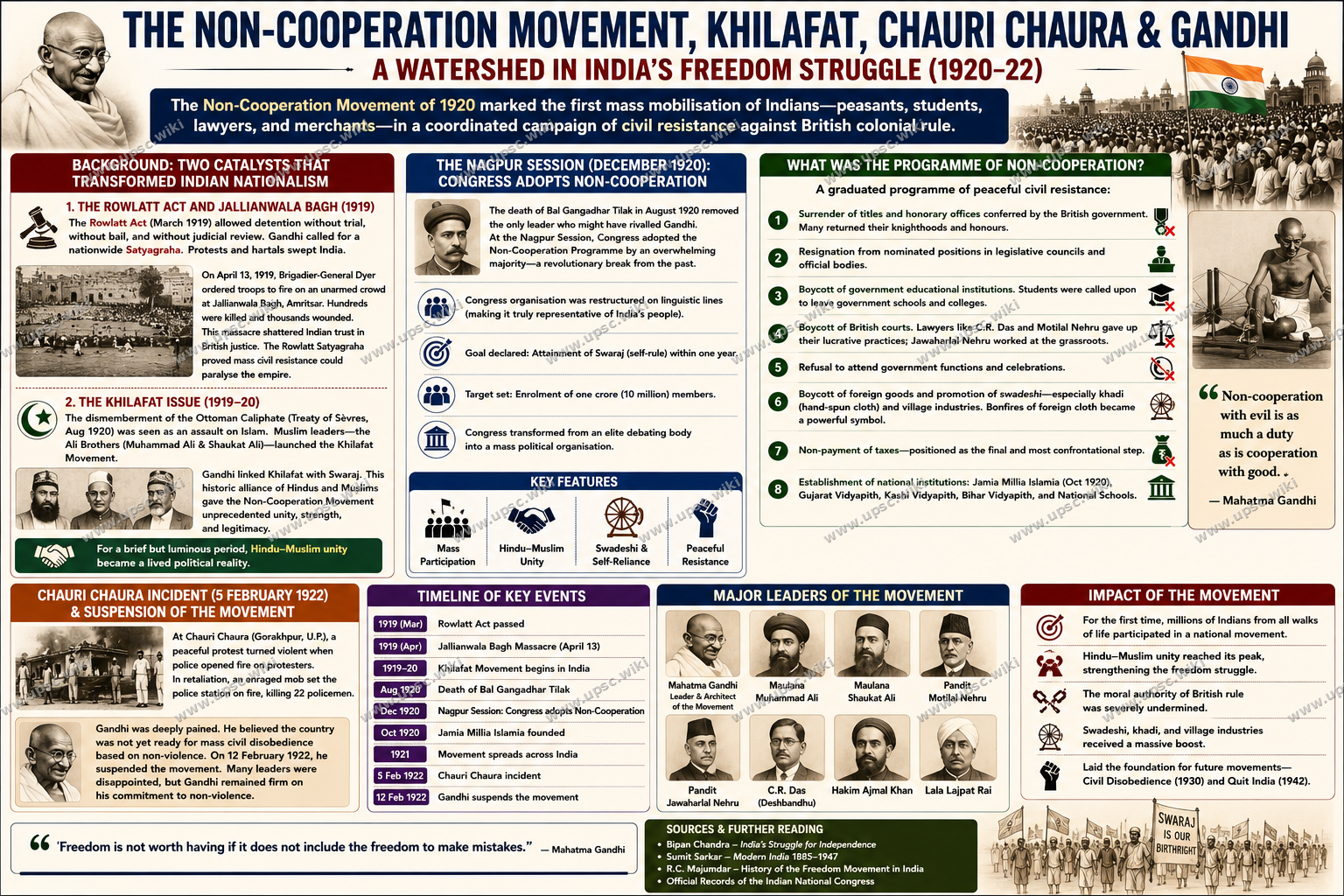
The Non-Cooperation Movement Khilafat Chauri Chaura Gandhi represents a watershed in India's freedom struggle — a mass agitation launched in 1920 that, for the first time, mobilised millions of ordinary Indians — peasants, students, lawyers, and merchants — in a coordinated campaign of civil resistance against British colonial rule.
Background: Two Catalysts That Transformed Indian Nationalism
The Rowlatt Act and Jallianwala Bagh (1919)
In the immediate aftermath of World War I, Britain tightened its grip on India by enacting the Rowlatt Act (March 1919), which permitted the colonial government to detain suspects without trial, without bail, and without any meaningful judicial review. The Indian nationalist community was furious. Mahatma Gandhi called for a nationwide Satyagraha against the Act — his first mass movement in India. The response was electrifying: hartals, processions, and public protests swept across the country from Punjab to Bombay.
The British response was swift and savage. On April 13, 1919, Brigadier-General Reginald Dyer ordered troops to open fire on an unarmed crowd gathered at Jallianwala Bagh, Amritsar, during the festival of Baisakhi. Hundreds were killed and thousands wounded in the enclosed garden with no exits. The massacre sent shockwaves across India and the world. Gandhi, who had until then believed in working within the constitutional framework, now began questioning the moral legitimacy of British rule itself. The Rowlatt Satyagraha — though ultimately suppressed — demonstrated for the first time that mass civil resistance could paralyse the machinery of empire.
Why Did the Khilafat Issue Unite Hindus and Muslims in 1920?
The second and equally powerful catalyst was the Khilafat crisis. After World War I, Britain and France moved to dismantle the Ottoman Sultanate through the Treaty of Sèvres (August 1920). For the Muslim world, the Ottoman Sultan was also the Caliph — the supreme spiritual and temporal leader of Islam globally (Khalifat-ul-Muslimeen). The humiliation and dismemberment of the Caliphate was seen as a direct assault on the faith.
In India, prominent Muslim leaders — especially the Ali Brothers, Muhammad Ali and Shaukat Ali — launched the Khilafat Movement to pressure the British government into reversing its policy. Mahatma Gandhi recognised a historic opportunity. He argued that the Khilafat cause and the cause of Indian self-rule were inseparable, and that by standing together, Hindus and Muslims could deal a decisive blow to the colonial order. Gandhi's championship of the Khilafat cause brought the Ali Brothers into the Congress fold and gave the Non-Cooperation Movement its greatest numerical and moral strength. For a brief but luminous period, Hindu-Muslim unity in India was a lived political reality rather than a pious aspiration.
The Nagpur Session (December 1920): Congress Adopts Non-Cooperation
The death of Bal Gangadhar Tilak in August 1920 removed the only leader who might have rivalled Gandhi's claim to Congress leadership. Tilak had been the voice of assertive, mass-based nationalism for a generation. With his passing, Gandhi became the undisputed conscience and captain of the movement. At the Nagpur Session of the Indian National Congress in December 1920, the party formally adopted the Non-Cooperation Programme by an overwhelming majority. This was a revolutionary break with the past: the Congress had traditionally drafted petitions, passed resolutions, and sent delegations to London. Now it was openly calling for defiance of British authority.
The Nagpur Session also restructured the Congress organisation dramatically. Provincial Congress Committees were reorganised along linguistic lines rather than administrative boundaries — making the Congress genuinely representative of linguistic communities across India. The goal was stated boldly: attainment of Swaraj (self-rule) within one year. The party also set a target of enrolling one crore (10 million) members, transforming Congress from an elite debating society into a mass political organisation.
What Was the Programme of Non-Cooperation?
The Non-Cooperation Movement operated through a graduated programme of peaceful civil resistance:
- Surrender of titles and honorary offices conferred by the British government. Many respected Indians returned their knighthoods and other honours.
- Resignation from nominated positions in legislative councils and official bodies.
- Boycott of government educational institutions. Students were called upon to leave government schools and colleges. While many participated initially, sustaining the boycott proved difficult where alternatives did not exist.
- Boycott of British courts. Prominent lawyers — including C.R. Das and Motilal Nehru — suspended their lucrative legal practices as a public act of sacrifice. Jawaharlal Nehru threw himself into organising at the grassroots level.
- Refusal to attend government functions and celebrations.
- Boycott of foreign goods and active promotion of swadeshi — particularly khadi (hand-spun cloth) and village industries. Bonfires of foreign cloth became powerful public symbols.
- Non-payment of taxes — this was positioned as the final and most confrontational escalatory step.
- Establishment of national institutions: Jamia Millia Islamia was founded in 1920 as a national Muslim university; Gujarat Vidyapith was established by Gandhi. These provided educational alternatives outside the colonial system.
Key Events and Timeline of the Non-Cooperation Movement
| Date / Year | Event | Significance |
|---|---|---|
| March 1919 | Rowlatt Act passed | Detention without trial; triggered Gandhi's first mass Satyagraha in India |
| April 13, 1919 | Jallianwala Bagh Massacre, Amritsar | Hundreds killed by Dyer's troops; radicalised nationalist opinion across India |
| August 1920 | Treaty of Sèvres signed; death of Bal Gangadhar Tilak | Khilafat crisis deepened; Gandhi emerged as undisputed Congress leader |
| September 1920 | Special Congress Session, Calcutta | Non-Cooperation Programme approved for the first time; Gandhi carried the vote |
| December 1920 | Nagpur Session of Indian National Congress | Formal adoption of Non-Cooperation; Congress restructured along linguistic provincial lines |
| 1920–1921 | Mass participation across Bengal, Andhra, Punjab, Maharashtra | Students, lawyers, merchants, and peasants mobilised; Ali Brothers inflamed Muslim solidarity |
| 1920 | Founding of Jamia Millia Islamia and Gujarat Vidyapith | National educational alternatives established outside the colonial system |
| December 1921 | Ali Brothers, C.R. Das, and other leaders arrested | British crackdown intensified; over 30,000 people imprisoned by end of 1921 |
| February 4–5, 1922 | Chauri Chaura Incident, Gorakhpur district | Police station burned; 22 policemen killed; Gandhi withdrew the entire movement |
| March 1922 | Gandhi arrested and tried for sedition | Sentenced to 6 years; served approximately 2 years due to surgery and health |
| 1923 | Formation of Swarajist Party by C.R. Das and Motilal Nehru | Council-entry strategy: obstruct British administration from within legislatures |
| March 1924 | Abolition of the Caliphate by Kemal Ataturk | Khilafat Movement became irrelevant; Hindu-Muslim unity began to permanently fracture |
How Did the Chauri Chaura Incident End the Non-Cooperation Movement?
By early 1922, the movement had reached its zenith. Tens of thousands had been imprisoned; merchants had boycotted British goods; lawyers had emptied the colonial courts; students had walked out of government schools. Gandhi was preparing a focused civil disobedience campaign in Bardoli, Gujarat — which would have included the most direct challenge yet: non-payment of taxes. The British administration was visibly strained.
Then came the event that changed everything. On February 4–5, 1922, in the village of Chauri Chaura in Gorakhpur district, United Provinces (present-day Uttar Pradesh), a procession of Non-Cooperation volunteers marching past the local police station came under provocation. A scuffle broke out; the police opened fire. The enraged crowd retaliated with devastating force — they surrounded the police station and set it ablaze. Twenty-two policemen were burned alive or killed as they tried to flee.
Gandhi's response silenced the nationalist movement: he announced the immediate and unconditional withdrawal of the Non-Cooperation Movement across the entire country. He declared a fast as penance for the violence and called upon Congress to re-dedicate itself to constructive work. His reasoning was uncompromising: the movement had violated the cardinal principle of ahimsa (non-violence). A Satyagraha contaminated by violence, however understandable the provocation, could not serve as the path to Swaraj. The masses were not yet morally prepared. The struggle would have to wait.
The reaction within nationalist circles was one of shock and bitterness. Leaders already imprisoned — C.R. Das, Motilal Nehru, and the young Subhas Chandra Bose among them — were outraged. They argued the movement was at its peak momentum and that withdrawing it was a strategic catastrophe. C.R. Das believed Gandhi had made a historic error. But Gandhi was immovable: the moral integrity of the movement was non-negotiable, even at the cost of tactical advantage.
Consequences and Aftermath of the Withdrawal
The withdrawal of the Non-Cooperation Movement set in motion a chain of political consequences that shaped the next decade of Indian nationalism:
- Gandhi's arrest and trial (March 1922): The colonial government moved swiftly. Gandhi was arrested on charges of sedition for his writings in Young India. At his trial, he made his famous statement asking for the maximum sentence: "I am here to invite and cheerfully submit to the highest penalty." He was sentenced to 6 years; released in February 1924 following surgery for appendicitis.
- Political vacuum and communal drift: Without Gandhi's unifying presence, Indian nationalist politics fragmented. The fragile Hindu-Muslim unity built on the Khilafat-Congress alliance began to crack. Communal riots — notably in Kohat (1924) and elsewhere — signalled a dangerous deterioration.
- The Council-Entry Debate (1923): C.R. Das and Motilal Nehru formed the Swarajist Party to contest elections to provincial and central legislative councils, with the aim of obstructing British administration from within. They clashed with the "no-changers" — Gandhi's loyal supporters — who believed the Congress should focus on constructive work at the village level until conditions were right for renewed mass action.
- End of the Khilafat Movement (1924): Mustafa Kemal Ataturk's secular Turkish Republic abolished the Caliphate in March 1924. The Khilafat cause, already weakened by the Non-Cooperation withdrawal, lost its entire raison d'être. The politically potent Hindu-Muslim solidarity of 1920–22 never fully recovered.
- Foundation for 1930: The lessons of 1920–22 — both in what worked and what failed — directly informed Gandhi's next great campaign: the Civil Disobedience Movement launched with the iconic Dandi Salt March of March 1930.
Historical Significance
The Non-Cooperation Movement permanently transformed the character and scale of Indian nationalism. It was the first truly mass movement in Indian history — reaching peasants in villages, textile workers in mills, and students in small-town schools, not just the educated elite of Calcutta or Bombay. It proved that the power of numbers and moral courage could challenge — even unsettle — the world's greatest colonial empire.
The movement also demonstrated that Satyagraha was a genuine political weapon, not merely a philosophical ideal. The British found it extraordinarily difficult to govern a country where millions simultaneously refused to cooperate with colonial institutions. The mass mobilisation of 1920–22 planted the seeds of nationalist consciousness in a generation that would eventually win independence in 1947.
The Chauri Chaura withdrawal, though deeply controversial, reinforced a defining characteristic of the Gandhian independence movement: its insistence on moral means as inseparable from the goal of freedom. This principle — frustrating to many impatient leaders — gave the Indian independence struggle a distinctive ethical character that distinguished it from many other anti-colonial movements of the twentieth century.
Frequently Asked Questions
What was the Non-Cooperation Movement and when did it start?
The Non-Cooperation Movement was a mass civil disobedience campaign launched by Mahatma Gandhi and the Indian National Congress in 1920 to resist British colonial rule without resorting to violence. It officially began with the Nagpur Session of Congress in December 1920, calling for boycotts of British institutions, goods, and titles.
What was the connection between the Khilafat Movement and the Non-Cooperation Movement?
The Khilafat Movement was led by Indian Muslims, especially the Ali Brothers (Muhammad Ali and Shaukat Ali), to protest British dismemberment of the Ottoman Caliphate after World War I. Gandhi allied the Indian National Congress with the Khilafat cause, merging it with the Non-Cooperation Movement to create a united Hindu-Muslim front against British rule between 1920 and 1922.
What happened at Chauri Chaura in 1922?
On February 4–5, 1922, a crowd of Non-Cooperation protesters in Chauri Chaura village (Gorakhpur district, United Provinces) clashed with police. After police opened fire, the mob burned the police station, killing 22 policemen. Gandhi, citing the violation of the movement's non-violent principles, immediately withdrew the entire Non-Cooperation Movement across India.
Why did Gandhi withdraw the Non-Cooperation Movement after Chauri Chaura?
Gandhi withdrew the movement because the killing of 22 policemen at Chauri Chaura represented a fundamental breach of ahimsa (non-violence), the moral cornerstone of Satyagraha. Gandhi believed that a movement contaminated by violence could not achieve true Swaraj (self-rule), and that the masses needed deeper moral preparation before the struggle could be resumed.
What were the long-term consequences of the Non-Cooperation Movement?
The movement transformed the Indian National Congress into a mass organisation, demonstrated the power of Satyagraha, and gave millions of ordinary Indians their first experience of nationalist politics. Its withdrawal led to the formation of the Swarajist Party (1923), Gandhi's imprisonment (1922–1924), a resurgence of communal tensions after the collapse of the Khilafat Movement (1924), and set the stage for future mass movements like the Civil Disobedience Movement of 1930.
Sources and Further Reading
According to IGNOU's BHIC-134 (History of India from c. 1707–1950), the Non-Cooperation Movement marks a decisive shift in the character of Indian nationalism — from elite constitutionalism to mass-based political mobilisation. Further reading includes Bipan Chandra's India's Struggle for Independence (Penguin, 1989), Shahid Amin's Event, Metaphor, Memory: Chauri Chaura 1922–1992 (University of California Press, 1995), and Gail Minault's The Khilafat Movement: Religious Symbolism and Political Mobilization in India (Columbia University Press, 1982). Primary sources include Gandhi's writings in Young India (1920–1922) and the proceedings of the Indian National Congress Nagpur Session, December 1920, available through the National Archives of India.