
Six Schools of Indian Philosophy (Shad Darshana): Nyaya, Vaisheshika, Sankhya, Yoga, Mimamsa and Vedanta
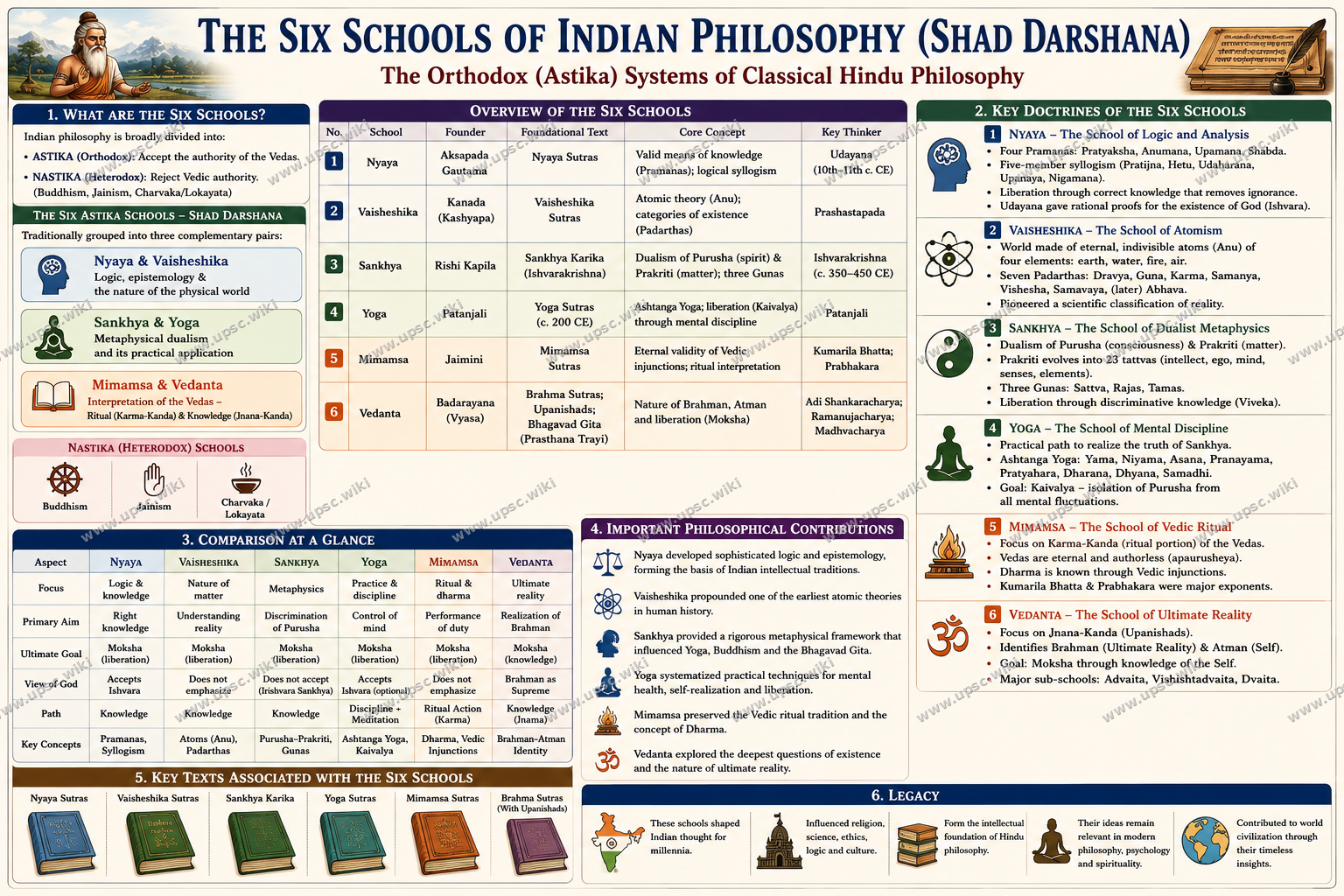
A comprehensive UPSC study note on the six Astika (orthodox) schools of Indian philosophy — Nyaya, Vaisheshika, Sankhya, Yoga, Mimamsa, and Vedanta — covering founders, foundational texts, core doctrines, and the Nastika schools.
The six schools of Indian philosophy, known as Shad Darshana, comprise the orthodox (Astika) traditions of Nyaya, Vaisheshika, Sankhya, Yoga, Mimamsa, and Vedanta — systems of thought that accept the authority of the Vedas and collectively represent the intellectual foundation of classical Hindu philosophy, each offering a distinct approach to knowledge, reality, and liberation.
What Are the Six Schools of Indian Philosophy and How Are They Classified?
Indian philosophical tradition is broadly divided into two categories: Astika (orthodox) schools, which accept the authority of the Vedas, and Nastika (heterodox) schools, which reject Vedic authority. The Nastika schools include Buddhism, Jainism, and Charvaka/Lokayata (materialist philosophy).
The six Astika schools — collectively called the Shad Darshana — are traditionally grouped into three complementary pairs:
- Nyaya and Vaisheshika — concerned with logic, epistemology, and the nature of the physical world
- Sankhya and Yoga — metaphysical dualism and its practical application
- Mimamsa and Vedanta — interpretation of the Vedas; Mimamsa focuses on ritual portions (Karma-Kanda) while Vedanta focuses on the Upanishads (Jnana-Kanda)
| School | Founder | Foundational Text | Core Concept | Key Thinker |
|---|---|---|---|---|
| Nyaya | Aksapada Gautama | Nyaya Sutras | Valid means of knowledge (Pramanas); logical syllogism | Udayana (10th–11th century CE) |
| Vaisheshika | Kanada (Kashyapa) | Vaisheshika Sutras | Atomic theory (Anu); categories of existence (Padarthas) | Prashastapada |
| Sankhya | Rishi Kapila | Sankhya Karika (Ishvarakrishna) | Dualism of Purusha (spirit) and Prakriti (matter); three Gunas | Ishvarakrishna (c. 350–450 CE) |
| Yoga | Patanjali | Yoga Sutras (c. 200 CE) | Ashtanga Yoga; liberation (Kaivalya) through mental discipline | Patanjali |
| Mimamsa | Jaimini | Mimamsa Sutras | Eternal validity of Vedic injunctions; ritual interpretation | Kumarila Bhatta; Prabhakara |
| Vedanta | Badarayana (Vyasa) | Brahma Sutras; Upanishads; Bhagavad Gita (Prasthana Trayi) | Nature of Brahman, Atman, and liberation (Moksha) | Adi Shankaracharya; Ramanujacharya; Madhvacharya |
What Are the Key Doctrines of Each of the Six Schools?
1. Nyaya — The School of Logic and Analysis
Founded by Aksapada Gautama (not to be confused with Gautama Buddha), the Nyaya school is primarily concerned with epistemology — the theory of valid knowledge. The Nyaya Sutras establish four valid means of knowledge (Pramanas): perception (Pratyaksha), inference (Anumana), comparison (Upamana), and testimony (Shabda). Liberation is achieved through correct knowledge that dispels ignorance.
Nyaya developed a sophisticated theory of the syllogism (Anumana) with five members — a notable contrast to Aristotle's three-part syllogism. Udayana (10th–11th century CE), the greatest Nyaya philosopher, is celebrated for his rational proofs for the existence of God (Ishvara). From around 1200 CE, the Navya-Nyaya (New Logic) movement developed a near-mathematical technical language for philosophical analysis that was extraordinarily precise.
2. Vaisheshika — The School of Atomism
Founded by Kanada (also called Kashyapa), Vaisheshika is the world's first systematized atomic theory, developed independently of Greek atomism. Its central claim: the material world is composed of eternal, indivisible, and indestructible atoms (Anu) of four elemental types — earth, water, fire, and air. Two atoms combine to form a binary molecule (Dvyanuka), and further aggregations produce all perceptible matter.
Vaisheshika also proposes a framework of Padarthas (categories of existence) to account for all that can be known: substance (dravya), quality (guna), action (karma), universal (samanya), particular (vishesha), inherence (samavaya), and — added later — non-existence (abhava). These categories constitute a comprehensive ontological inventory of reality.
3. Sankhya — The School of Dualist Metaphysics
Traditionally attributed to Rishi Kapila, Sankhya is among the oldest Indian philosophical systems. Its foundational text, the Sankhya Karika by Ishvarakrishna (c. 350–450 CE), articulates a strict metaphysical dualism between two eternal and independent realities:
- Purusha — pure consciousness or spirit; multiple, eternal, and entirely passive
- Prakriti — unconscious matter or primordial nature; one, dynamic, and the source of all material evolution
The entire material world — including the mind (manas), intellect (buddhi), and ego (ahamkara) — evolves from Prakriti. Prakriti is constituted by three qualities (Gunas): Sattva (clarity, luminosity), Rajas (activity, passion), and Tamas (inertia, darkness). Liberation (Moksha) occurs when Purusha, through discriminative knowledge, realizes its complete independence from Prakriti. The Sankhya framework profoundly influenced the Bhagavad Gita, early Buddhism, and the Yoga school.
4. Yoga — The School of Mental Discipline
Founded by Patanjali, whose Yoga Sutras (c. 200 CE) systematize the methods for achieving liberation, Yoga is the applied practical counterpart of Sankhya philosophy. While Sankhya provides the metaphysical map, Yoga provides the path. The goal is Kaivalya — the complete isolation and liberation of Purusha from all mental fluctuations (Chitta-Vritti).
Patanjali's Ashtanga Yoga (Eight-Limbed Path) outlines a progressive system of discipline:
- Yama — ethical restraints (non-violence, truthfulness, non-stealing, celibacy, non-possessiveness)
- Niyama — personal observances (purity, contentment, austerity, self-study, surrender to God)
- Asana — stable seated posture for meditation
- Pranayama — regulation and extension of breath
- Pratyahara — withdrawal of the senses from their objects
- Dharana — sustained concentration on a single point
- Dhyana — unbroken flow of meditation
- Samadhi — complete absorption, leading to liberation
While contemporary usage of "yoga" centres almost entirely on Asana (physical postures), classical Yoga philosophy is a comprehensive system of mental and ethical training aimed at liberation from suffering and the cycle of rebirth.
5. Mimamsa — The School of Ritual Interpretation
Founded by Jaimini, the Mimamsa school is concerned with the correct interpretation (Mimamsa = investigation/inquiry) of the Vedic injunctions and the performance of Vedic rituals. Mimamsa holds that the Vedas are eternal (Nitya), self-existent, and not the creation of any divine being or human author (Apaurusheya). The primary purpose of the Vedas is to prescribe ritual action (dharma), and following these injunctions yields both worldly and transcendent results.
Two major sub-schools emerged from Shabara's foundational commentary on the Mimamsa Sutras: that of Kumarila Bhatta, who argued that words and their denotative power are eternal, and that of Prabhakara, who developed a distinctive theory of self-luminous knowledge. Mimamsa's sophisticated methods of textual interpretation — for resolving conflicts, determining the primary meaning of injunctions, and reconciling apparent contradictions — had a lasting influence on Indian legal hermeneutics and literary theory.
6. Vedanta — The Culmination of the Vedas
Vedanta (literally "end/culmination of the Vedas") is grounded in the Prasthana Trayi — the triple canonical foundation: the Upanishads (Shruti-Prasthana), the Brahma Sutras of Badarayana/Vyasa (Nyaya-Prasthana), and the Bhagavad Gita (Smriti-Prasthana). Its central concerns are the nature of Brahman (ultimate reality), Atman (individual self), and the relationship between them.
Three major sub-schools articulate fundamentally different answers:
- Advaita Vedanta (Non-dualism) — Adi Shankaracharya (788–820 CE): Brahman alone is ultimately real and without any second (a-dvaita). The individual Atman is not distinct from Brahman; their apparent difference is due to Maya (illusion or cosmic ignorance). Liberation (Moksha) means the direct realization of this identity.
- Vishishtadvaita (Qualified Non-dualism) — Ramanujacharya (1017–1137 CE): Brahman is real but internally differentiated; individual souls (chit) and the material world (achit) are real but exist as the body or modes of Brahman. Devotion (Bhakti) to a personal God is the supreme path to liberation.
- Dvaita Vedanta (Dualism) — Madhvacharya (1238–1317 CE): Brahman (identified with Vishnu) and individual souls are entirely and eternally distinct (five-fold difference / Pancha-Bheda). The individual soul is permanently dependent upon and subordinate to God. Liberation consists in the joyful service of Vishnu.
What Are the Nastika (Heterodox) Schools of Indian Philosophy?
The Nastika schools reject the authority of the Vedas and offer radically different worldviews:
- Charvaka / Lokayata: India's only thoroughgoing materialist philosophy, associated with Brihaspati. It rejected the Vedas, the afterlife, karma, and all transcendent reality. Only direct sensory perception (Pratyaksha) is a valid source of knowledge. Pleasure is the highest good.
- Jainism: Propounded by the Tirthankaras, culminating in Mahavira (6th century BCE). Key doctrines: Anekantavada (many-sidedness of truth — reality is complex and no single viewpoint is complete), Syadvada (conditional predication), and Ahimsa (non-violence) as the supreme ethical principle. Matter and soul are both real and eternal.
- Buddhism: Founded by Siddhartha Gautama (the Buddha). Key doctrines: Pratityasamutpada (dependent origination — all phenomena arise in dependence on conditions), the Four Noble Truths (existence involves suffering; suffering has a cause; cessation is possible; the Eightfold Path leads to cessation), Anicca (impermanence), and Anatman (no permanent self). The goal is Nirvana — extinction of craving and liberation from samsara.
Frequently Asked Questions
What are the six schools of Indian philosophy (Shad Darshana)?
The six schools of Indian philosophy, collectively called Shad Darshana, are Nyaya, Vaisheshika, Sankhya, Yoga, Mimamsa, and Vedanta. They are classified as Astika (orthodox) schools because they accept the authority of the Vedas. They are traditionally grouped into three complementary pairs: Nyaya-Vaisheshika (logic and atomism), Sankhya-Yoga (metaphysics and practice), and Mimamsa-Vedanta (ritual and spiritual interpretation of the Vedas).
What is the difference between Astika and Nastika schools of Indian philosophy?
Astika schools accept the authority of the Vedas as a valid source of knowledge, while Nastika schools reject Vedic authority. The six orthodox Astika schools are Nyaya, Vaisheshika, Sankhya, Yoga, Mimamsa, and Vedanta. The three main Nastika schools are Buddhism, Jainism, and Charvaka/Lokayata. This classification is based on the philosophical relationship to the Vedas, not necessarily on theism or atheism.
What is the atomic theory in Vaisheshika philosophy?
The Vaisheshika school, founded by Kanada, holds that the material world is composed of eternal, indivisible, and indestructible atoms (Anu) of four types: earth, water, fire, and air. Two atoms combine to form a binary molecule (Dvyanuka), and further combinations produce all perceptible substances. This is considered the first systematized atomic theory in world history, developed independently of the Greek atomism of Democritus and Leucippus.
What are the three major sub-schools of Vedanta?
The three major sub-schools of Vedanta are: (1) Advaita Vedanta (non-dualism) of Adi Shankaracharya, which holds that Brahman alone is ultimately real and identical with the individual Atman; (2) Vishishtadvaita (qualified non-dualism) of Ramanujacharya, which holds that individual souls and the world are real modes of Brahman; and (3) Dvaita Vedanta (dualism) of Madhvacharya, which holds that Brahman (Vishnu) and individual souls are eternally distinct.
What is Ashtanga Yoga in Patanjali's Yoga Sutras?
Ashtanga Yoga, codified by Patanjali in the Yoga Sutras, refers to the eight-limbed path to liberation (Kaivalya). The eight limbs are: Yama (ethical restraints), Niyama (personal observances), Asana (stable posture), Pranayama (breath regulation), Pratyahara (sense withdrawal), Dharana (concentration), Dhyana (meditation), and Samadhi (complete absorption/liberation). Classical Yoga philosophy focuses on mental discipline and liberation, not merely physical postures.
Sources and Further Reading
According to IGNOU's BHIC-131 (History of India from Earliest Times to the 8th Century CE), the philosophical traditions of India developed over millennia and represent some of the most sophisticated intellectual achievements of the ancient world. Students preparing for UPSC should consult S. Radhakrishnan's Indian Philosophy (2 vols.), Chandradhar Sharma's A Critical Survey of Indian Philosophy, and M. Hiriyanna's Outlines of Indian Philosophy for comprehensive treatments. The translations of the Nyaya Sutras, Vaisheshika Sutras, Sankhya Karika, Yoga Sutras, Mimamsa Sutras, and Brahma Sutras published by Motilal Banarsidass are widely referenced in academic and competitive examination preparation.