
Subhas Chandra Bose and the Indian National Army: Azad Hind Fauj and the INA Trials
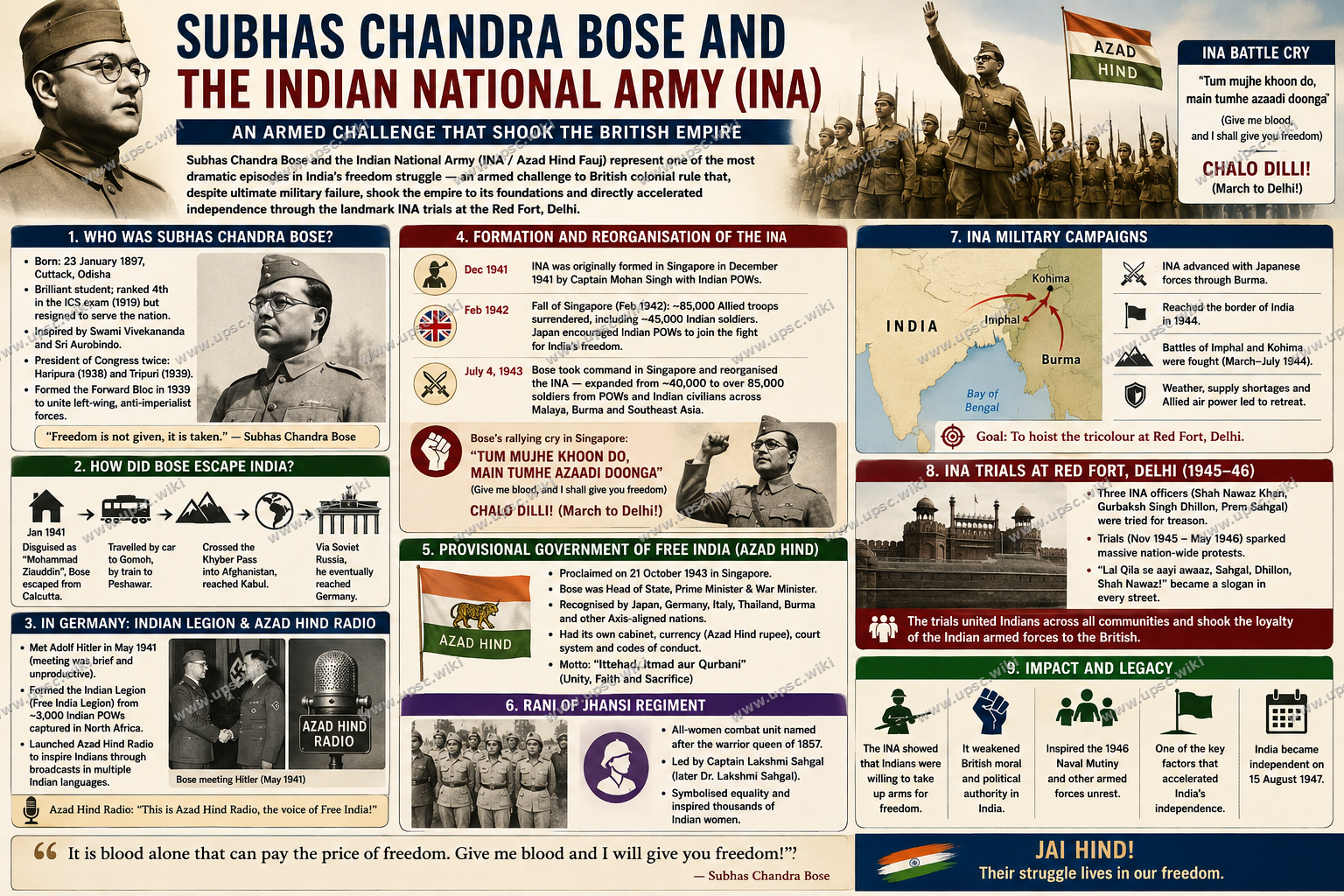
A comprehensive study note on Subhas Chandra Bose, the formation and campaigns of the Indian National Army (Azad Hind Fauj), the Provisional Government of Free India, and the INA trials that accelerated India's independence — essential for UPSC Prelims, GS1, and History Optional.
Subhas Chandra Bose and the Indian National Army (INA / Azad Hind Fauj) represent one of the most dramatic episodes in India's freedom struggle — an armed challenge to British colonial rule that, despite ultimate military failure, shook the empire to its foundations and directly accelerated independence through the landmark INA trials at the Red Fort, Delhi.
Who Was Subhas Chandra Bose and What Drove Him Towards Armed Struggle?
Born on January 23, 1897, in Cuttack, Odisha, Subhas Chandra Bose came from a prosperous Bengali family. He received his early education in Cuttack, attended Presidency College, Calcutta, and later travelled to England where he studied at Fitzwilliam College, Cambridge. In 1919, Bose appeared for the Indian Civil Service (ICS) examination and ranked fourth overall — a remarkable achievement. Yet he resigned, declaring that he could not serve a government that oppressed his countrymen.
Deeply inspired by Swami Vivekananda's philosophy of spiritual nationalism and by Sri Aurobindo Ghosh's revolutionary politics, Bose entered the Indian National Congress under the mentorship of Chittaranjan Das. His convictions separated him sharply from Mahatma Gandhi: while Gandhi championed non-violent civil disobedience, Bose believed that armed struggle and coordinated international pressure were essential to force the British out of India.
Bose rose rapidly within the Congress, becoming President twice — first at the Haripura Session (1938) and then, controversially, at the Tripuri Session (1939), where he defeated Pattabhi Sitaramayya, the candidate backed by Gandhi. This victory was short-lived: opposition from Gandhi and senior Congress leaders, who refused to cooperate with his executive, forced Bose to resign. He subsequently formed the Forward Bloc in 1939 to consolidate left-wing, anti-imperialist forces within the nationalist movement.
How Did Bose Escape India and Build the Azad Hind Fauj?
In 1940, the British placed Bose under house arrest at his Calcutta residence. In January 1941, Bose executed one of the most audacious escapes in colonial history. Disguised as "Mohammad Ziauddin," a Pathan insurance agent, he slipped out of his home at night, travelled by car to Gomoh, by train to Peshawar, and then by road through the Khyber Pass into Afghanistan. From Kabul, he made his way through Soviet Russia and eventually arrived in Berlin, Germany.
In Germany, Bose met Adolf Hitler in May 1941 — a meeting that proved brief and largely unproductive. Hitler showed little sustained interest in the Indian independence cause. Nevertheless, Bose established the Indian Legion (also known as the Free India Legion) from approximately 3,000 Indian prisoners of war captured by Rommel's Afrika Korps in North Africa. He also launched Azad Hind Radio, which broadcast in several Indian languages, inspiring millions across the subcontinent.
In early 1943, Bose undertook one of the longest and most hazardous submarine voyages of the Second World War. He boarded a German submarine at Kiel, sailed around the Cape of Good Hope, and transferred to a Japanese submarine near Madagascar in the Indian Ocean. He arrived at Sabang and then proceeded to Tokyo before reaching Singapore in July 1943.
Formation and Reorganisation of the INA
The Indian National Army (INA), also called Azad Hind Fauj (literally "Army of Free India"), was originally formed in Singapore in December 1941 by Captain Mohan Singh, an Indian officer of the British Indian Army who chose to resist the British after the Japanese advance through Malaya. The fall of Singapore in February 1942 — a catastrophic British defeat in which approximately 85,000 Allied troops surrendered, including roughly 45,000 Indian soldiers — provided the INA with its initial manpower. Japan encouraged Indian POWs to join the fight for Indian independence.
The early INA stalled due to mistrust between Mohan Singh and the Japanese command, and Mohan Singh was eventually arrested. When Bose arrived in Singapore and took formal command on July 4, 1943, he transformed the INA into a formidable fighting force, expanding it from approximately 40,000 to over 85,000 soldiers drawn from both POWs and Indian civilians across Malaya, Burma, and Southeast Asia.
Bose's most celebrated speech, delivered in Singapore, became the defining rallying cry of the movement: "Tum mujhe khoon do, main tumhe azaadi doonga" — "Give me blood, and I shall give you freedom." His battle cry of "Chalo Dilli!" — "March to Delhi!" — expressed the INA's ultimate objective.
The Provisional Government of Free India (Azad Hind Government)
On October 21, 1943, Bose proclaimed the Arzi Hukumat-e-Azad Hind (Provisional Government of Free India) in Singapore. Bose simultaneously held the positions of Head of State, Prime Minister, and War Minister. The government was formally recognised by Japan, Germany, Italy, Thailand, Burma, and several other Axis-aligned nations. It had its own cabinet, currency (the Azad Hind rupee), court system, and codes of conduct. Its motto was "Ittehad, Itmad aur Qurbani" — Unity, Faith, and Sacrifice.
One of the Azad Hind Government's most historically significant features was the Rani of Jhansi Regiment — an all-women combat unit named after the iconic queen of 1857. Led by Captain Lakshmi Sahgal (later Dr. Lakshmi Sahgal), it was the first all-women military regiment in Asia, drawing volunteers from the Indian diaspora across Southeast Asia.
What Happened at the Battles of Imphal and Kohima?
In early 1944, the INA fighting alongside the Japanese Fifteenth Army launched Operation U-Go, advancing into northeast India. On April 14, 1944, the Azad Hind flag was raised at Moirang, Manipur — the first time the flag flew on Indian soil, the symbolic high point of the entire campaign.
The Battles of Imphal and Kohima (March–July 1944) proved to be the decisive turning point. Allied forces under General William Slim mounted a ferocious counter-offensive. Japanese supply lines had broken down, the monsoon devastated the attackers, and Allied air superiority proved decisive. The combined Japanese-INA force suffered catastrophic casualties from battle, disease, and starvation. In a 2013 survey by the National Army Museum (UK), Imphal-Kohima was voted "Britain's Greatest Battle" — recognition of its enormous strategic significance in halting the Japanese advance into India and, with it, the INA's march toward Delhi.
After the failure of the campaign the INA retreated through Burma. As Japan's war effort collapsed across the Pacific and Southeast Asia, the INA disintegrated. Bose attempted to flee to Soviet Russia via Japanese-controlled territory. He boarded a Japanese bomber at Taipei, Taiwan, on August 18, 1945. The plane crashed shortly after takeoff and Bose died of severe burns the same day, aged 48. Multiple official investigations — including commissions led by Shah Nawaz Khan (1956) and G.D. Khosla (1974) — confirmed the Taipei crash as the cause of death.
How Did the INA Trials Backfire on the British?
Rather than suppressing the memory of the INA, the British decision to prosecute its officers transformed them into national heroes. In November 1945, the British government convened the first and most prominent INA trial at the Red Fort, Delhi — the symbolic seat of Mughal power and the site where India's tricolour would fly just two years later. The three accused were Colonel Prem Kumar Sehgal (Hindu), Colonel Gurubaksh Singh Dhillon (Sikh), and General Shah Nawaz Khan (Muslim) — a combination that became a powerful symbol of Hindu-Muslim-Sikh unity against colonialism.
The defence team was led by the eminent jurist Bhulabhai Desai, with Jawaharlal Nehru (who donned his barrister's gown for the first time in decades), Tej Bahadur Sapru, and Asaf Ali also appearing for the defence. The prosecution charged the accused with waging war against the King-Emperor and abetting murder.
The trial spectacularly backfired. Across India, mass demonstrations erupted in support of the INA officers. Congress, the Muslim League, and the Communist Party of India all united in demanding their release. The public viewed Sehgal, Dhillon, and Shah Nawaz not as traitors but as patriots. Popular pressure was so intense that the British Viceroy, Lord Wavell, was compelled to recommend leniency, and the sentences against the three were ultimately remitted. The men were released.
The political damage to British authority was irreversible. The INA trials had revealed a fundamental crack in the foundation of British power in India: the loyalty of the Indian Army. This realisation was reinforced dramatically by the Royal Indian Navy Mutiny of February 1946, when ratings in Bombay and other ports rose in revolt, partly inspired by the INA's example. The British military establishment concluded that it could no longer rely on Indian soldiers to suppress Indian nationalist sentiment — a calculation that directly accelerated the decision to transfer power, leading to independence on August 15, 1947.
Key Events in Subhas Chandra Bose's Life and the INA Campaign
| Year / Date | Event | Significance |
|---|---|---|
| January 23, 1897 | Birth of Subhas Chandra Bose in Cuttack, Odisha | Early life shaped by Vivekananda's nationalism and Aurobindo's revolutionary politics |
| 1919 | Ranked 4th in ICS exam; resigned to join freedom struggle | Symbolised sacrifice of personal advancement for the national cause |
| 1938 | Elected Congress President at Haripura Session | First presidential term; proposed the National Planning Committee |
| 1939 | Re-elected at Tripuri Session (defeating Gandhi's candidate Pattabhi Sitaramayya); resigned; formed Forward Bloc | Open break with Gandhi and Congress high command; formation of independent leftist platform |
| January 1941 | Dramatic escape from house arrest in Calcutta, disguised as "Mohammad Ziauddin" | Launched Bose's international effort to build armed resistance; escape via Peshawar, Kabul, Moscow, Berlin |
| May 1941 | Met Hitler in Berlin; organised Indian Legion and Azad Hind Radio | Attempted to mobilise Indian POWs in Europe; built a propaganda and diplomatic infrastructure |
| December 1941 | INA originally formed by Captain Mohan Singh in Singapore | First organised military effort by Indian POWs against the British; foundation for Bose's later expansion |
| February 1942 | Fall of Singapore; ~45,000 Indian soldiers become POWs | Provided manpower base for the INA; exposed catastrophic British military weakness in Asia |
| Early 1943 | Bose's submarine voyage from Germany to Southeast Asia (via Indian Ocean, Madagascar transfer) | One of the longest submarine journeys in WWII history; demonstrated extraordinary personal resolve |
| July 4, 1943 | Bose takes formal command of the INA in Singapore | Reorganised and expanded INA to 85,000+ soldiers; delivered the "Give me blood" and "Chalo Dilli" speeches |
| October 21, 1943 | Proclamation of Provisional Government of Free India (Azad Hind Government) in Singapore | Recognised by Axis powers; established Rani of Jhansi Regiment — first all-women military regiment in Asia |
| April 14, 1944 | Azad Hind flag raised at Moirang, Manipur | First time the INA's flag flew on Indian soil — the symbolic high point of the campaign |
| March–July 1944 | Battles of Imphal and Kohima | INA and Japanese forces repulsed with catastrophic losses; voted "Britain's Greatest Battle" (National Army Museum, 2013) |
| August 18, 1945 | Death of Bose in plane crash at Taipei, Taiwan | End of Bose's direct leadership; official investigations confirmed the crash |
| November 1945 | INA trials begin at Red Fort, Delhi (Sehgal, Dhillon, Shah Nawaz Khan) | Trials backfired spectacularly; all India united in support; prisoners released; British moral authority shattered |
| February 1946 | Royal Indian Navy Mutiny | INA's example spread to the navy; signalled collapse of British military control over Indian forces |
| August 15, 1947 | Indian Independence | INA trials and naval mutiny had accelerated the British decision to transfer power |
Frequently Asked Questions
What was the Azad Hind Fauj and who founded it?
The Azad Hind Fauj, or Indian National Army (INA), was originally founded in Singapore in December 1941 by Captain Mohan Singh from Indian prisoners of war captured by Japan after the fall of Singapore. Subhas Chandra Bose took command in July 1943, reorganised the force, and expanded it to over 85,000 soldiers, transforming it into the armed wing of the Provisional Government of Free India (Azad Hind Government).
Why did the INA trials backfire on the British?
The INA trials at Red Fort (1945–46) backfired because the Indian public, across communal and political lines, viewed the accused officers — Sehgal (Hindu), Dhillon (Sikh), and Shah Nawaz Khan (Muslim) — as patriots and war heroes rather than traitors. Mass demonstrations erupted nationwide. The defence by Bhulabhai Desai and Nehru highlighted the INA's nationalist motivations. Under intense public pressure, the British remitted the sentences and released the prisoners, suffering a severe blow to their moral authority.
What was the significance of the Battles of Imphal and Kohima for the INA?
The Battles of Imphal and Kohima (March–July 1944) represented both the high-water mark and the catastrophic defeat of the INA campaign. The INA briefly entered Indian territory and raised the Azad Hind flag at Moirang, Manipur, in April 1944. However, Allied counter-attacks, Japanese supply failures, disease, and the monsoon led to a devastating reversal. The INA retreated through Burma with enormous losses, effectively ending its military campaign. The battle was later voted "Britain's Greatest Battle" in a 2013 National Army Museum survey.
How did Bose escape from India in 1941?
In January 1941, Bose escaped from house arrest in Calcutta by disguising himself as "Mohammad Ziauddin," a Pathan insurance agent. He travelled by car to Gomoh, then by train to Peshawar, crossed into Afghanistan through the Khyber Pass, and made his way through Kabul to Soviet Russia, eventually reaching Berlin, Germany. This daring escape allowed him to pursue international support for India's independence, first in Germany and then in Japan-controlled Southeast Asia.
What was the Rani of Jhansi Regiment in the INA?
The Rani of Jhansi Regiment was an all-women combat unit of the Indian National Army, established under the Azad Hind Government and named after Rani Lakshmibai of Jhansi, the iconic leader of the 1857 uprising. Led initially by Captain Lakshmi Sahgal (later Dr. Lakshmi Sahgal), it was the first all-women military regiment in Asia. Women from the Indian diaspora in Southeast Asia volunteered for the regiment, which served in combat-support and nursing roles during the Burma campaign.
Sources and Further Reading
According to IGNOU's BHIC-134 (History of India from c.1707–1950) course material, Subhas Chandra Bose and the INA are studied within the broader context of anti-colonial nationalism and the final phase of the independence movement. The INA trials are examined as a watershed moment that decisively undermined British military and moral authority in India. Additional scholarly sources include Sugata Bose's His Majesty's Opponent: Subhas Chandra Bose and India's Struggle against Empire (Harvard University Press, 2011); Peter Ward Fay's The Forgotten Army: India's Armed Struggle for Independence, 1942–1945 (University of Michigan Press, 1993); and Hugh Toye's The Springing Tiger: Subhas Chandra Bose (Allied Publishers, 1959). Primary documents related to the INA trials are held at the National Archives of India, New Delhi.